When a Cuban communist objects to the strategy on moral grounds, he receives a prompt dressing down. “We have no morality,” Vlanoc shoots back. “What we do is above morality; therefore, there is no immorality. Only after we have won shall there be morality. To discuss it further is counter-revolutionary.”
The next day, the same Cuban man is found dead in a ditch outside Havana, half his head blown away. He’s quickly tarred as a police informant and a traitor. Starr, who believes the assassination was necessary simply because the party says it was necessary, soon travels to Spain to help fight against the fascist uprising, joining the Soviet-backed International Brigades.
What happens throughout Starr’s saga, however, is a plotline that obsessed Herrick’s writing for decades: The loyal communist instead ends up serving as a party hitman, hunting down and murdering members of dissident and left-wing anti-Stalinist groups. As Starr’s body count grows, his own body begins to fail. His story embodies the question at the heart of Herrick’s eight-decade life: Just how much, exactly, does ideology justify? Put another way, as Herrick would later do in his autobiography, when, if ever, is murder necessary?
In January 1915, William Herrick was born to Jewish socialist immigrants who had traded what became Belarus for New Jersey. As he wrote in his 1998 autobiography, Jumping the Line: The Adventures and Misadventures of an American Radical, portraits of Vladimir Lenin and Leon Trotsky were nailed to the wall above his crib when he was an infant. It wasn’t until he became a teenager that his parents replaced the photos of Lenin and Trotsky with what he would one day sardonically describe as “the benign image of Joseph Stalin.”
His mother worked as a seamstress from childhood until she was nearly 70. She was also a committed member of the CPUSA and had a keen interest in Yiddish culture. His father, who put up wallpaper for a living, died when Herrick was four. That loss opened the path for a chaotic upbringing. After his father’s passing, his mother attempted to leap into the grave at his funeral. She was pregnant at the time. Herrick, who didn’t take his father’s death any better, would spend much of his childhood running the streets, chasing girls, and getting into brawls. (“It took me 40 years to forgive my father for dying when I was four,” he’d reflect in his autobiography. “The bastard.”)
For the rest of his childhood, violence, abuse, and instability surrounded Herrick. At 11, he found a man in his mother’s bed and attempted to stab him. When she was later hospitalized with sarcoma, Herrick and his younger sister (who was born six months after his father’s death) went to live with an Orthodox Jewish couple in Trenton, New Jersey. What was meant to last only a few months stretched on for five years. By the time Herrick and his sister finally returned to live with their mother, she was stretched for cash and scraping by to rent a place in New York City. She eventually leased a spare room to a tenant named Daniel, who routinely sexually assaulted Herrick.
On its surface, Herrick’s childhood in New Jersey and New York resembles the gritty, immigrant family tales immortalized in novels like Betty Smith’s A Tree Grows in Brooklyn and Anzia Yezierska’s Bread Givers. What first and foremost defined Herrick’s upbringing, though, was politics.
He was born into communism, but his relatives — his mother, his uncles, his aunts — and close family friends all followed different sectarian paths within the left. His mother, a CPUSA loyalist through and through, stuck with Stalin. A handful threw their weight behind Trotsky, whom Stalin had banished in 1928 and (and later had ordered assassinated in Mexico in 1940). Yet others hitched their wagons to Soviet history’s more obscure figures. He’d often listen as his mother and her friends tore into shouting matches over the direction of the international left.
For his part, Herrick suffered little uncertainty about whose team he was on. As a young “fundamentalist” attached to the Soviet cause, he’d recall, he often daydreamed of hunting down a traitor to the communist party and “putting a bullet between his cowardly eyes.” He blithely recounted having undertaken his “first act as a revolutionary” at age seven or eight. Still in New Jersey at the time, he and a group of neighborhood boys gathered on the anniversary of the October Revolution, headed to a nearby factory, and passed out leaflets to the workers during their lunch break. “Long live the revolution,” the boys shouted.
“It took me 40 years to forgive my father for dying when I was four. The bastard.” – William Herrick, Jumping the Line
Anti-communism became an unavoidable feature of American life after the First Red Scare wreaked injustice across the country between 1917 and 1920, but the young Herrick would more frequently endure outright antisemitism. The bullying he faced seemed to solidify his political commitment to solidarity. In his telling, a group of local Polish boys would assemble beneath a railroad bridge and harass Black and Jewish children walking to school. Herrick and a local Black boy, both finally fed up, responded by teaming up: They gathered an arsenal of stones and pelted the Polish boys.
Such violence would have landed most kids in trouble, but that wasn’t the case in Herrick’s household. His mother regularly joined rowdy picket lines outside the stores on Fifth Avenue — and on one occasion, she and his aunt beat up a scab, an incident that resulted in the police roughing her up and taking her to jail. She was bailed out and came home with bandages on her leg, a sight that he took to heart.
At the time he graduated high school in 1932, the Great Depression was wreaking havoc in New York City. Nearly one-third of New Yorkers were unemployed, and soaring homelessness had led to shantytowns popping up across the city. Herrick briefly got a gig selling cigarettes and candy at a stand near a private beach in Brighton, then found work transporting silk for a wholesaler. When his cousin turned up one day with an idea, Herrick was already pining for a change. His cousin told him of a farm in the Midwest where the communism he longed for was being put into action. (“Utopia was at hand,” he put it in his autobiography.)
Starting in the summer of 1933, Herrick would spend a significant amount of time at the Sunrise Colony in Saginaw Valley, Michigan. The farm was a commune where Jewish anarchists and other leftists lived communally, had neither leaders nor hierarchy (at least on paper), and raised peppermint, sugar beets, wheat, and barley, among other crops. Herrick would come and go, clearing 40-acre parcels of peppermint under the summer sun while he was there and riding freight whenever he traveled to visit his mother back east.
His experience there proved formative, as did his time riding the rails and sleeping at hobo camps between New York and Michigan. (Unlike the romanticized view of hobo life found in popular books like Jack Kerouac’s 1953 novel The Dharma Bums, Herrick chronicled a far grimmer view of hopping trains, one that painted a picture of hobo life as a cold, lonely experience that included fighting off people who wanted to steal his food and not allowing himself to sleep because “you didn’t want to get raped.”)
He eventually left Sunrise altogether as infighting, drought, and financial hardship took their toll on the community and its residents. Herrick was already drifting across the country again when the commune finally collapsed. For the next couple years, he worked in Miami, joined his comrades to attack Trotskyist meetings, and participated in a CPUSA campaign to organize (in his later view, exploit) Black sharecroppers in southern Georgia. When white men opened fire on a group of Black sharecroppers and a respected party organizer fled, Herrick would quietly question the CPUSA’s commitment to anti-racist solidarity.
Five decades later, he would acknowledge that the Sunrise Colony had shown him that “no other human organization on earth … respects the rights of an individual more than an anarchist commune.” This was the mid-1930s, though, and on the other side of the Atlantic Sea, fascism was on the march, leaving a trail of bodies in its wake.
In mid-1936, the situation in Europe was becoming bleaker by the day. In Italy, more than a decade had passed since Benito Mussolini installed himself as the head of a fascist dictatorship, and in 1933, Adolf Hitler and the Nazi Party had seized control of Germany. Now, Germany and Italy were arming Franco’s military uprising, a murderous campaign fought under the mantra “long live death.” To beat back the fascist surge, the Soviet Union backed the strategy of adopting a popular front in Europe and North America. (Ironically enough, this strategy came at the same time Stalin was orchestrating show trials against Soviet leftists he considered a threat to his power.) The CPUSA followed suit, forging alliances with labor, anti-Stalinist socialists, and even liberals to mount an anti-fascist response.
In his own retelling of that time, Herrick harbored private mistrust in the Popular Front well before Spain erupted on the front pages of newspapers across the country. Once the war broke out, however, he put aside his misgivings in the same way he had after the sharecroppers incident in Georgia. He obsessively read news dispatches from the fight in Spain and followed developments in Nazi Germany. (According to family lore, Herrick wrote, a Nazi soldier had bayoneted his grandmother to death, though he couldn’t guarantee the story was true.)
Although it was illegal for American citizens to participate in foreign conflicts, thousands would fight in Spain. Between 1936 and 1939, an estimated 35,000 foreign anti-fascists from dozens of countries went to Spain under the banner of the International Brigade. Of that total, some 2,800 Americans — around a third of them Jewish, according to some estimates — participated in the Spanish Civil War, joining the Abraham Lincoln Battalion, the George Washington Battalion, and the John Brown Battery. For his part, Herrick read about and was inspired by the German, Austrian, and other volunteers of the Thälmann Battalion.
The more he read of Spanish resistance to fascism, the more he felt compelled to join the fight. He remarked to his friend Ben Dvosin that he’d like to volunteer, and Dvosin soon came back to him wanting to know how serious he was. By December 1936, Herrick had attended a series of meetings with party organizers and Communist International (Comintern) representatives. He soon found himself aboard the Normandie, a French vessel nodding across the Atlantic toward Europe. The volunteers stopped over in France, then rode the rails south, and finally crossed the mountains into Spain. At the border, Spanish anarchists greeted the foreign volunteers with cheers of ¡Viva la revolución!
Herrick joined the Abraham Lincoln Battalion. Unsurprisingly, he soon learned that the conflict in Spain was far more complicated than he had previously understood. For one, he would later reflect, he and his comrades in arms were fighting not just fascists but Moroccans whom Franco had forcibly conscripted. Meanwhile, the Soviet Union was sending aid and weapons to the International Brigades, but Stalin had also grown concerned that anti-Stalinist revolutionaries could stymie his plans to forge an alliance with France and the United Kingdom. Amid Stalin’s plotting, Moscow limited its supplies and ordered its loyalists in Spain to turn their guns on people Herrick considered genuine revolutionaries within the resistance. Because of its fealty to the Soviet Union, the Spanish Communist Party helped carry out the crackdown on dissident left and anarchist groups under the unfortunate mantra, “First win the war, then make the revolution.”
During arguments with friends, Herrick defended the Soviet approach. He also attempted to justify, at least to himself, the lethal purge of Trotskyists, anarchists, and other non-Stalinist leftists. It seemed no personal doubts could amount to him breaking the party line.
What happened in February 1937, however, would put into motion a series of events that would eventually, after a lot of heartache, completely rupture the worldview he’d inherited at birth and once held dearly. Franco’s forces had been attempting to break through Republican-held lines along the Jarama River near Arganda del Rey. If the fascists dislodged Republican forces, they would have had a straight shot to Madrid, the capital. During the fighting, Herrick’s machine gun company encountered a barrage of artillery fire. While they “began to set the heavy gun in place,” he later wrote, “a sledgehammer hit me in the back of the head.”
That sledgehammer, in fact, was a bullet that struck Herrick in his spine. In and out of consciousness, he lay sprawled out on the battlefield and heard someone say, “Poor Bill, he must be dead.” In response, Herrick grumbled “Long live the Communist International,” and promptly passed out again.
While Herrick was recovering at a hospital in Murcia, the Battle of Jarama ended in late February. Franco’s forces had only gained a modest amount of territory, and the anti-fascist resistance claimed victory for preventing the overthrow of Madrid. Herrick, though, watched from his hospital cot as wave after wave of wounded International Brigades volunteers arrived. A man on the cot next to him lost half his face in battle. Another was paralyzed from the waist down. Yet another had a bullet enter through his ear and leave through his cheek. Even more had lost legs and arms.
The bullet in Herrick’s spine proved impossible to remove, but he told himself he was merely lucky to be alive. He read the party newspapers, followed news from the front, and eventually managed to heal up enough to walk around Murcia. Soon, Herrick’s faith in a broad anti-fascist front would be tested yet again. Official communist papers began running articles about seditious uprisings by anarchists, Trotskyists, and members of POUM. The more he read and the more he heard stories from comrades, the more the doubt crept in.
Propped up in the hospital bed day in and day out, Herrick meanwhile fell in love with a married nurse who was assigned to treat him. The pair struck up a secret romance. They gossiped about internal feuds in the Spanish and international resistance, and Herrick heard more and more rumors of anarchists and Trotskyists being killed not by fascists but by pro-Soviet communists. As the relationship deepened, Herrick confessed his increasingly sour views on the Soviet Union and its role in Spain. In response, the nurse broke off the affair.
Before dawn a few days later, gun-toting International Brigades men showed up next to his hospital cot and ordered him to get dressed. The men quietly marched Herrick through the narrow streets of Murcia. They dragged him into a building, up the stairs, and into an office. There, an imposing security chief sat behind a desk, a gun in front of him. The man read off a list of disparaging remarks Herrick had made about the Soviet Union, and it dawned on Herrick that his lover had snitched on him. The group interrogated Herrick and, before he was dismissed, told him he could make his transgressions right by snitching on other similarly disillusioned comrades.
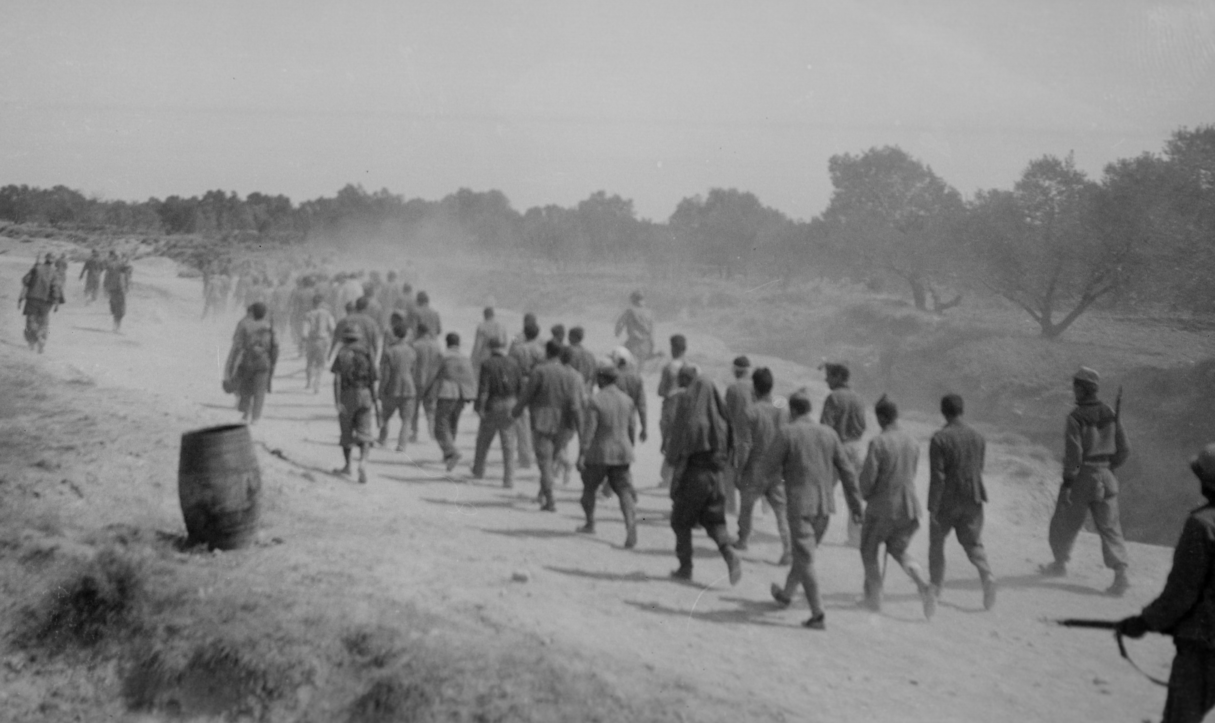
Not long after that, Herrick was summoned by party brass one night, taken half an hour outside of town, and forced to witness the execution of three young Spanish leftists, two men and a woman. A moment before a bullet struck her head, the woman shouted, ¡Viva la revolución!
The incident shook Herrick. Though he only witnessed the executions (he later said he knew the party could have forced him to do the killing himself), he felt as personally responsible for the deaths as the men who pulled the triggers. In his autobiography decades later, he asked the reader, “Were some murders more necessary than others? Can you answer that? I, yes, I, had murdered three Spanish revolutionaries. Real ones. … Who, goddamnit, was the fascist?”
Herrick returned to the United States later in 1937 and received a hero’s welcome among his comrades. Fellow union members treated him to meals, and he received job offers based on his sacrifices in the fight against fascism. For a time, he indulged anyone who wanted to hear stories of bravery and bloodshed from the battlefield. Whenever a doctor in New York ordered him to wear a neck brace for his wound, he even admitted to “enjoying the attention it brought me.”
In her 1977 book The Romance of American Communism, the American writer Vivian Gornick recounts the story of Joe Preisen, who, like Herrick, was a working-class Jewish American that the CPUSA sent to fight the Francoists halfway across the world. “In Spain, something clarified for me,” he told Gornick. The Americans he’d fought alongside in the Abraham Lincoln Battalion had been sorely detached from the working class. “To me, socialism was the street mix I’d come out of. To them, it was all dense, celibate theory,” he recounted. “Suddenly, I saw that these guys didn’t know anything about the American working class.”
If Preisen had learned that the party had largely broken with the American working class, Herrick had learned another lesson altogether: Breaking with the party line could lead to grave, even deadly consequences. As his misgivings grew, he tormented himself over the question of whether leaving behind an ideology he no longer believed in was worth the risks. He got back to work at the Furriers Union he had worked with before leaving for Spain. In his own words, he demurred when high-ranking unionists urged him to join the organizing wing within the union. At the same time, he became treasurer of the Friends of the Abraham Lincoln Brigade. He soon attended a trade school to become a court reporter.
Meanwhile, stories of the International Brigades killing its own men, often for the spurious crime of supposed Trotskyism or anarchism, ate away at him. When Franco declared decisive victory over Republicans in April 1939, touching off his 36-year dictatorship, Herrick mourned. He stopped attending meetings held by the Veterans of the Abraham Lincoln Battalion, the Communist Party, and the Young Communist League. Instead, he began to seek out “seditious information,” going to gatherings held by Trotskyists and followers of Jay Lovestone, a former CPUSA general secretary who had ditched the party to form a small splinter group that objected to Stalin’s purges in Moscow. Herrick’s curiosity prompted warnings from party leadership and his union boss, but even in the face of these threats, he continued to insist on his loyalty. (In his version, he needed the union work and the healthcare it provided.)
For years, Hitler’s regime, as part of its genocidal war against Jews, had painted Bolshevism as a Jewish plot to undermine the German nation. The Nazis also interned in concentration camps and murdered tens of thousands of German communists, socialists, and trade unionists. But on Aug. 23, 1939, the Soviet Union and Nazi Germany signed the Molotov-Ribbentrop Pact, a nonaggression treaty that ceded large swaths of Europe to each country’s so-called “spheres of influence.” By then, the Popular Front strategy had long since died. The official organ of the CPUSA, The Daily Worker, ran a front-page story the same day attacking critics of the agreement, including social democrats and “the Trotskyite detachment of fascism.” The paper asked, “What else could one expect from such quarters?”
Herrick saw the pact as a full-frontal assault on the political values he cherished, and it proved one betrayal too many. He criticized Stalin’s decision as opportunistic appeasement to the Nazi regime, and the union soon fired him. Enraged, he printed hyperbolic fliers in which he described himself as “the first victim of the Hitler-Stalin pact,” then passed them out around town with a friend. Together, the pair picketed outside the union halls and harassed the party brass, even throwing up sarcastic Nazi salutes and shouting “hail Hitler” to mock their former comrades. His antics often led to party loyalists cursing at him or spitting on him, and he was soon fired from his union job.
Politically adrift, Herrick worked as a court stenographer in the 1940s. For a period, he took time off to work as a secretary for acclaimed Hollywood writer and director Orson Welles, with whom he had a complicated relationship. World War II ended with the Axis’s defeat, but the Cold War soon filled the void. Anti-communist hysteria swept the United States. The CPUSA had only around 75,000 members in 1947, but the Second Red Scare was coming into full effect. That year, President Harry Truman issued an executive order requiring federal employees to demonstrate “complete and unswerving loyalty” to the US, defining disloyalty, in part, as belonging to “totalitarian, fascist, communist, or subversive” organizations.
By 1950, the Red Scare had gained frightening momentum. US Senator Joseph McCarthy — the namesake of McCarthyism — had become the face of anti-communist paranoia in the country. In McCarthy’s hands, the political crackdown grew yet more severe. The senator conducted high-profile investigations of alleged communists, hauling many in front of the House of Un-American Activities Committee (HUAC) to interrogate them until, in many cases, they spilled the names of other supposed communists. The repression targeted leftist politicians, activists, unionists, academics, government workers, and, of course, people in the entertainment industry. Millions of people were investigated, and before it was all said and done, thousands of people had lost their jobs.
For his part, Herrick would later claim an intense hatred for McCarthy, calling him a “prize package of lard,” but resentment was still resentment. He relished in watching Communist Party members plead the Fifth “like common criminals,” going as far as to say in his autobiography that “it was satisfying to see the commies squirm.”
If that confession is hard to square with the moral high ground he claimed in leaving the party, then what can be said of what he did when he received a summons to testify against his old friends? In March 1953, his court reporters’ union went on strike, and it landed the union on the Senate Committee’s list of subversive organizations. Soon, one of McCarthy’s investigators turned up and threatened to subpoena him if he didn’t give up names. Then an FBI agent summoned him.
Herrick claimed he rebuked the FBI’s offer to snitch, but in the end, he decided to testify all the same. He justified the decision by arguing that his aim was merely to save his union. On the stand, he insisted that he only gave the names of already known communists, then spoke of the International Brigades and the Soviet Union’s involvement in Spain. In his autobiography, he attempted to brush off the possibility that he “inadvertently” let the names of “innocents” slip and begged for forgiveness, but there, too, the resentment soaked through. “But where were you, my dear comrades, when harm was done me?” he wrote. “I still await your apologies.”
Herrick eventually dedicated himself to a career of writing novels. The Itinerant, his 1967 debut, tells the story of Zeke Gurevich, a vagabond who knocked around the United States during the Great Depression. Gurevich’s father had been a revolutionary, his mother sold vegetables at a street market, and he traveled the country until he ended up at a commune in Michigan. Soon, he left the US to fight in the Spanish Civil War. It is a close tracking of Herrick’s life, or at least a fictionalized shadow of its chronology.
Herrick would go on to write nine more novels before his death. The Last to Die, his 1971 follow-up to ¡Hermanos!, is written as the diary of Ramon Cordes, a revolutionary on the run. Cordes is a flimsy stand-in for Che Guevara, and Herrick uses his character to again dissect moral betrayals and rigid ideology. Herrick abandoned Spain — and largely, revolutionary politics — in his 1973 Strayhorn (about a man who loses his wife and child and becomes a stalker) and his 1976 Golcz (a dark riff on American romance), but the 1980 publication of Shadows and Wolves (the story of a father and son in Spain who disagree on Franco’s rule) revived his political preoccupations. All told, these stories are at times provocative and compelling but ultimately repetitive.
Love and Terror, his 1981 novel, stands out as a short but expansive story that spans three continents. In it, left-wing German and Arab militants hijack a Tel Aviv-bound plane, and Herrick explores generational political divides by contrasting the German radicals against three elderly passengers who had their own earlier dalliances with revolutionary politics in Spain and the Soviet Union. As was Herrick’s custom, he used the book to retread his own hangups over the clash of basic morality and ideology.
Critics often praised his fiction, but some took aim at his clunky prose and meandering plots. More often than not, the at times overwhelming bitterness and angry, black-and-white worldview imbuing his books chided critics.
Herrick’s preoccupation with the Spanish Civil War’s legacy was never illustrated in greater depth than in ¡Hermanos!, the book that earned him a healthy paycheck and enough praise to keep at it. Clumsy at times, the novel nonetheless convincingly offers readers a crucial opportunity to consider the tug-and-pull between ideology and violence — the same moral conundrum that plagued the author through so much of his own life. After Jacob Starr murders his way across POUM enclaves in Spain, he eventually comes to pieces and dies on the battlefield.
Still, ¡Hermanos! wasn’t without controversy. And that controversy, centered on the fictional character of a Black American soldier savagely murdered by his own comrades, would reignite nearly two decades later.
In the summer of 1986, newspapers around the United States marked the 50th anniversary of the beginning of the Spanish Civil War. Speaking to the Associated Press, Herrick insisted that he was proud he had taken up arms on behalf of the Spanish Republic, but admitted he regretted having fought “under Stalin’s banner.” Around a week later, the prominent New York alternative newspaper the Village Voice published an interview that the political and cultural writer Paul Berman conducted with Herrick. Had Berman sat down with another Abraham Lincoln Battalion veteran, he might have heard a very different story.
“No one who reads ¡Hermanos! is likely to forget the killing of an officer in the Abraham Lincoln Battalion by his own men,” Berman asked at one point. “Is any of this real? Was an officer killed that way?”
“His name was Oliver Law,” Herrick replied.
Born in Texas at the turn of the 20th century, Oliver Law had served in one of the US Army’s Buffalo Soldier regiments, cut his teeth in militant labor organizing in Chicago, and ran for state office in Illinois as a write-in candidate for the communist party. In 1936, Law traveled to Spain and joined the fight against Franco as a commander in the Abraham Lincoln Battalion. According to official party lore, he had died a heroic death while leading his troops in battle.
Berman expressed shock at the possibility that Law, who had become a symbol of international solidarity in Spain, had been killed by his own men. “Oliver Law was Black,” he said. “For many years he has been celebrated as the first Black American known to have commanded a mostly white military unit. Why was he killed?”
After claiming that Law had been “terribly incompetent” and “very, very frightened,” Herrick recounted a conversation he had with other veterans who said they were present when Law died. According to this version of events, Law had recklessly led his troops into ambushes and lost their trust.
“So, they got into battle position and at one point there he was, he hove into sight somehow, and there were a group of them, and they all looked at each other, they nodded, and he was shot,” Herrick said. “And it was a pretty nasty thing because he bloated up, they danced around him, he was in a coma. Somebody said they pissed on him. Later on, they refused to bury him. He lay there for days.”
These claims prompted backlash from other American veterans of the war in Spain. Some even picketed outside the Village Voice’s offices in New York. Reader letters and firsthand accounts arrived at the paper’s office, many of them dismissing Herrick’s story as a fabrication.
In his 1994 book, The Odyssey of the Abraham Lincoln Brigade, the late historian Peter Carroll confronted what he called “rumors” of how Law died. He described Herrick, a “vigorous anti-communist,” as “the prime source of this story,” outright dismissing its authenticity: The two surviving witnesses Carroll had interviewed “vociferously denied it,” and the medic who treated Law before he died “also saw him shot in a furious burst of enemy machine-gun fire.”
In 1996, Harry Fisher, one of the last surviving witnesses of Law’s death, also offered a vastly different story than Herrick in his autobiography, Comrades: Tales of a Brigadista in the Spanish Civil War. His telling tracked more closely with the official account. While Fisher was bandaging the wounded foot of another comrade who’d been hit by gunfire, Law dashed up a hill and shouted to his men to help drive fascist forces off a nearby hill. Fisher wrote, “But he had no protection; he was fully exposed to the enemy. The bullets all seemed to be aimed directly at him. You could see the dust rising around him, where hundreds of bullets seemed to be converging.” Law died within an hour’s time, he said.
Such rebuttals piled up for years — the claim still crops up today from time to time — and Herrick altered details of the story across different interviews he gave. Still, neither firsthand accounts nor academic consensus could convince Herrick otherwise, and he went on insisting the story was fundamentally true.
As Herrick publicly interrogated the legacy of other American communists who fought in Spain, his own writing career was beginning to wind down. In 1990, his final novel, Bradovich, was published. It was a break from his previous fiction, the story of an artist progressing in years and grappling with the certainty of death.
Yet, his writing would return to the matter of Spain again. In 1998, the University of Wisconsin Press released his autobiography, Jumping the Line. Berman, who had since left the Village Voice, penned the book’s introduction, praising Herrick as someone who refused to allow ideology to overcome basic political morals. “William Herrick is our American Orwell,” he announced. “Like Orwell, he went to Spain during the Civil War of the 1930s to fight against the Fascists. Like Orwell, he was shot at the front and was lucky to survive. Like Orwell, he saw horrifying goings-on behind the lines in Spain — saw the Communist forces, who claimed to be the champions of democracy, try to impose a dictatorship of their own, Soviet-style, on the Spanish people.”