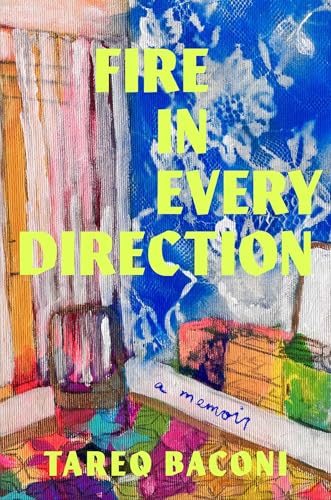











What makes for continuity in displacement? What makes a life within the disruptions of war? Memoirs and witness accounts that trace the interstices of geopolitical upheavals — meals being served, relationships formed, weddings, births celebrated, and funerals mourned — suggest a particular trajectory of cultural practice magnified in times of precarity. Tareq Baconi’s Fire in Every Direction is a memoir that resists erasure and is shaped by the layered concerns of an upbringing that spans countries and historical moments. Born in Jordan to Christian Palestinians whose own parents fled Haifa and Jerusalem, and who themselves then fled Beirut during Lebanon’s civil war, Baconi’s formative influences probe major political events as they shape the imagination of a queer, bookish child.
Key to Baconi’s coming-of-age narrative is the centrality of memory itself. The book begins with a yellow box, described as “worn, its corners collapsing.” An apt metaphor for the past, this box is “crushed under the weight of travel — Amman, London, Sydney, Beirut, Ramallah.” But it is also a gift. High school friends gave it to Baconi upon his graduation, and it is home to old journals, photographs, correspondences (particularly from a friend called Ramzi), the diaries of Baconi’s maternal grandmother, Tata Eva, even an old packet of chewing gum, and “two cigarettes and a bullet.”
A container, or as Baconi notes, an archive like Pandora’s box, is a portal and an organizing trope in the memoir. There is as much emotional chaos unleashed within its contents as there is evidence of what has preserved life — and love, family connections, and eros. Its contents attest to what remains precious in the vagaries of movement and dispossession.
Fundamental to the work of retrieving and structuring the agency of the past is the act of writing itself, a return throughout the book to the yellow box that provides the crumbs meant to lead the seeker, like Hansel and Gretel, out of the forest. But for Baconi, like those children looking for lost crumbs, the journey through the archive becomes one of disappearing markers as much as newly visible ones. It is, in part, a process of putting back together the many shattered and shattering parts of what it means to be part of the Palestinian diaspora.
Still, it is not just that diaspora, as the gathering of multiple narratives suggests that any scattering, as the noun’s Greek root defines it, is one in which discoveries and reconfigurations of home and belonging are as much the product of chance and luck as they are the result of more predictable and conventional qualities of privilege and circumstance. “Neither exile nor home could ever offer shelter from heartbreak or the senseless violence of war,” writes Baconi.
What, then, constitutes “shelter” and how is it built in the midst of near continuous change? For the young Baconi, it is built of a childhood immersed in books and a gradual and contested sense of sexual and emotional difference. It is built of family, of his father and brothers, but particularly the lineages of women from Baconi’s two grandmothers to Rima, Baconi’s mother, and his childhood friend Ramzi who he becomes physically attracted to and falls in love with. And, crucially, it is built of storytelling itself, of the shelter language creates and preserves within narrative.