Beyond her focus on social movements, Dell’Omo also contributes to a burgeoning literature that seeks to highlight the importance of political operatives once cast aside as figures of an impotent fringe. Examining the contest over sanctions policy in the Reagan administration, Dell’Omo highlights the role of Pat Buchanan, then serving as White House Communications Director, in advancing a pro-apartheid agenda. By the late 1980s, Buchanan’s advocacy for the South African regime was so aggressive that it brought him into direct conflict with National Security Advisor John Poindexter and other National Security Council officials. Buchanan, who would later run for president, also went as far as to describe apartheid South Africa as “an outpost of Western empire and Western civilization.”
In this sense, Saving Apartheid builds on the recent work of John Ganz, Nicole Hemmer, Quinn Slobodian, and Michael Edison Hayden, who each explore how prominent far-right ideologues, operatives, and politicians of the 1990s have shaped the trajectory of late 20th-century American politics. Even as the names and organizations of many of these figures have fallen into relative obscurity, their ideas have gained traction within America’s governing institutions.
While Dell’Omo does not specifically highlight the work of Peter Brimelow, his career serves as a particularly instructive link between mainstream and extreme views of South Africa over the past four decades. A contemporary of Buchanan, Brimelow is best known for espousing anti-immigrant sentiment over the course of several decades, but his perspective on South Africa is worth highlighting as well.
In the late 1980s, Brimelow, a senior editor at Forbes magazine at the time, took to PBS to debate Democratic Congressman Sander Levin on the merits of sanctions against the apartheid regime. By the end of the century, he would go on to found VDARE.com, one of the most notorious white supremacist websites of the early internet era. Throughout the early 2000s and 2010s, VDARE hosted a series of articles framing South Africa as a sort of ominous warning for the United States — a site of “racial conflict” and a victim of conspiracies seeking to undermine white rule. And though Brimelow continues to cite South Africa as a prime example of the supposed worldwide elimination of white populations on popular programs such as The Tucker Carlson Show, his role within the ideological vanguard of the far right is less necessary than before. As Hayden notes in a recent book covering Brimelow’s retreat to a small-town West Virginia castle, Brimelow’s once-taboo platform is increasingly reflected in mainstream political culture. Pat Buchanan himself offered a similar reflection in a 2017 interview, in which he concluded that his ideas had finally “made it” into the political zeitgeist — even if he had personally never reached the presidency.
Buchanan and Brimelow thus embody a key theme in Dell’Omo’s historical narrative — a symbiosis between various components of the transnational far right. Her examination of actors ranging from white power militias to public officials reveals an “interplay between the far right and electoral right [that] creates a ‘dialectic of extremism and respectability’ between the two factions.” In taking this broad perspective, Dell’Omo concludes that “the pro-apartheid movement signified an evolving form of US and South African white supremacy that proved far reaching, organized, and innovative in its ability to graft onto existing mainstream right-wing ideas.”
That said, the relationship between competing factions of the far right shifted as political conditions evolved, and Saving Apartheid importantly documents the campaign of violence led by the white power paramilitary organization known as Afrikaner Weerstandsbeweging (AWB). Especially during the early 1990s, as South African President FW de Klerk initiated a series of reforms and began the negotiation process that would eventually end apartheid, AWB unleashed a reign of terror on Black South Africans and the group’s political enemies. This mobilization culminated in the 1993 storming of the Kempton Park World Trade Centre by thousands of AWB members in an attempt to disrupt the apartheid negotiations.
“Dell’Omo also contributes to a burgeoning literature that seeks to highlight the importance of political operatives once cast aside as figures of an impotent fringe.”
Yet, as Dell’Omo makes clear, the diverse forms of mobilization led by firebrands like Buchanan, organizations like the Council of Conservative Citizens, and white power extremists such as AWB were not the only tactics deployed in an attempt to save the dying apartheid regime. In addition to those who sought to engender support for apartheid through paramilitary violence, rhetoric, and community organizing, a simultaneous campaign sought to demobilize apartheid’s opponents. This two-pronged strategy, as the scholar JM Berger suggests, reflects an interest among extremists not only in channeling hostility toward perceived out-groups, but also in halting the momentum of social movements that seek to challenge the status quo.
Similar to how Berger highlights the importance of the “defensive maintenance” of slavery in the antebellum United States, Saving Apartheid traces attempts on both sides of the Atlantic “to preserve white rule as the apartheid state collapsed.” By the early 1980s, when pressure against the South African regime began to mount, Dell’Omo notes how this defensive posture took the form of attacks on the legitimacy of the African National Congress (ANC), often leveraging the salience of anti-communist rhetoric during this period. In 1982, for example, the Senate Judiciary Committee convened a hearing on The Role of the Soviet Union, Cuba, and East Germany in Fomenting Terrorism in Southern Africa, in which witnesses crafted an “image of the ANC as unbridled with terrorist violence and ill-prepared for rule.”
Later, as the Cold War came to a close, Dell’Omo documents how efforts to demobilize and delegitimize opposition to apartheid appropriated the language of the human rights community to “defend and reimagine white rule.” At this stage, the South African far right “demanded the formation of segregated ethno-states or a volkstaat under the guise of minority rights protections.” Across the Atlantic, former Knights of the Ku Klux Klan leader and apartheid defender David Duke cynically adapted the branding of the NAACP to create the National Association for the Advancement of White People. Dell’Omo explains that these trends reflect a broader campaign among the pro-apartheid movement to claim the language of the international human rights movement, including by “setting up commissions, fact-finding missions, visits with so-called political prisoners, and witnesses and testimonials on ANC atrocities.” These tactics, she concludes, “became essential tools of the pro-apartheid movement, who positioned themselves as brave truth tellers in opposition to a global conspiracy against South Africa.”
To Dell’Omo’s credit, Saving Apartheid also avoids neat narratives that obscure complex social movement dynamics. Perhaps the most complicated aspect of this historical account lies in her explanation of the fragile alliance between Black bantustan leaders and members of the white South African paramilitary right during the waning days of apartheid — a coalition emerging from a mix of economic, religious, and nationalistic drivers. In one sense, it would be a mistake to extrapolate too much from the unique political and ethnic conditions in late 20th-century South Africa. Still, we would also be remiss to write off this cross-racial coalition building as sui generis, particularly as scholars such as Daniel Martinez HoSang have documented the rise of a multiracial right in the United States. In highlighting the unexpected development of such curious alliances, Saving Apartheid elevates the role of agency and contingency in the ultimate success (or failure) of social movements.
Dell’Omo thus challenges readers to consider the legacy of the transatlantic apartheid movement. Even as the book traces the pro-apartheid movement’s downfall, Saving Apartheid helps readers understand the roots of today’s powerful, and clearly interconnected, far right. Today, the Trump administration and its allies have elevated and embraced anti-democratic movements across the globe — from Latin America to Eastern Europe. While apartheid’s defenders ultimately failed, Dell’Omo underscores the intergenerational salience of this movement, as well as the ongoing relevance of the tactics used to advance their cause.
Today, similar attempts to stoke hatred and thwart pro-democracy mobilization hide in plain sight. Earlier this year, for example, the Department of State and a sitting member of Congress welcomed Tommy Robinson, the former leader of an anti-Muslim street movement known as the English Defence League, to Washington, DC. More recently, Elon Musk has fanned the flames of anti-immigrant riots in Northern Ireland and amplified conspiracies popular among neo-Nazis — just the latest examples of the tech oligarch’s descent into outright extremism. On the same platform, the United States government’s own accounts have continued to spread overtly racist rhetoric.
Yet we can perhaps also begin to observe, following Berger’s framework, the early stages of a shift away from the mobilization of an anti-democratic base and towards an effort to demobilize the opposition. A range of activity from a variety of actors can serve this purpose, from the use of terrorism labels to undermine constitutional rights, to ICE’s impediment of congressional and gubernatorial oversight authorities, to campaigns by non-state extremists to intimidate public officials. And just as the pro-apartheid movement co-opted the language of human rights, we have also seen anti-democratic actors in the United States characterize convicted Jan. 6 insurrectionists as “hostages” and “political prisoners” prior to the mass pardonings of January 2025.
Amid these ongoing attacks, Saving Apartheid serves as a reminder that global anti-democratic networks transcend executive branch coordination to include collaboration among legislators, civil society, and the technology sector. Dell’Omo demonstrates, though, that the fate of anti-egalitarian social movements are not predetermined. In the United States and beyond, a range of far-right actors seek to stoke violence, chill dissent, and undermine equal protection – but their long-term success is far from guaranteed. To confront the threat of the far right, pro-democracy movements will require similarly diverse coalitions to contest authoritarianism wherever it exists, from political and economic structures to social and cultural arenas.
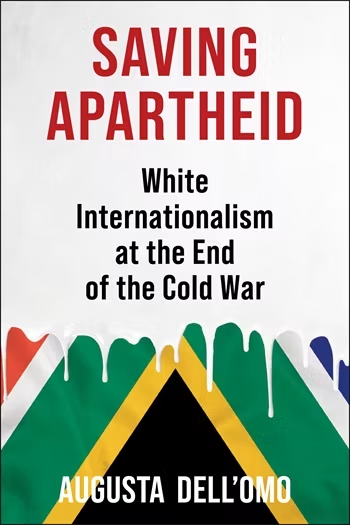
Augusta Dell’Omo’s Saving Apartheid: White Internationalism at the End of the Cold War was published by Columbia University Press in March 2026.