












There was a brief time, after the 2017 murder of Heather Heyer, when it seemed some white nationalist groups would be permanently cast aside. A 20-year-old man affiliated with the neo-Nazi group Vanguard America plowed his car through a crowd at the infamous Unite the Right rally in Charlottesville, Virginia, killing Heyer and injuring several others. He was sentenced to centuries in prison, and a subsequent civil suit yielded $25 million in damages from the rally’s organizers.
But white nationalist groups, including those affiliated with the Charlottesville riot, didn’t fade away. In fact, they gained influence. Many of these disparate groups became more protective of their members’ identities; they increasingly rely on private messaging apps and opt for masks when holding rallies or harassing celebrants of Pride Month. Other groups rebranded.
As shown by their recent July 4 march in Washington, DC, Patriot Front — a group that spun off from Vanguard America — is comfortable stepping into the public sphere (or at least comfortable doing so while masked). For the people closely watching the group’s evolution after Charlottesville, the haunting images from the Independence Day march were no surprise.
“We all, I think, as Americans, have a caricature of the racist extremist as trailer park trash,” says Kris Goldsmith, a US Army veteran who studies domestic extremism. “We dehumanize and we oversimplify because they are the enemy, right? But the fact is that these people have conferences, these people have thought leaders and authors and professors. There are members of Patriot Front who have been exposed by anti-fascist activists who are university professors, engineers, who have all sorts of roles in society.”
Goldsmith also points out that white nationalists and their ideologies had become a recurring feature of Donald Trump’s MAGA movement long before this year’s July 4 march in DC. Neo-Nazi podcaster Nick Fuentes dined with Trump, after all, and the president has claimed that immigrants were “poisoning the blood” of America, echoing similar language used by Adolf Hitler in Mein Kampf.
During the 2024 election, the Trump campaign also adopted a lie about Haitians first spewed by white nationalists. “If you recall, when Trump went viral for being on the debate stage saying that they’re eating dogs, they’re eating cats, he was talking about the Haitians, and that was a racist lie that started with a bunch of neo-Nazis, swastika flying neo-Nazis — the Blood Tribe — trying to do exactly what has been accomplished today, which is to remove Haitians from the country,” Goldsmith says.
Then Vice President-candidate Vance later trumpeted that same lie, telling a TV news interviewer that he was willing to “create stories” to ensure the media “actually pays attention to the suffering of the American people.”
Most recently, Trump aide Stephen Miller has made nationalism a feature of his argument to end birthright citizenship, and Border Patrol commander Greg Bovino, the face of Trump’s immigration enforcement in 2025 and early 2026, was a guest of honor at a “remigration” summit held in Portugal.
“Remigration is about ethnic cleansing,” says Heidi Beirich, an expert with the Global Project Against Hate and Extremism. “That’s a war crime.” Experts and researchers like Beirich argue that Trump’s immigration tactics are best understood as white nationalism in policy form.
“In short,” Goldsmith says, “there is no daylight between how the extreme far-right and the Trump administration talk about immigration.”
In the years after Heyer’s murder, some of the most incendiary violence from white nationalists was committed by individuals, not groups. The “white replacement” theory was a motivator for mass shooters in Buffalo and Texas. In the latter state, a 21-year-old killed 23 people and injured 22 others at a Walmart in El Paso. His manifesto, shared online minutes before the shooting, talked about a “Hispanic invasion” and the “replacement” of white people. Trump and Texas Governor Greg Abbott have used similar language before the murders and since, and when the Texas shooter made it to trial, his lawyer revealed the extent to which Trump had inspired his client to murder people.
“He thought he had to stop the invasion because that’s what his president was telling him,” the attorney, Joe Spencer, told a reporter in El Paso. “He thought, if he doesn’t do it, then nobody’s going to do it. He’s got to start.”
Similarly, the founder of Patriot Front, Thomas Rousseau, told an interviewer in 2020 that he believes Trump is a white supremacist who at least indirectly supports the white nationalist movement. (Rousseau also claimed he made contact with “mid-level” members of Trump’s first administration.) That same year, a senior leader of the Southern Poverty Law Center (SPLC) warned a House of Representatives panel that white nationalism was on the rise in the military — fears that only grew with Trump’s second election victory.
In her testimony, the SPLC’s Lecia Brooks said her organization has been urging the government to take the threat of extremist views in the armed forces more seriously since 1986. “Because service members often possess unique training and capabilities,” she noted, “those who are indoctrinated into white supremacist ideology may represent a significant threat to national security and the safety of our communities.”
The SPLC is a longtime target of Trump and his allies, and this spring, the Department of Justice indicted the nonprofit on a battery of fraud charges related to an old paid informant program the SPLC used to gain information on the KKK and organizers of events like Unite the Right. The SPLC has called the indictment an act of retribution, while most legal experts are, at best, skeptical of the charges. Beirich, the extremism expert, is a former director of intelligence for the SPLC, was viciously attacked by right-wing media when the indictment was announced.
The overlap in ideology between the Trump administration and white nationalists can also be seen in the president’s official policy, including an executive order headlined “Guaranteeing the States Protection Against Invasion” and a new website that talks about immigrants as otherworldly “aliens” who invade the US “under the cover of darkness.” Meanwhile, the Department of Homeland Security used messaging reminiscent of white nationalist texts as part of a massive recruitment push. What’s more, nearly every refugee admitted to the US in the current fiscal year is a white South African; the roughly 7,000 total refugees recently resettled in America is also a shocking low compared to recent years. (This, too, is a function of policy due to the Trump administration’s cap on refugees.)
As Goldsmith sees it, the Trump administration has little need for the support of white nationalists when administration officials are now acting with similar malice toward immigrants and protestors.
“The Trump administration created a website, aliens.gov,” he notes. “The idea of self-deportation is to make through policy, through harassment, life so unlivable for immigrants that they leave the country on their own accord. That is now federal policy.” He adds, “What the relatively small group of neo-Nazis are doing is irrelevant compared to the modern day brown shirts who are doing it with a badge and with the protection of the Department of Justice.”
The increasing popularity of the “remigration” concept — the supposed voluntary return of immigrants to their original homelands — is yet another example of once-fringe ideas becoming mainstream. “Remigration is an obvious euphemism for ethnic cleansing,” says Christopher Mathias, a journalist and longtime chronicler of fascism in the US. “It’s a way of softening the idea of ethnic cleansing and making it sound more respectable.”
Mathias says he “used to see that word all the time in Nazi chats,” and now it’s the name of an official office within the State Department. Mathias has long tracked the use of the word “remigration” and the broader adoption of the “Great Replacement” theory, a coinage of Renaud Camus, a French conspiracy theorist who claimed remigration was a solution to a “replacement” or erosion of white hegemony.
Camus has fans like conservative writer Rod Dreher, a close friend and advisor to JD Vance who has taken credit for Vance’s rise in popularity. During his evolution from Trump critic to endorser and VP, Vance often talked about how the Democratic Party was attempting to “transform the electorate” via immigration.
The Great Replacement theory is frequently echoed by Stephen Miller, the architect of Trump’s immigration enforcement strategy. Miller has been one of the administration’s chief advocates for ending birthright citizenship, arguing that “If you import the Third World, you become the Third World.”
“Change the voters, change the country,” Miller has also said, and in addition to the massive arrest totals he’s demanded of ICE agents, the aide has also played a key role in shaping the SAVE Act legislation that the Brennan Center for Justice says could vastly decrease the number of voters. (Several states have already implemented their own versions of the SAVE Act.)
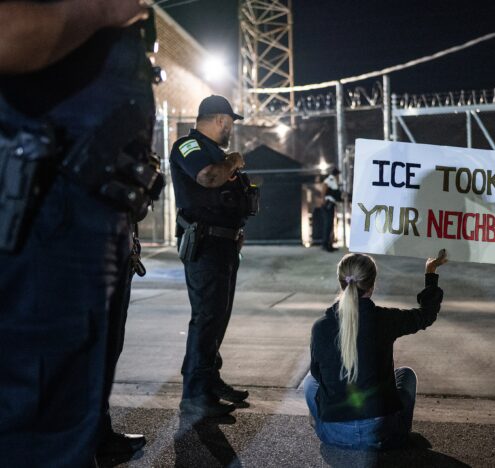
The way Mathias sees it, anti-fascist action is the solution to such policy, and he’s heartened by “everyday people” taking up that mantle even as the Trump administration seeks to crush dissent by labeling antifascists as terrorists. Protests in Minnesota played a role in Bovino losing his Border Patrol leadership role, Mathias says. By drawing attention to what he calls ICE’s “political violence,” those same grassroots efforts can continue turning public opinion against the agency.
“You’ve had everyday people adopting military antifascist tactics of ‘We go where they go,’ monitoring, surveying, following ICE, identifying ICE agents, pressuring hotels and businesses not to fuck with ICE. It was creating a social cost for being a part of ICE. And I think the polls show that there are actually record levels of support for the term ‘Abolish ICE.’”
For her part, Beirich hopes more people are inspired by organizers in Minneapolis or simply fed up with the extremism she’s seen from the US government.
“I just feel like it’s not breaking through, right? That people don’t understand the dangers of these ideas, what it means about democracy and civil rights and marginalized populations,” she says. “I just frankly believe that there’s not enough attention on the fact that this administration is being run by some really extremist white supremacist ideas.”