She speaks to me from Beirut, Lebanon, which is currently at the epicenter of a tense Iran-Hezbollah-USA-Israel ceasefire. Living the latest round of conflict in the small Mediterranean country was yet another reminder of the love she witnesses in her everyday life, such as her recent visit to a center for people the war has displaced.
“I was with displaced people, and they were talking about how they support each other and how if somebody has a problem, they help them,” she says. “You have people going to rescue each other if there’s an evacuation warning, things like that.”
She adds, “There would be an Israeli evacuation warning and everybody’s phones just start lighting up because people are checking if they’re okay. I would define all of that as love.”
Apart from raising the question of how humans love one another, Hayden’s book also explores the when. The final chapter of the book centers on Yuji Akagawa’s project that lets people in Japan “communicate” with those they lost in a devastating 2011 tsunami through a postbox he manages for people to post letters to those they lost in the disaster.
“I thought that it was important to have that (story) at the end. At the end, [the chapters] get a bit chronological. … For me, the Japan chapter was not chronological in that sense, but in terms of the chronology of love, it was about loving people after they die.”
Hayden’s writing is interspersed with her characteristic unwitting humor, often containing undertones of the whimsy life brims with. She references how being called qamar — ‘moon,’ an expression of love in Arabic — confused her because she thought the addresser was saying she has a “large, round, pale face.”
She reflects on the irony of a Siamese fighting fish, which kills females after mating, swimming around in a bowl in a wedding photography shop. Her eye for detail introduces readers into the minutiae of how love is expressed in different parts of the world; from the Arabic phrase ya’aborni, which means “I hope you outlive me,” to how Irish, her own native tongue, has no direct translation for the simple phrase I love you. Yet, she noticed a uniting factor: Almost everyone wanted to talk about their experiences of love.
“I really noticed, in many of these situations, that people actually wanted to share experiences. … At the start, a lot of the people were a bit surprised, and then they said, ‘Actually, I have loads of advice that I can share, my experience could be helpful for somebody else,’” she explains.
“Sometimes we think all these situations are unique, but they don’t have to be. …The people suffering through them don’t have to be totally alone.”
It’s hard to imagine journalists working the same beats as Hayden won’t pick up on the depth of detail she provides when exploring the intricate personalities of the people she interviews — that careful attention, after all, is one of the most striking elements of the book.
Today, news reporting is often constrained by the news cycle, preconceived expectations of what stories come out of what part of the world, and our ever-shrinking attention spans. Most journalists, including me, are guilty of shrinking our protagonists — humans who open up to us despite often barely knowing who we are — into narrative tools that help lend a shred of humanity to a vague geopolitical development or social phenomenon that would be “uninteresting” on its own to a detached news consumer.
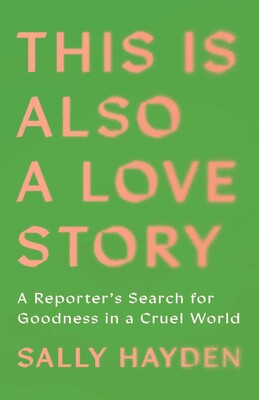
More than a book about real-life love anecdotes, This is Also a Love Story feels like a compilation of stories about real people who feel, lose, and love. It is, by the author’s own admission in her powerfully written epilogue, “atonement for more than a decade in the journalistic world, which can strip detail, remove agency, and flatten emotion.”
“It can be quite painful for people to feel that they’ve been flattened such that the basic description of them is as someone experiencing a horrible thing, and I think it’s good to occasionally course correct,” she says. “I don’t know if it succeeded, but that was something that I was thinking about.”
In the book’s prologue, Hayden poses the question of whether the world would look different if news stories more often filtered stories through “the prism of love.” Asked whether reporting and writing the book helped her find an answer, she says she is unsure. “Ideally, the book would start some kind of conversation rather than ending the conversation,” she says.
“A journalist actually asked me the other day [if I thought] there need[ed] to be a paradigm shift in the way that we report. … It’s not for me to tell other people how to do their job, but I also think, certainly, it’s a question that’s worth asking.”
Sally Hayden’s This is Also a Love Story was published in June 2026 and is now available for order.