








Daniel Sanchez Estrada’s friends call him “Des.” He is 39 years old, a husband, a father, and a longtime teacher’s aide at an elementary school in Texas. His sister, Ana Bell, says Estrada is one of the gentlest people you’ll ever meet; he became a vegan long ago out of love for animals. Estrada is also a tattoo artist, and before he was arrested, he was on track to open a studio of his own.
In June, he was one of nine people dealt lengthy sentences — in one case, another defendant received a 100-year sentence — after the first-ever “Antifa” trial in the US.
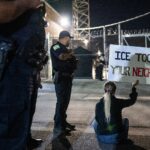
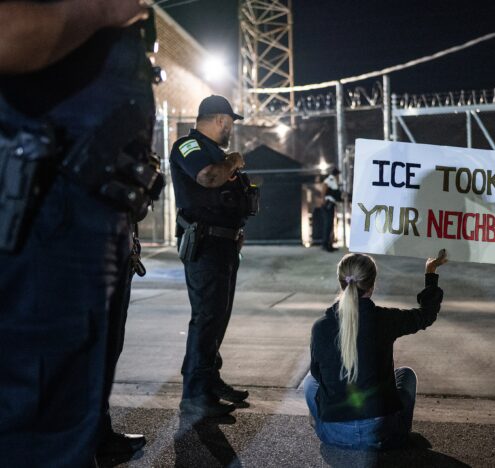
Estrada wasn’t present at the July 4, 2025 protest during which a police officer was shot and injured after a noise demonstration outside an ICE detention facility. But his wife was there, and she was one of the 16 people arrested in the aftermath of the protest gone awry. The government would later claim the arrestees and some of their friends and loved ones were part of an “Antifa cell” that planned to wreak havoc at the facility — despite the fact that no official “Antifa” organization exists, and many of the people there that night did not know each other. (Antifa is shorthand for anti-fascist.)
In the days afterward, Sanchez was arrested after moving a box of zines and anti-fascist literature from his family home to a friend’s apartment. He was convicted of conspiracy to conceal documents and corruptly concealing a document or record, and he was sentenced to 30 years in prison. (His wife received a 70-year sentence after multiple convictions, including rioting and providing material support to terrorists.)
Bell says she could “hear the mourning” in her brother’s voice when they talked on the phone after the sentencing. “He called me, and he’s screaming and crying,” Bell says. “He’s like, ‘This is not happening.’”
In the moments where he fell quiet, to gather his thoughts or take a breath, Bell heard a haunting sound in the background. “You could hear the cries and screams from the other defendants,” she says. “And it’s horrifying, because you could hear the pain as these people are screaming, trying to understand why this is happening to them.”
After the verdicts, extremism and counterterrorism expert Jason Blazakis explained to Inkstick that Estrada’s sentencing — as well as the sentences of the eight other Prairieland defendants who pleaded not guilty to their charges — was far more severe than people convicted of supporting the Islamic State (ISIS). He pointed to Estrada’s case as especially troubling.
“A lot of that has been made of the design propaganda, the homemade propaganda, some of it like old school pamphlets,” he says of the zines, posters, and stickers presented as part of the prosecution’s case. “The government made the case that it’s Antifa material. So [Estrada] gets 30 years for having printed material. No matter how detestable you see the rhetoric therein, this is a country founded on freedom of speech.”
Estrada’s sister spoke to Inkstick, too, and she shared how her family is trying to cope with life after a devastating case that Blazakis and other experts worry is just the first big blow in the Trump administration’s campaign against protestors they’ve repeatedly called terrorists. “He’s not a danger to society,” Bell says. “The guy is a marshmallow, and I’m not even biased when I say that. You can ask any of the people that know him.”
After he dropped off the box of zines at his friend’s house in Denton, Texas (a college town roughly 45 minutes north of Dallas), Estrada’s Silverado was swarmed by police and FBI agents, their weapons drawn. He was told they stopped him for taking too wide of a right turn, though law enforcement asked if he had explosives in his car. Body camera footage later reviewed at trial shows law enforcement officers saying things like, “We’ve got to figure out how we’re detaining his ass.”
He was taken to a nearby jail, and the next day, he was charged with the concealment offense.
Estrada’s wife had already been arrested the night of the protest, and he and his attorneys would later learn that prosecutors were using a phone call between the couple as part of the case against the Prairieland defendants. “Our house is good so far,” Estrada had told his wife during a discussion about other protestors’ homes being raided. In the prosecution’s telling, saying his house was “good” meant Estrada had made efforts to conceal documents from law enforcement.
After the arrest, it took family members like Bell roughly a week to find out where he was. The wait was excruciating. “We couldn’t find his name registered on any of the court systems,” Bell says. “There wasn’t an arrest form or anything for him. So we didn’t know where he was at the beginning. And then once you figure it out, there’s still not a way for you to contact him because he has to make the first contact.”
Once he finally reached his family, they began to understand how dire his condition was in lock-up.
At Johnson County Jail, Bell says her brother was held 24 hours a day in a cell with seven other people. The small confines were scorching. “I don’t know if the air conditioning wasn’t working or they weren’t turning it on, but he says that the sweat from the people kind of wet the floors, and they were sliding when they’re trying to walk in there because it’s so wet,” Bell says.
During the scant hours the people in the cell were able to sleep, a guard would occasionally walk by the cell and slam a baton or a meal tray against the bars, waking everyone up. The meals themselves were another issue.
The only food items that officials gave Estrada to fit his vegan diet were bread and water. What’s more, Bell says her brother lacked regular access to a shower. “So he’s literally going to court dirty,” she says. “It’s just basic human things that, little by little, they break a person.”
He was eventually transferred to a different jail in Fort Worth. Then, in November, Estrada was surprisingly released.
The week of Thanksgiving, Bell received a phone call while working at the bookstore she recently opened in Fate, Texas, a small city roughly an hour east of Fort Worth. The call was from the jail, telling her to pick up her brother. She called Estrada’s attorney during the long drive, and the lawyer was equally confused; no one knew what was happening.
“I show up, I get him, put him in the car, and I still don’t know what’s going on,” Bell recalls. “We’re driving off, and the entire time I feel like I’m doing something illegal, like I’m running away from the police or something. I felt like I had a target on my back. My brother has a target and we’re going to get intercepted at some point and they’re going to scoop him out and they’re going to take him.”
They didn’t on that day, but shortly after Thanksgiving, Estrada’s attorney called Bell: Her brother needed to turn himself in, or police would arrest him at home. Evidently there’d been what attorneys later described as a “clerical error” in records while Estrada was added to the superseding indictment against the other Prairieland defendants. For a few days, he had no charges attached to his name (at least in the jail’s system).
“I’m so happy that I’ve gotten to hug some favorite people and cry with them, and hear so many hopeful feelings,” he said in a statement the day he turned himself in. “The amount of prayers and all the efforts that people are doing to support me and others is beyond believable, and we all feel super blessed.”
His sister held onto some faith that justice would prevail when the case finally went to trial, especially since there were some moments, however brief, when the judge seemed to question the government’s case.
For instance, during a pretrial motions hearing in February, Estrada’s attorneys sought to suppress their client’s arrest on the basis that law enforcement had no search warrant or valid reason to pull him over. Judge Mark Pittman told the prosecutors he’d never heard of anyone being arrested for turning right “too wide.” “I think that even you can admit that this is pretty weak tea,” he told the government’s attorneys.
“When he said that, I was like, ‘Okay, he can see it. He can see that this is so messed up,’” Bell says. “And he still denied the motions. To me it’s just like, why would you agree with us and then still deny the motion?”
When talking about her brother’s case, Bell can’t bring herself to use the words “found guilty.” In her eyes, the government didn’t find anything linking Estrada to any kind of terroristic beliefs or activities. Instead, she says he was “declared guilty.”
Shortly after the verdict, the court prepared a pre-sentencing report: a document that contains a person’s criminal history (of which Estrada has none) and details on the offense. The report recommended a sentence of 10 to 16 months. Bell believes even a single day in jail was far too much for her brother, but she was ready to hear the 10-16 month sentence and prepare for an appeal. Yet, the government argued for the application of the terrorism enhancement, which ultimately pushed the sentence much higher.
This argument echoes the Trump administration’s broader efforts to brand left-wing protestors and organizers as terrorists in a “network” undermining US national security. Most recently, the State Department argued some of these supposed agitators have ties to Cuba, a longtime foe of the US and administration officials like Secretary of State Marco Rubio.
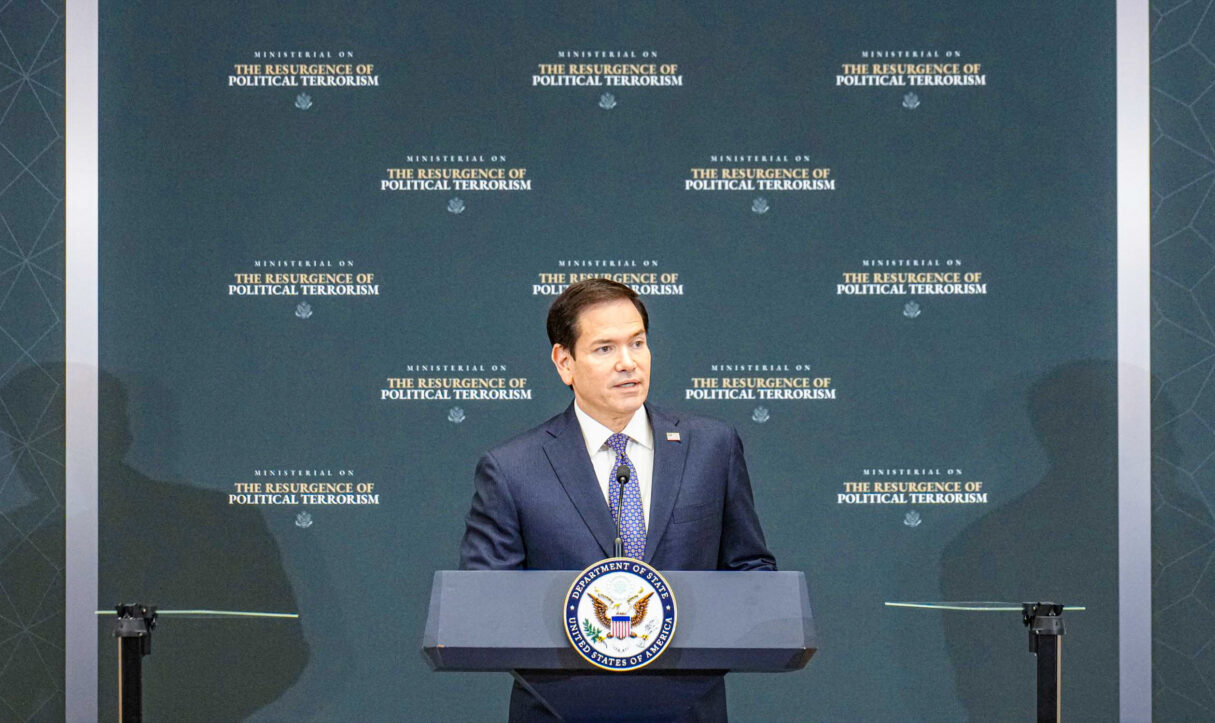
Shortly before Estrada was sentenced, Rubio and Trump aide Stephen Miller, a principal architect of Trump’s immigration policy, spoke at a conference on political terrorism. They called upon US allies to aid in stopping the “left-wing political terrorism” that Miller deemed a “cancer.”
“For far too long,” Rubio said, “our counterterrorism doctrine has had a blind spot — a blind spot when it comes to extremist violence from the political left,” adding that the Trump administration “will dismantle these networks brick by brick.”
“It is time,” he said, “for the people of the civilized world to defend ourselves, to stand united against this encroaching darkness, and fight — fight for what is ours.”
About a week later, on the day of her brother’s sentencing, Bell and her parents were among the first people at the courthouse. Estrada’s mother and father stood a foot or two from the closed courtroom doors for 20 minutes, waiting for them to open so they could see their son walk in. Once inside, they listened as one of the state’s prosecutors tied their son and the other defendants to a trend of “Antifa stuff” that had “been going on for years.”
“You can try deterrence,” one prosecutor said, “but with these beliefs, that’s hard to do.”
Once more, a judge’s reaction gave Bell a glimmer of hope; she watched as Judge Reed O’Connor, who hadn’t presided over the trial, nodded his head to her brother’s impassioned statement rejecting the “terrorist” label that was thrust upon him.
The judge then issued a 30-year sentence, which Bell says was part of a clear “pattern” she saw that day. The judge, as she sees it, clearly bought the state’s argument that a message had to be sent.
“We had a lot of hope that the justice system will be just, because there’s honestly nothing illegal going on here,” Bell says of her brother’s case. “And our hearts and our hopes were shattered in the courthouse.”
She says her family is now “going through the motions,” trying to figure out how to go on living life while fighting for Estrada’s freedom. His attorneys have filed a notice of appeal, but that process will likely take years. Most recently, Bell has considered that a pardon could be her brother’s best hope of getting out of prison anytime soon.
When she was interviewed by Inkstick for this story, she expressed hope that he might be housed in a prison relatively close to Texas. This way, she and Estrada’s other family members wouldn’t have to travel very far to visit him. But shortly after the interview, word came down that her brother had been transferred to a prison in California.
She’s not sure what life will look like for him there, but she knows that every time she eats something, she thinks, “He can’t have this.” She calls it survivor’s guilt; she doesn’t know how else to describe it.
Bell also knows that her brother had somehow found tiny moments of his own hope at the North Texas prison where he was held during the trial and before his transfer to California. In Fort Worth’s Federal Medical Center, Estrada was allowed one hour of “outside time” per day.
“That’s his favorite part,” Bell says. “He gets to go outside to see the sun, the sky.”
Top photo: Secretary Marco Rubio delivers opening remarks at the Ministerial on the Resurgence of Political Terrorism at the Department of State in Washington, DC, on July 16, 2026. (Freddie Everett/State Department/Wikimedia Commons)



.jpg)