











Attorneys for plaintiffs in Vasquez Perdomo v. Mullin have asked a federal court to block the Trump administration from continuing unjustified, racially discriminatory immigration stops across the Central District of California, pointing to a vastly expanded evidentiary record built from months of expedited discovery.
At ACLU of Southern California, Mayra Joachin, deputy director of the group’s immigrants’ rights project, said the filing should “shock the conscience,” arguing that internal government records confirm what affected communities have said all along.
The 40-page motion, filed July 27 in the US District Court for the Central District of California, draws on internal directives, sworn depositions, body worn camera footage, and text messages exchanged among agents. According to the filing, an ICE headquarters email sent in late May 2025 instructed field offices to begin arresting so-called “collaterals,” meaning people who were not the actual targets of investigations, en masse.
Trump reinforced that shift days later, directing federal law enforcement to “take all such action necessary to liberate Los Angeles from the Migrant Invasion.” What followed, the motion argues, was a sustained campaign of stops built not on individualized suspicion but on a demographic profile: people who appeared Latino and low income or working class.
The record describes three overlapping tactics. Under “roving patrols,” agents swept through neighborhoods hunting for “possibles” based on appearance alone, with no claimed enforcement target at all.
Under so-called “targeted area” operations, teams scouted locations like Home Depots and car washes, ran identity checks until they found a handful of possibly undocumented people, then raided the location on a chosen day regardless of whether the people they had identified were even present.
And in operations where defendants were simply labeled “targeted,” officers used a supposed target as pretext to question and detain other Latino bystanders nearby, including at a Pasadena bus stop where agents ambushed named plaintiffs who had no connection to any investigation.
Sworn testimony captured how central race was to these decisions. One Border Patrol supervisor, asked whether apparent Hispanic ethnicity factored into which stops officers made, said he would still consider it “one articulable fact,” even after acknowledging that most Hispanic people in the district were lawfully present.
Body camera footage and recovered text messages showed agents referring to people they targeted using slurs, including one instance in which an agent told a colleague to “plug us in wherever you see some tonks,” a term tied to the sound of a flashlight striking someone’s head. Other messages used a derogatory term for undocumented immigrants to describe people based solely on how they looked.
Officers repeatedly described their targets as “day laborers,” and referred to them as “wet” in bodycam footage, but the filing argues that term functions as shorthand for low-income Latino workers rather than any coherent occupational category. One lead officer, asked to describe the appearance he looked for, answered simply, “Older Hispanic males.”
The same officer testified he did not call people “day laborers” at all, saying instead: “I call them illegal aliens.” The record also documents a pattern in which agents stopped Latino customers or workers at a location while leaving light-skinned coworkers untouched nearby, evidence plaintiffs say undercuts any claim that officers were relying on neutral, work-related cues rather than race itself.
The filing details the toll these stops have taken on individuals who have been swept up despite lawful status, including several US citizens. One plaintiff, a Latino US citizen named Angel Santiago Tafolla, was stopped at gunpoint and later said the experience left him unable to sleep for a week. Another described losing confidence that citizenship offered any protection at all.
Attorneys argue that defendants’ stops violated both the Fourth Amendment’s protection against unreasonable seizures and the Fifth Amendment’s equal protection guarantee, noting that courts have long held that broad demographic characteristics cannot substitute for individualized suspicion.
Plaintiffs have asked the court to bar agents from stopping or detaining people based on apparent low-income Latino status without a prior, individualized basis to suspect unlawful presence, and to impose documentation requirements to enforce compliance.
A hearing on the motion is scheduled for Sept. 24 before US District Judge Maame Ewusi-Mensah Frimpong. The case follows a 2025 lawsuit brought by individual Latino workers alongside CHIRLA, the Los Angeles Worker Center Network, and the United Farm Workers, after a federal judge’s initial restraining order was stayed by the Supreme Court without explanation last August, allowing the challenged practices to continue while litigation proceeded.
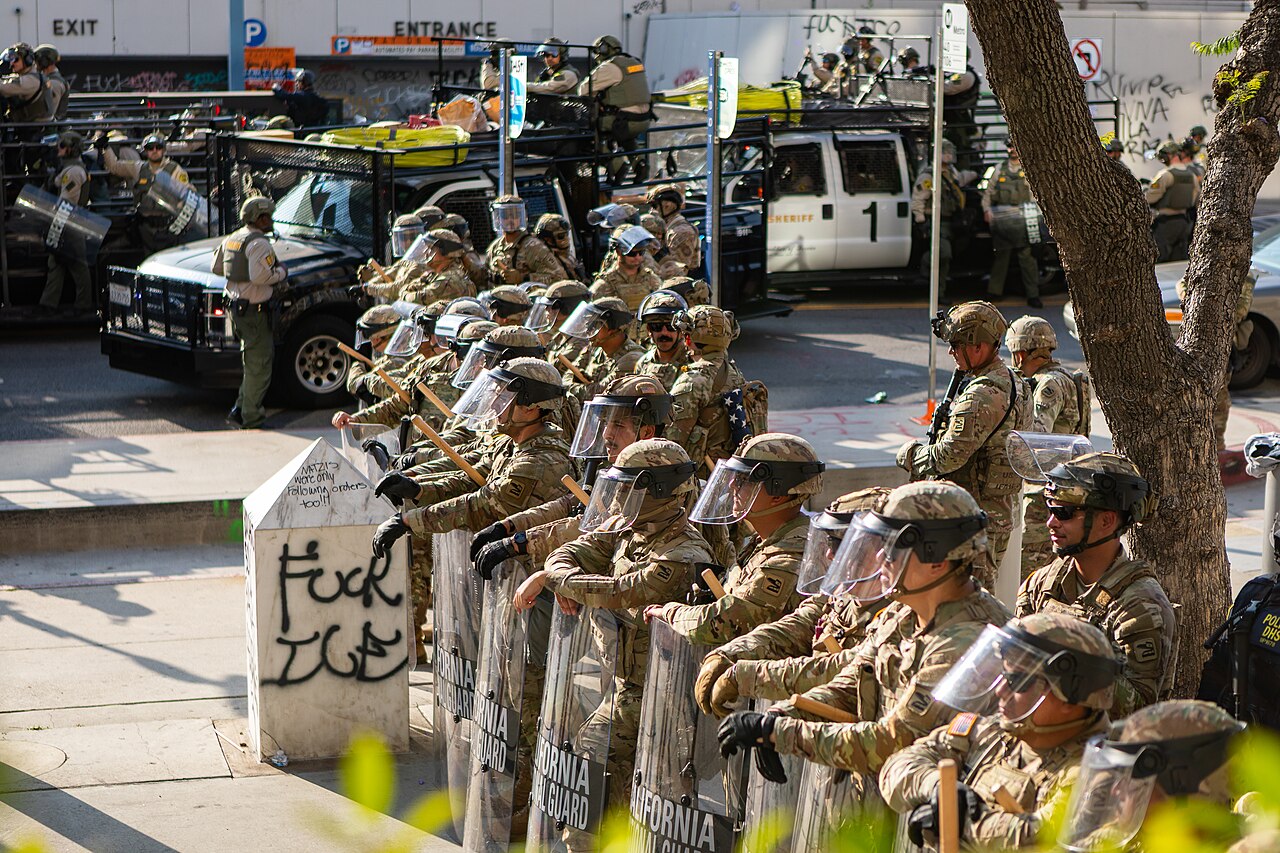
Top photo: California National Guardsmen gather during an anti-ICE protest in Los Angeles in June 2025 (US National Guard/Wikimedia Commons)