













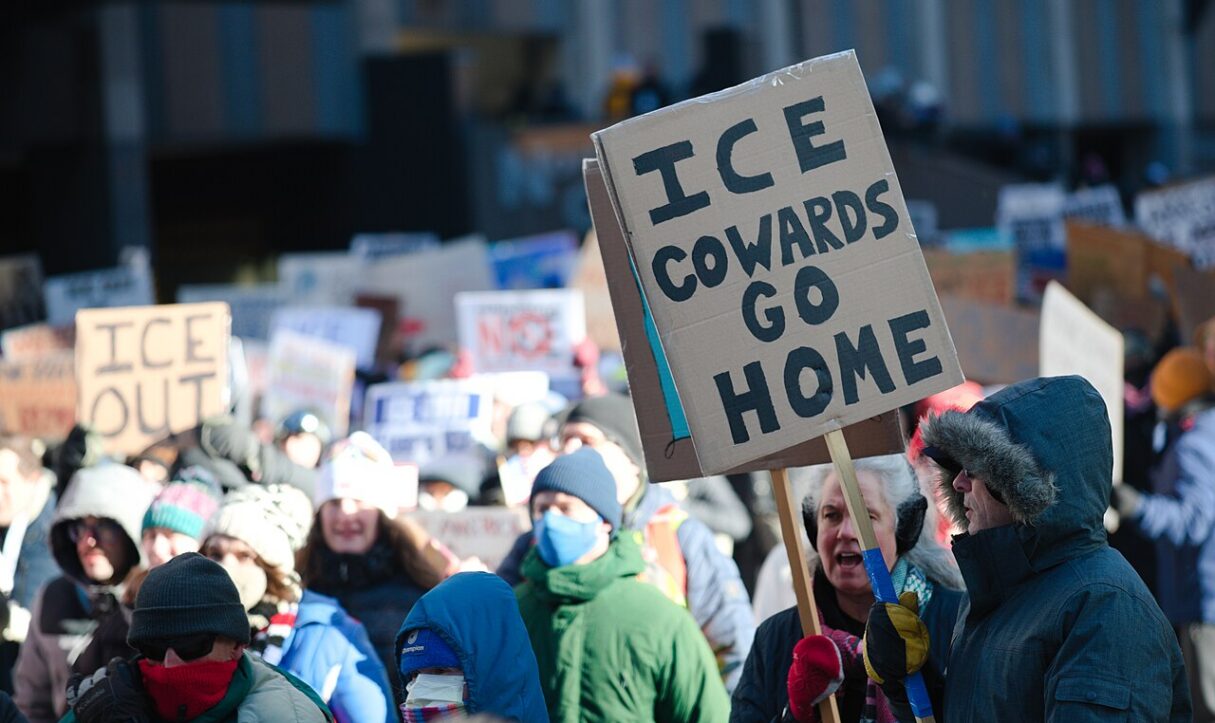
For nearly two months now, a fierce battle over immigration enforcement has been raging outside of an Immigration and Customs Enforcement detention facility in Newark, New Jersey, called Delaney Hall. Videos of clashes between protesters donning gas masks and law enforcement officers in riot gear spread on social media following reports that detainees had launched a hunger strike and issued handwritten demands for better conditions and medical care. Dozens of people have been arrested in these attempts to hold ICE and GEO Group — the private contractor operating the facility — accountable.
It’s not just New Jersey. On July 15, dozens of Coloradans protested at a town hall following an announcement from days prior that GEO Group had signed a $529 million contract with ICE to convert a shuttered prison north of Denver into a detention facility. As the largest ICE detention contractor, one that operates facilities that hold a third of all people in immigration detention, GEO Group is a logical target for anyone standing up for migrants’ rights and seeking accountability for reported negligence and abuse.
According to the most recent Department of Homeland Security data, more than 65,000 migrants were in ICE detention as of July 11. Nearly 90% of those detained are currently held by private contractors. What conditions are like inside many of these facilities is difficult to know with certainty because independent oversight has been sharply curtailed. What is documented is this: at least 38 people died in ICE custody between January 2025 and February 2026, the highest toll in any non-COVID year on record, with 71% of those deaths occurring in facilities managed for profit.
Accountability, though, can be elusive when it comes to private immigration enforcement contractors. GEO Group, for its part, has argued that it enjoys “qualified immunity” and is thus protected from any litigation related to these allegations. That assertion may well be on shaky legal ground, but the overall point is true: Despite protestors’ best efforts, GEO Group and other private contractors do enjoy a kind of de facto immunity when it comes to immigration enforcement. With an executive branch unwilling to conduct oversight on its own agencies, a majority in Congress uninterested in criticizing the Trump administration in any way, and a judicial branch deferential to the president on issues of national security and immigration, there are very few avenues for legal action and other forms of accountability against these private contractors.
Protest actions can sometimes fill this accountability gap. Earlier this year, for example, Avelo Airlines announced it would cancel an estimated $150 million contract to operate deportation flights for DHS after a grassroots campaign mounted a boycott and mobilized other forms of political pressure against the company. And to be sure, the New Jersey and Colorado protests aimed at GEO Group have helped keep the contractor in the headlines, trained a critical national eye on the alleged abuses occurring in the facilities it runs, and likely encouraged members of Congress to visit the facilities and conduct some much-needed oversight.
Of course, not everyone has the same ability or risk tolerance to take to the streets, and successful campaigns beyond the Avelo example are few and far between. Even more troubling is the fact that some of the people taking to the streets may be undercutting their own aims by unwittingly supporting the very companies they are protesting.
Seven publicly traded companies hold active contracts or data agreements with ICE and DHS: GEO Group, CoreCivic, Palantir, Axon Enterprise, Thomson Reuters, RELX (whose LexisNexis division provides ICE with its Accurint database), and GlobalX Airlines. Most of the nearly 60% of US adults who have money invested in a retirement savings plan such as a 401(k), 403(b), or IRA hold at least one without knowing it. (Many other companies have subcontracts related to immigration enforcement, but this kind of work is often not the core focus of the business.)
Since the beginning of the second Trump administration, private contractors such as GEO Group have seen profits soar to record levels. The passage of HR1, the so-called “Big Beautiful Bill,” in July locked in $45 billion more for immigration detention — the largest single appropriation for ICE in history. Many people rarely consider or even understand that the index funds and ETFs in their retirement accounts are holding hundreds of individual stocks on their behalf. One of the coauthors of this piece, Jon Nealon, recently developed a new tool that lets users search index funds and ETFs by ticker symbol to see if their retirement savings are invested in the immigration detention and deportation industry. It includes some of the most widely held funds in the country, such as VOO, SPY, and FXAIX.
Understanding whether and how one’s money is tied up in an industry with which you disagree is arguably even more important at a time when the administration is prosecuting anti-ICE protesters as terrorists. This June, for instance, the federal government charged 15 people with conspiracy to impede or injure a federal officer for their involvement in anti-ICE activism in Minneapolis earlier in 2026.
Still, figuring out whether and by how much you are invested in ICE is only half of the battle. There’s a name for what to do about it: divestment. The tactic or strategy aimed at social change has a long history, stretching back at least to the anti-apartheid movement of the 1960s-1980s and through today, to recent calls from students demanding their universities divert endowment funds away from fossil fuel companies or weapons manufacturers supporting Israel’s war in the Gaza Strip.
Generally speaking, the larger the institutional divestment, the bigger the impact on the target, but, with the right coordination and broad-based buy-in, divestment can also work on a distributed, personal level. And, collectively, these actions can influence companies like Fidelity and Vanguard to rethink whether to include morally questionable companies inside their index funds.
Some institutions have already started the process. In June, officials in Jersey City, New Jersey, announced that the city will divest $260 million of its funds from Citizens Bank, which helped secure more than $2.5 billion for GEO Group and CoreCivic, another large private prison company and operator of immigration detention facilities.
“Citizens Bank made a choice to finance the caging of human beings for profit,” Mayor James Solomon said in a statement about the vote. “Jersey City is making a choice too: we will not be complicit. … As long as institutions continue to bankroll the private prison industry and the suffering it depends on, we will use every tool at our disposal to ensure Jersey City taxpayers are not financing the abuse of our neighbors.”
If you happen to be one of the millions of American adults invested in ICE, then that same tool — divestment — is at your disposal, too.