










Sameeha Rizvi, a Texas-based civic engagement coordinator for the Council on American-Islamic Relations, can easily name a half-dozen incidents that have rattled her over the last year. There was the time, in Houston, when a man threw a Quran into a fire at an event hosted by an Islamic student group. Then there was the incident in Austin, where a man cloaked in white garb with a red cross emblazoned on his chest told a prayer group, “God is going to throw every last Muslim into hell.”
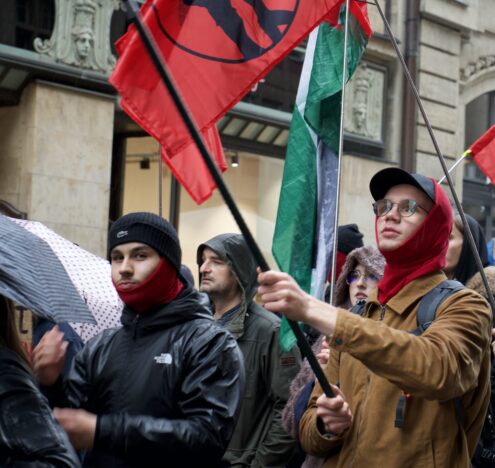
These acts of hatred, and the many others like them, are part of a disturbing trend in the US and abroad: Anti-Muslim hate speech and hate crimes are on the rise.
Rizvi worries about the politicians “fanning the flames” of anti-Muslim hatred. In an attempt to sell the legitimacy of the war with Iran and stave off a potential “blue wave” of Democratic victories, Republican politicians and the Trump administration have cast Islam as one of the main threats to the future of the US and the broader world. That includes President Donald Trump, who has said that if Abdul El-Sayed, the Democratic nominee for Senator in Michigan, wins his race, he and the Democrats will “open the floodgates and welcome hordes of jihadists to our shores, creating a nightmare of violence and terror until you cannot even have a Christmas.”
As Rizvi sees it, this fearmongering is a distraction from the issues affecting millions of Americans, including inequality and access to affordable healthcare. But that doesn’t mean it’s not dangerous.
“What they are doing right now by instilling hate and fear and misinformation is only going to create more division,” Rizvi says. “It’s only going to create more hate crimes and more events like what we saw in San Diego.” She’s referring to a shooting in May, where white nationalists killed three people at a California mosque.
Much of the rampant Islamophobia in this election cycle has been intermingled with Republican efforts to frame the US and Israel’s war with Iran as a spiritual conflict.
Defense Secretary Pete Hegseth has called Iran’s leaders “religious fanatics” who seek a nuclear weapon to bring about “religious Armageddon.” Mike Johnson, the Republican Speaker of the House, has claimed lying is part of some Iranian leaders’ religion, thus explaining why a long-term peace deal has been elusive. Additionally, Christian leaders like Robert Jeffress, an influential voice among Trump’s evangelical constituency, have echoed this argument. The war with Iran, Jeffress says, is “a spiritual war between good and evil, between the kingdom of God and the kingdom of Satan.”
Jacob Neiheisel, a professor and expert of political communication and campaigns at the University of Buffalo, says this “apocalyptic” messaging will likely resonate with a coveted voting bloc.
“Trump has a constituency that he really needs to turn out, and that’s evangelicals,” he says. “He really needs charismatics to come out for him, and they see the world predominantly through this lens of looking toward the end times, and animosity, war, all these things going poorly feed into that vision of, ‘the time is soon, it’s coming.’”
Still, Neiheisel is hesitant to believe there’s a coherent strategy behind these religious arguments by Trump and his allies. He recently recorded a TV interview in which he discussed how campaigns and presidential administrations often conduct detailed message testing and focus groups. Afterwards, Neiheisel says a friend of his “who works in Washington circles” called and told the professor he was being “too kind.”
“A lot of these folks don’t do that,” his friend told him.
In lieu of a unified strategy or messaging about a cost of living crisis and its ties to the Iran war, Neiheisel says that Republicans are likely attempting to draw attention to the topics that will scare voters — “Like, ‘Here’s some communists,’ or, ‘Here’s what’s going on abroad.’”
Ali, an Iran-born retiree now living in the US, tells Inkstick that his family members in Iran are dealing with their own affordability and inequality crises as a result of the war.
“The middle class is very much squeezed really to the core,” says Ali, who asked to use a pseudonym so as not to identify his family. “The basic necessities are getting really, really hard to come by and more expensive every day.”
The irony, Ali adds, is that the Iranian regime was at one of its weakest points in recent memory before the US launched the war earlier this year. (Others interviewed by Inkstick, including economics professor Djavad Salehi-Isfahani, have made the same argument.)
In other words, despite the Trump administration’s insistences that the war has prevented Iran from obtaining a nuclear weapon, Ali says the conflict has “galvanized” support for the regime.
“They don’t care, obviously, about the people themselves,” he says of the Iranian regime. “So, they’re going to stay in power, and they’re going to fight until the last man or last people in Iran.
“They care less about the economic situation of Iranian people anyways. Same as Trump. He doesn’t care about the American people. It’s an interesting similarity there, for sure.”
Max Burns, founder of the political consulting firm Third Degree Strategies, agrees with Neiheisel that there is no coherent messaging strategy emanating from the White House right now. Part of the reason for that, Burns says, is that the incumbent party has no substantive or popular policy victories on which to campaign.
What’s more, the erosion of support for Israel among US voters and the war’s impact on Americans’ finances present a no-win scenario for the Trump administration: “The less they talk about the war, the better,” Burns says.
The issue, he points out, is the president’s tendency to go off-script. At multiple rallies in recent weeks, Trump has argued that preventing Iran from obtaining a nuclear weapon was worth the pain caused by higher prices at the gas pump. (There was no evidence Iran was close to creating a nuclear weapon at the time the war began.)
As a result, experts interviewed for this story say the GOP has amplified the Islamophobia that was already a major theme of the Trump era.
As Neiheisel sees it, the last time midterm results went against expectations was in 2002. Islamophobia and anti-Muslim hate crimes spiked after the 9/11 attacks, and shortly after, the Republican party, which occupied the White House at the time, won seats in both chambers of Congress during the midterm elections.
That was the last time the party in power won more Congressional seats in the midterm races, and it was only the third time that happened since the Civil War.
“I think if you can bring back specters of that, if you can make it us versus them — and there’s clear ‘them’ here with the Iran connection — I think that’s a lever that a lot of strategists would say to pull,” Neiheisel says.
In the final days of the 2026 midterm elections, Trump said at one of his rallies that the Senate may need a metal detector if Abdul El-Sayed is elected. It was just the latest invective in a year in which at least five sitting Congressmen have made statements advocating for immigration bans from majority-Muslim nations or suggesting Muslim Americans do not belong in the US.
Most recently, the racist attacks have revolved around El-Sayed, the possible first Muslim senator in the US and a man whom the president has repeatedly called a “jihadist.” Allies of the White House further claim El-Sayed is a “trojan horse” seeking to cause some sort of damage to the US once elected.
Similar language has spread up and down the ballot and throughout the country.
Last week, US Senator Ted Cruz, a Republican from Texas, appeared at a campaign event for fellow Republican Senator Roger Marshall. The latter is fighting off Democratic challenger Adam Hamilton in Kansas, a Methodist minister whom some polls show leading in the race.
During his appearance, Cruz took issue with past remarks by Hamilton, in which the minister said people of all faiths can be admitted to Heaven.
“He says, ‘When we get to Heaven, there will be Muslims,’” Cruz said, paraphrasing Hamilton. “‘And we can hug and embrace them, and they will be welcome in Heaven.’”
It’s an “interesting idea,” Cruz mused: “We show up there in Heaven, first thing you see is Osama bin Laden.”