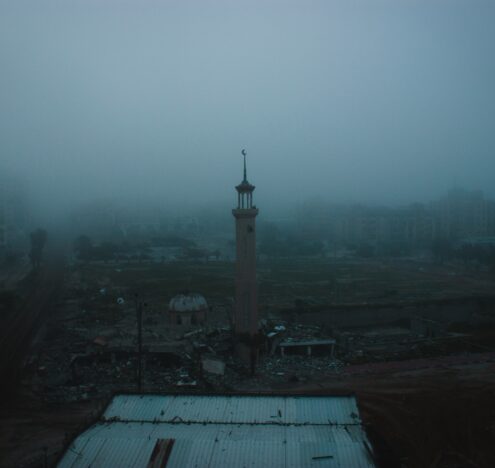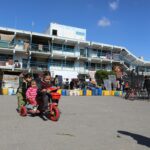


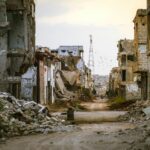


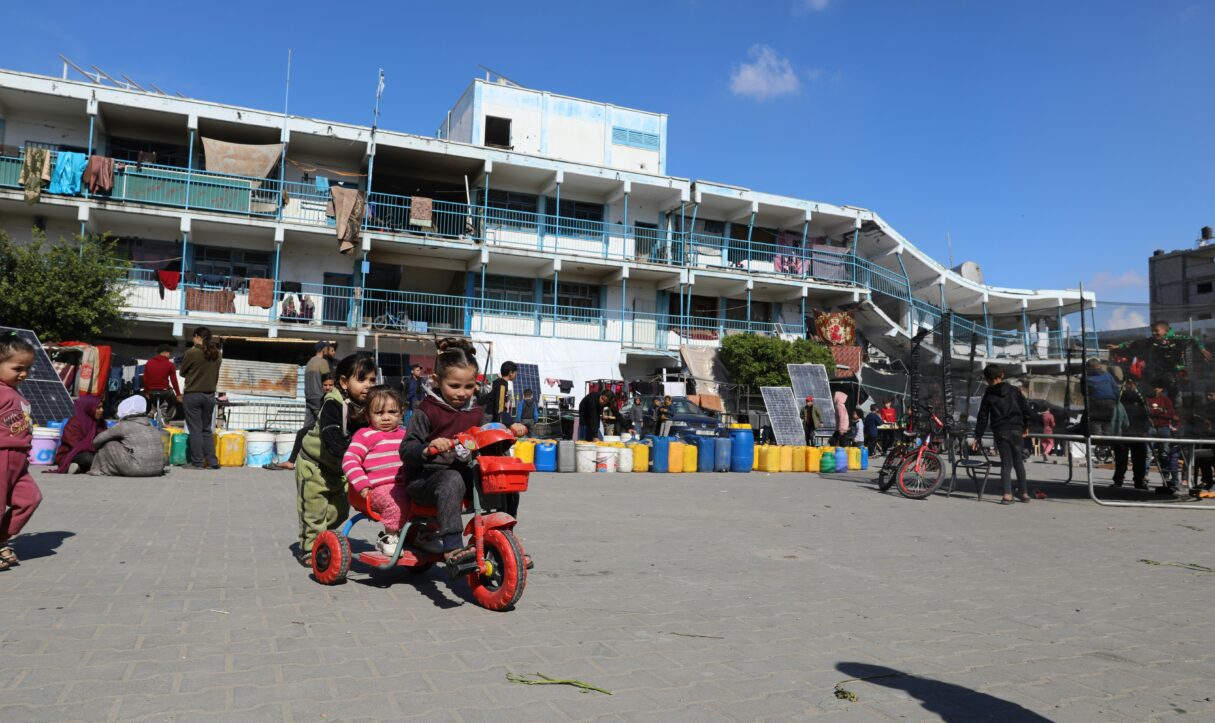
On a recent rainy morning, I walked past my old school. Looking at it, I felt like I’d never studied there at all. Shrapnel had scarred the walls, and displaced families sheltering in the building had hung clothes in the windows. Everything around it was also destroyed. I stopped for a moment, and 10 years fell away.
It was one of Gaza’s UNRWA schools, an ordinary place built for Palestinian refugees who’d fled their historic homeland for the Strip during the 1948 Nakba. The blue gate bore the United Nations agency’s emblem, and right beneath it was a warning: No weapons allowed. Studying there, we were taught to believe that our only capital as Palestinians is knowledge, the weapon we’d use against the bitterness of life under occupation. Our parents and grandparents planted that belief in us after 1948, when Zionist militias took their land and homes.
The school uniform was standard: a blue shirt for boys, and for girls a gray-and-white striped pinafore worn over jeans. We joked that it looked like zebra skin and wondered why nobody organized a protest to change it. We wanted to look elegant even on the way to school. On rainy mornings like the one when I’d recently happened upon the school, we would hide under the blanket and pretend to be sick so we could skip class. If we were lucky enough to be convincing, we might enjoy a cup of hot sage tea with a za’atar sandwich while watching the morning cartoons.
Our mothers, of course, had other ideas. “You won’t drown,” for instance. Or: “Take your umbrella, and go with the others. The streets are full of students.”
The first bell rang at 6:45 am. We stood in orderly lines. Then came our first class. The room was wide and clean, the walls decorated with posters encouraging diligence and self-reliance. We designed our own teaching aids, competing for bonus grades: drawings in biology, poems by Mahmoud Darwish for Arabic class.
Each class lasted 45 minutes, and after the first three, we got a break to recharge: friends laughing, debating the latest episodes of our favorite shows, the smell of fresh pastries drifting across the yard. If we were especially lucky, the class after the break was gym, art, or dabka, the traditional Palestinian folk dance. Thursday was inevitably the happiest day of the school week: We had Fridays off, and it offered a chance to feel joy after a long, tiring week of studying. No early bedtime, no homework.
Still, nothing gave us as much joy as a school trip. Anytime the administration announced one, all of the students began to plan early. It was like preparing for a holiday. We got to ignore the rules for a day: We wore whatever accessories we wanted, carried our phones, and brought along dishes of delicious sweets. Pastries, orange cake, chocolate coconut balls. The bus driver would play upbeat songs, and teachers and students alike would sing along.
For our part, my friends and I would claim the back row seats. The bus would carry us from where we lived in the southern part of the Strip to Gaza City and further north. Along the road, we’d wave at street vendors and pedestrians who, funnily enough, would almost always wave back.
I now teach English at a private learning point, a makeshift learning center that serves as a stand-in for normal schools. The buildings where we studied — the buildings where most of Gaza’s students studied — are no longer safe enough to learn in.
One day recently, I asked my fourth grade students what came to mind when they heard the word school. Some said the sound of the bell. Others said the cafeteria. Most, though, said they pictured a playground-like area with a basketball court. These children were either in kindergarten or the first grade when Israel’s latest war on Gaza began. What they describe as the image that comes to mind has almost disappeared entirely. Now, they sit in a tent that’s too crowded to stretch their legs in.
With younger students, I have to start from scratch. I teach them how to hold a pencil and right from left to right, a skill they would’ve normally mastered in kindergarten. The high school students have forgotten most of what they’d already learned. I built a comprehensive review of basic grammar they learned years ago, and a foundational course in phonetics and pronunciation. Our students work hard. They learn quickly despite everything they’ve survived. A miracle of sorts.
Still, school is an imaginary concept for most children in Gaza. Many were too young to begin classes before the war. The onslaught has turned healthy learning environments into rows of overcrowded tents and makeshift camps for the displaced. There are neither chairs nor desks. Students sit in the tents for four hours, their backs hunched the entire time. The colorful stationary displays lining the shelves of bookstores are gone. Israeli authorities have banned stationery from entering Gaza. Why? In their telling, paper, notebooks, and colored pens are nonessential goods. Buying them now means paying exorbitant prices.
In January 2026, UNICEF, the UN children’s agency, managed to bring in shipments of educational supplies. It was the first time in two and a half years. One item the agency brought was blue school bags stamped with the agency’s logo in bold print. Like kids anywhere, children in Gaza want bags with Superman or Hello Kitty. Instead, they are condemned to carrying a bag that reminds them, no matter where they go, that they are refugees.
There are initiatives to provide psychological support to children here, though. Palestinian painters recently launched a project that involves decorating and coloring the UNICEF school bags. Ola al-Namra came up with the idea after seeing how sad her little cousins were when they received their UNICEF bags.
After she painted her cousins’ bags, it caught the eyes of their classmates. She soon painted several more free of charge. “I have plans for coloring workshops and courses to develop their talents,” she said, “but high prices and limited supplies stand in the way.”
Education, of course, should occur in a safe, warm, and stable environment. Learning shouldn’t have to take place in the husks of schools that have endured repeated attacks, nor should it happen in weather-battered tents that cannot keep out the summer heat or the winter rain.
The few schools that escaped total destruction are mostly far from the displacement camps, and some stand near the so-called Yellow Line, which Israeli forces forbid Palestinians from crossing. This means students are at serious risk.
Before the war, Gaza was home to more than 560 school buildings serving more than 660,000 students, all of whom are now deprived of their right to education in a psychologically and materially supportive setting. According to the Palestinian Ministry of Education and Higher Education, more than 97% of the Strip’s schools and universities have been partially or completely destroyed. What remains has become shelter for displaced people who have nowhere else to go and who refuse to leave as winter approaches. Widows, orphans, and families with no income. One displaced woman there points out that she supports education, but she needs a safe shelter and has no other options.
When you step into a classroom today, you see chaos: no posters, no teaching aids, burned walls, no uniforms. The Ministry of Education has cut the school day to four classes of 40 minutes, covering core subjects only. Their daily conversations circle around questions: Is your house still standing, or was it bombed? How many times have you been displaced? Do you live in a tent?
One girl crawled out from under the rubble. She’s amazed she is still alive. Another lost her entire family. Another lost her closest friend. Another has been displaced more than 15 times. Yet another jokes that she comes to school only to take a break from life in the tent and the chores her mother assigns her: fetching water and washing dishes. When they talk about their dreams of studying abroad, even the lighter conversations are riddled with sadness. There are no school trips. Israeli forces destroyed the amusement park and burned the strawberry farms in Beit Lahia, annexing them to the other side of the Yellow Line.
For teachers, the reality is no less bleak. Their pay does not cover their families’ needs amid soaring prices. UNRWA teachers have faced salary cuts, threats of dismissal, and the conversion of some from permanent positions to monthly contracts. Those who left at the start of the war seeking safety have had their pay cut off permanently. Many have lost their homes and loved ones. The education ministry says Israel has killed some 805 school employees. Still, most show up to teach.
School itself isn’t the only dangerous part of learning. In fact, getting to and from school is potentially lethal. There is no organized transportation, so students walk every morning, past random gunfire and the drone that buzzes overhead like a bee. Suha, the parent of a young girl, says: “In my area, the shooting is concentrated at the time of the morning assembly, as if it were deliberate.”
In October, at the start of the school year, I read on Facebook about a student named Tamer who was shot dead on his way to school in Jabalia camp. I do not know his age. It was just a passing news item, and that is what hurts most. In the same month, a girl Shahd was killed while doing her homework inside her tent in the same camp, and 16-year-old Rafif was fatally shot in the head on her way home from class. They are among the 14 students and four teachers who were killed in Gaza in October 2026 alone. In total, more than 19,000 school students have been killed since October 2023.
And here I am again, almost in a trance while standing at the gate of my old school. The sound of gunfire drowns out the chirping of birds. I’m lost in memories until I see children carrying those blue UNICEF bags and wearing thin, soaked clothes. They’re running down muddy streets, the wreckage of homes piled up on either side. They’re pointing at the learning tent and yelling at me, “To school!”