





Skip to content
Estonia, Orthodox
35mm negatiivfilm

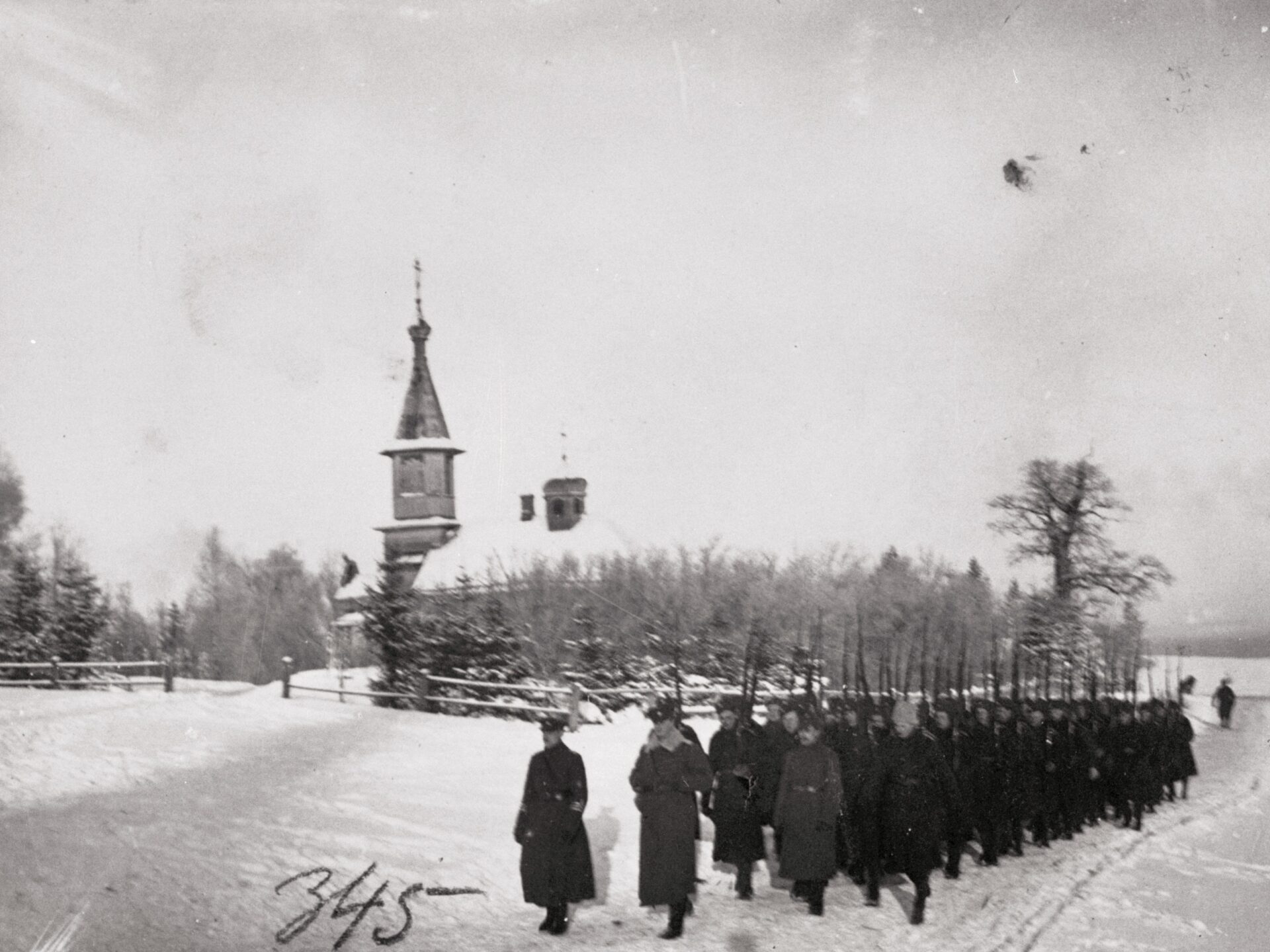
An Orthodox Convent in Estonia Is Caught Between Faith and National Security

At Pühtitsa Convent, near the border with Russia, Estonia’s effort to close channels of Moscow influence has collided with a community that measures time in bells, cows, harvests, and obedience.

Words: Francisco Martínez
Pictures: Puhtitsa Archive
Date:

Fewer Russian pilgrims now reach the Pühtitsa convent in Estonia’s eastern borderland. The border is about 20 kilometers (12.4 miles) to the east, but the full-scale invasion of Ukraine has made it difficult to cross. 

This Orthodox convent is arranged through a different kind of calendar: bells divide the day. Rye, wheat, and oats organize the year. After Easter comes planting and work in the greenhouse. Then the summer means harvesting hay, berries, and mushrooms, and gathering firewood. By November, the nuns’ hands are sewing, painting icons, embroidering and bookbinding.

“We follow another temporality,” novice Jekaterina tells me. It is August 2026. I am walking through the gardens of the Pühtitsa Dormition Convent with Jekaterina and Mother Ignatia, who has been a nun since 1989. Around us are green roofs, black cupolas, vegetable beds, fields, and coniferous trees. Everything seems immaculately arranged. I say so.

“Of course,” Ignatia replies. “It is a women’s convent.”

Later, a table waits for us: tea, pancakes, and delicious homemade food in abundance. I thank her and confess that I had not expected a feast.

“Why are you surprised?” she asks. “This is Russian hospitality.”

In this borderland, even hospitality has acquired geopolitical weight. Pühtitsa is Estonia’s only Orthodox nunnery. It is also directly subordinate to the Patriarch of Moscow and All Russia, the leader of the Russian Orthodox Church. Since Patriarch Kirill endorsed Russia’s war against Ukraine, the Estonian government has come to regard that canonical bond as a possible channel of hostile influence. The state wants the convent to cut its administrative connection to Moscow. The nuns say the connection is not an administrative cable that can simply be unplugged. It is part of the sacred order by which their lives remain whole.

In public discussions, the convent is identified with the “Russkiy mir.” Translating to “Russian World,” the term has a long history, but since the early 2000s has been politicized and associated with neo-imperialist policy. The concept advocates the defense of the Russian language and Orthodox identity, as well as the protection of the Russian people wherever they live. This became the dominant frame of Russia’s foreign policy, and contributed to the framing and justification for the full-scale invasion of Ukraine. The Estonian state seeks to prevent a religious tie from becoming an instrument of hostile, imperial power.

Mother Ignatia joined Pühtitsa as the Soviet Union was approaching its end. More than 170 nuns and novices lived here then. Today there are 93, many of them elderly. Jekaterina is among the relatively few younger women.

“Life in the convent is always the same. The organization of the day remains the same.”

Estonia, Orthodox
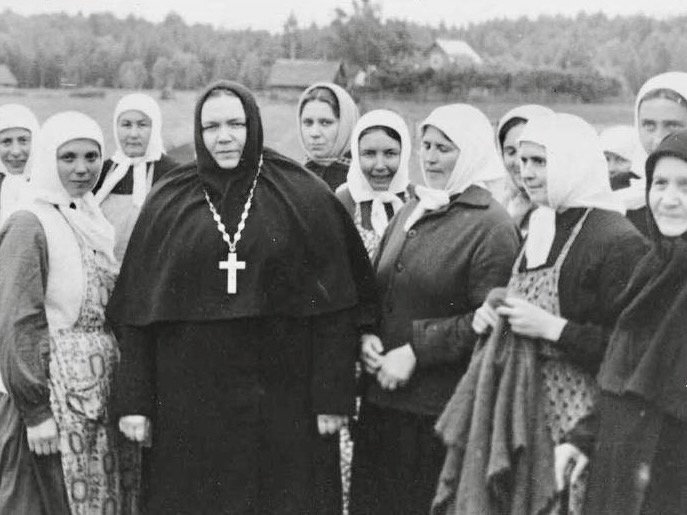
Field work rest, 1957-1960, Puhtitsa archive

“Is it difficult to become a nun?” I ask her. “How is the exam?”

“There is no exam,” she says. “You have to feel the call inside you; then learn from the elders and cultivate devotion daily.”

I ask Ignatia what is hardest about monastic life.

“The total submission of your will,” she replies. “Hierarchy is very important. There cannot be order without a hierarchy.”

There is still bread to bake, land to cultivate, and livestock to tend. Permanent workers help with plumbing, carpentry and metalwork. The convent grows food not only for itself but also for pilgrims, who are fed without charge.

What has changed since 1989? I ask Ignatia.

“Nothing.”

Nothing?

The Soviet Union disappeared. Estonia restored its independence and joined the European Union and NATO. Smartphones arrived. The nearby frontier hardened after Russia’s attack on Ukraine. Yet a sister still leaves the choir for the cowshed, dough still enters the ovens, and psalms are repeated at appointed hours.

Pühtitsa was founded in the 1890s, when Estonia was part of the Russian Empire. The new Estonian republic confiscated most of its land in 1919. During World War II, German troops occupied buildings on the grounds, and a military hospital operated inside the main cathedral. The nuns brought food, medicine, and clothes to Russian prisoners held nearby.

Then came Soviet atheism. Monasteries closed across the Soviet Union, but Pühtitsa survived. Its continued existence became part of its aura. Survival under an authoritarian regime is never a clean miracle. It leaves bargains, suspicions, and silences. The walls symbolize that other time, though they cannot stop history at the gate. Russia’s war against Ukraine has closed the nearby border and reduced the number of pilgrims. The community is smaller and older; the work remains.

Now the state that emerged from Soviet occupation fears that this old line of continuity leads back to Moscow. Estonia has learned that pressure from Russia rarely arrives only in tanks. It can travel through energy grids, media, business networks, historical myths, cyberattacks, and institutions that appear harmless until a crisis activates them. After the invasion of Ukraine, inherited connections were read as potential weapons.

Estonia, Orthodox
Mowing cloud berries, 1970s, Puhtitsa archive

The convent is Stavropegial: It answers to the Moscow patriarch. For the government, this is a foreign chain of command. In April 2025, Estonia’s parliament passed amendments intended to prevent religious organizations from remaining tied to foreign authorities that threaten the state. Abbess Philareta appealed to then Estonian President Alar Karis, warning that the legislation would force the convent to violate church law. The president refused to promulgate it. Parliament tried again. He refused again. The dispute reached the Supreme Court, as if judges had been asked to measure the distance between a prayer and an order.

In June 2026, the court allowed the law to stand but limited its reach. A religious affiliation could not be treated as dangerous merely because it existed. The threat had to be genuine and demonstrable. Dissolution would require judicial review after less restrictive measures had failed. Religious organizations received until Dec. 28 to remove administrative ties to foreign authorities deemed a real security threat. The government insisted that Orthodoxy itself was not under attack, but they had to choose between God or the Kremlin.

Secrecy usually suggests a hidden archive or a locked door. Pühtitsa offers a stranger form: a place visible from every side that remains difficult to read. Visitors may enter the grounds from six in the morning until nine at night. The domes can be photographed, the statutes examined, the pilgrims counted. Some of its services are even broadcast online. Everyone knows about the Moscow connection. Everyone knows Kirill has supported the war. Everyone knows Estonia has reason to fear Russian influence. Everyone knows the nuns reject being treated as instruments of that influence. The solution lies in the relation between all these facts.

I discovered the convent’s thresholds when I offered to spend a month helping in its gardens. The reply was warm but firm: The sisters needed no male volunteer, and overnight stays were reserved for Orthodox pilgrims. I tried again, proposing a shorter visit as a pilgrim. Was I Orthodox? What was my baptismal name? A Catholic, I was told, could find a monastery of his own in Pirita. A women’s contemplative community owes no male anthropologist entry. I had mistaken hospitality for access. But a convent is not a spiritual theme park arranged for observation. 

Abbess Philareta later explained that she had avoided meeting me while the legal case was active because an interview might be portrayed as an attempt to influence the court. Yet she wrote about tractors, plumbing, and knowing how to milk a cow. Monastic life, she said, is filled with “prayerful attention and bodily labor.” Work performed with gratitude can become prayer.

Near the end of our walk, I ask Ignatia and Jekaterina about language. Russian and Estonian are spoken here, but the language of worship is Church Slavonic.

How is it different from Russian?

“It’s not about the language,” Ignatia says. “It’s about the grammar — what opens inside you.”

That is the conflict at Pühtitsa. Estonia and the convent inhabit different grammars of continuity. The state seeks to preserve constitutional order, while the convent seeks to preserve a sacred order. Because both claims arrive in the language of survival, neither can hear the other’s proposed protection except as a threat. As a result, the continuity of one order may require the interruption of another.

I later ask Abbess Philareta a simple question: What is politics?

She reaches back 2,500 years to Aristotle and answers that human beings have changed less than we imagine. Love, hatred, compassion, curiosity, and mercy still move us. Politics concerns states and individual lives, peace and war, she writes. Those who hold power can alter lives for better or worse, and therefore bear an immense moral responsibility.

Every political order decides which uncertainties it can tolerate and which it must eliminate. Estonia fears the uncertainty inside Pühtitsa’s tie to Moscow. The convent fears the uncertainty unleashed by severing it. Each side is trying to prevent a different future. For the state, a foreign dependency is a danger before it is activated. For the nuns, hierarchy is what prevents their world from dissolving. 

35mm negatiivfilm
Field workers, 1957-1960, Puhtitsa archive

In my final email to the Abbess, I ask: Why would separating from Moscow necessarily break the convent’s spiritual continuity, given that it was previously under the jurisdiction of the Patriarch of Constantinople (between 1923 and 1940)? And she answered, “A Stavropegial convent cannot alter its own status; such a change can only be taken by the ecclesiastical authorities. Were we to initiate such a move ourselves, we would become the instigators of a schism—an act considered a most grave sin within the Orthodox tradition.”

In Kuremäe, however, preparedness demands the state to act upon a religious bond for security reasons. Taimar Peterkop, former State Secretary of Estonia, locates the threshold in evidence of hostile action: plotting justifies intervention; prayer, if genuinely directed toward peace, does not. “We need to handle it with care,” he concludes. A democracy’s security may depend on preserving precisely this interval in which an unsettling relationship has not yet become an offence. Restraint, in this sense, is not the failure of preparedness but its constitutional limit.

Modern states need to read what they govern. They identify borders, owners, affiliations, taxes, chains of responsibility. In wartime, ambiguity becomes suspicious. Yet democracies also depend on their ability to tolerate lives that do not translate perfectly into official language. Faith has obligations older than the Estonian republic. Security has deadlines that faith does not recognize.

“We will survive it all,” Mother Ignatia had told me, “as we already have historically.”

Outside the walls, officials speak of foreign command structures, constitutional order, and national security. Inside, the vocabulary is prayer, hierarchy, and salvation. Estonia wants to know whether spiritual obedience could one day carry a hostile tool.  The Pühtitsa Convent has now filed complaints with the European Court of Human Rights over a law requiring them to sever ties with Moscow. At Europe’s eastern edge, the question is whether a democracy can defend itself without forcing every ambiguity to confess — and whether a holy place can protect its spiritual continuity without treating politics as someone else’s problem.

Francisco Martínez

Francisco Martínez is a visiting fellow at the Remarque Institute, NYU researching the Baltic Sea as a laboratory of European technopolitics. He has written four monographs, most recently The Future of Hiding (Cornell University Press, 2025).

YOU MADE IT THIS FAR.

You’re exactly why Inkstick exists.

Independent reporting on war and power shouldn’t belong to billionaires or governments. It survives because readers like you decide it matters.

Help keep this reporting independent, free, and accessible to everyone.

Join the people paying attention

SIGN UP FOR OUR NEWSLETTERS