









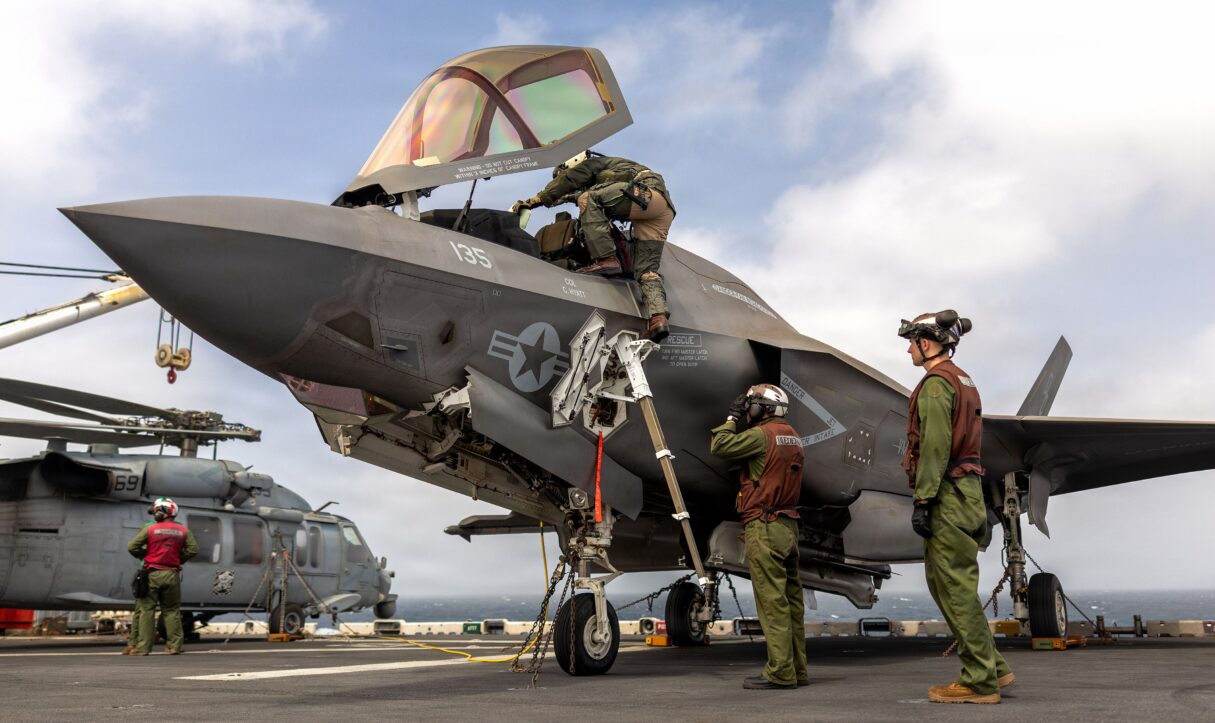
A new Government Accountability Office report, “F-35 Program: DOD Needs to Strengthen Oversight of Tens of Billions of Dollars in Parts,” has found that the Pentagon cannot say where all the parts of the F-35 supply chain — roughly 26 million engines, tires, bolts, and screws — are.
Auditors led by Asif A. Khan, the agency’s director of financial management and assurance, have found that the Defense Department had made “minimal progress in attaining and maintaining accountability for F-35 parts” despite years of warnings. The parts pool is worth an estimated $31 billion as of March, and program officials said the real figure is likely higher because some parts have been excluded or are missing from the count. The aircraft itself is projected to cost more than $1.9 trillion over a life cycle running through 2088.
The F-35 Joint Program Office, which manages the jet for the Air Force, Navy, Marine Corps, seven partner nations, and a dozen foreign buyers, does not keep its own complete inventory. It relies instead on data supplied by its two prime contractors, Lockheed Martin and Pratt & Whitney, and its official property system does not connect to theirs. Data on the shared spares pool arrives quarterly, so the government’s picture could be more than three months stale.
What does arrive is often thin. Only 29% of the records in a December 2025 contractor submission carried serial numbers, and almost 6% listed an acquisition cost of one cent or less. About 17,000 parts in maintenance or repair, worth at least $1.3 billion and perhaps as much as $2.5 billion, had not been entered into the system at all. Officials said they are testing a live link with one contractor’s system, though the auditors note that bad data could persist because the contractors will almost certainly still supply it.
Physical counts have done little to close the gap. The program office has spent at least $17 million since fiscal year 2020 on inventories, yet the most recent one leans on data from a prime contractor whose property management system the Defense Contract Management Agency has rated as disapproved. Neither the government nor its primes can see past the subcontractor level, and the report states flatly that “the locations of some F-35 parts are unknown.”
Parts in transit with commercial shippers could fall outside every tracking system. Officials promised a full wall-to-wall count, then told auditors it is not feasible because they cannot halt production or visit every site. The department’s comptroller has since asked the Defense Contract Audit Agency to build an auditable baseline, with a first full inventory targeted for March 2027.
Losses are murkier still. In 2023, the GAO reported that one prime contractor had lost more than 1 million parts valued at over $85 million between 2018 and 2022. Three years later, the program office could not say what became of them, because it kept no record of outstanding losses. A one-time bulk reporting process produced about $28 million in contractor-submitted losses dating back to 2012, and the contract agency had so far found the company liable for roughly $6 million. Nobody could tell auditors whether that $28 million overlapped with the earlier $85 million. At government-run sites, the office began tracking losses only in September 2025, using an ad hoc spreadsheet. Of 57 cases logged by April, 24 had been reported more than a year after discovery, against a 30-day requirement. Without monitoring, the auditors warn, the office weakens its ability to detect “fraud, waste, or theft.”
The auditors offer four recommendations, centered on monitoring losses and giving the program’s accountable property officers real procedures, training, and structure. Officials have been unable to agree on the basics. Some want a central team of about 40 full-time officers, while the program office favored roughly 12 who would handle the job as a side duty. One person tapped in December 2025 to oversee loss reporting had still not been formally appointed by June. The Defense Department concurred with all four. Of 34 earlier recommendations from the GAO and the Pentagon’s inspector general, 26 remained open.
The stakes go well beyond bookkeeping. The Pentagon has never passed a full financial audit, receiving a disclaimer of opinion in each of the eight years it has tried, and the F-35 weakness is one reason. Congress has ordered a clean opinion by the end of 2028. The department is also preparing to spend about $13.7 billion more to restock F-35 parts, and the GAO cautions that it might not be able to identify what it needs or account for what it has bought.