











Halima Salman was a Brooklyn-born Girl Scout who liked sewing and other DIY crafts. When she was 17 years old, Halima thought her father was taking them on a normal family vacation to Turkey — until they crossed the Syrian border into territory controlled by the Islamic State (ISIS). Just after her 18th birthday, her father married her to an Afghan-German ISIS fighter. In 2024, when her repatriation flight finally touched down at New York’s JFK airport, she was arrested and charged with training with ISIS.
Halima was the first American woman to go on trial over her involvement with ISIS in Syria. Her trial began on Oct. 13, at the US federal courthouse in Brooklyn.
Most days in court, Halima, now 27 years old, wore pastel colors, a palette of sky blue, mint green, and blush pink. She has soft features, and large, round glasses covered most of her face. For much of the trial, her mother sat in the front row, the bench closest to her daughter. Sometimes, other relatives would attend, bringing bags of take-out for the family’s lunch.
Halima’s face betrayed little as the lawyers traded impassioned arguments. “The evidence shows that the defendant received military training from a violent, brutal, terrorist organization — an organization that is responsible for attacks across the world,” Assistant US Attorney Amanda Shami told the jury.
In ISIS-related prosecutions, hard proof is often difficult to come by. Halima’s case rested largely on documents and photos recovered from her husband’s phone: an apparent ISIS-issued document that confirms her training, a seconds-long video of her holding an AK-47 in her home, and a selfie Halima took in front of an ISIS flag. Halima’s legal team argued that the document was fake — lacking a stamp found on other official ISIS documents — and pointed to the absence of witnesses who actually saw Halima training.
“For the last 10 years, Halima Salman has been through hell and back,” Halima’s attorney, Mia Eisner-Grynberg, said. “We don’t want to make the horrible mistake of convicting an innocent person.”
The case the prosecution painted against Halima “raises profound concerns,” Letta Tayler, a former associate director at Human Rights Watch (HRW), said in an interview. “Among many issues, the prosecution appears to have ignored the well-documented fact that thousands of foreign girls were taken to Syria by their parents and forced to marry ISIS members.”
On Oct. 19, Halima testified before the jury. Her attorney, Eisner-Grynberg, emphasized that she wanted the chance to tell her story.
Halima described, at first, what appeared like an average childhood. She grew up in Brooklyn’s Prospect Park borough, the second-oldest of nine children. Her family often spent time together; they’d have barbecues in the park and take trips to the zoo and museums.
Her father, however, had “two sides,” she said. On one hand, he was a funny, gift-giving story teller, but on the other, he was short-tempered, stubborn, and aggressive, sometimes getting physical with her siblings. “His mood was the house’s mood,” Halima said — and she and her siblings were raised to not question his choices. So, where he wanted to go, they went too.
When she was eight or nine years old, they moved to Egypt, and in the years that followed, they moved back and forth between Egypt and the US. They would also often travel to Turkey to visit Halima’s relatives on her father’s side.
That’s why, in her telling, she thought she was on another, average trip when she arrived in Turkey in 2016. Expecting to stay a few days with a relative, she brought along just her backpack with a few pairs of clothes. The large family climbed into a van, as normal, and Halima dozed off.
She woke to a clamor outside the van, she testified. A group of armed men, their faces masked, shouted in Arabic, as they rushed them into a building the vehicle had parked in front of. They entered a madafa, a type of guesthouse where women and children were held on arrival to ISIS territory. She had to hand over her belongings, including the blue hijab she’d been wearing. Instead, she was given a black niqab, a face veil with only a narrow slit for the eyes, which she was told she had to wear to abide by ISIS’s dress code.
ISIS lured in tens of thousands of foreigners; some 53,000 people arrived in ISIS territory in Iraq and Syria from at least 80 countries across North America, Europe, Africa, and Asia. The hundreds of Americans who traveled there pale in comparison to the thousands who came from countries like Tunisia and Saudi Arabia, or the more than 1,000 from France. “The Islamic State — out of all the international terrorist organizations — has been able to mobilize the largest number of internationals, including women and minors, in history,” said Joana Cook, a researcher with the International Center for Counter-Terrorism in the Netherlands.
Women and minors made up large portions of those who came to join ISIS — the recruitment of families was central to the group’s state-building ambitions, according to a 2024 book chapter on foreign women in ISIS, which Cook co-authored. The group often circulated propaganda portraying an idyllic family life, with happy children and families at play. As a result, not everyone who ended up in ISIS territory went there to fight.
Many children were also forcibly taken by their parents. And because of the length ISIS held territory, from 2014 to 2019, many who arrived young spent much of their childhoods, or came of age, under its rule. “You have to understand the development of these individuals along that trajectory,” Cook said. In cases like Halima’s, she continued, “this has to be accounted for.”
In July 2017, Halima was married off to a German-Afghan ISIS fighter. “‘I’m going to bring somebody over, and we are going to sit with him, and that will be the person you eventually marry,’” Halima remembered her father telling her. His name was Abu Ali. No one asked her what she thought of him. Days later, her father took her to a garage-like building, where there were some strangers and a man sitting at a small desk. She was told to press her fingerprint onto a document certifying the marriage, for a $5,000 payment that was “payable when able.”
They had a small ceremony, but Halima said that day, she was scared. “I had a very bad feeling about it. I was wondering to myself if this was supposed to happen to me,” she recalled. She moved in with Abu Ali and his mother. He only spoke broken English and his mother spoke none. “‘Get up, stupid wife, it’s time for you to be a wife,’” she recalled he’d tell her.
She would wake up early to knead dough and do laundry. Breakfast and dinner had to be ready before anyone asked, and the house had to be spotless. “It was like I didn’t have a break from their commands,” she said. She wasn’t healthy, she remembered; sometimes she’d stand up, get dizzy, and pass out. Clumps of her hair fell out.
She said she’d try to make the situation better by making their favorite food, or wearing nice clothes, but her efforts rarely worked. “I would dress up, make myself pretty,” she said, “but I was always body shamed.” Living with them degraded Halima. “It made me feel like I’m worthless,” she said.
Halima testified that she couldn’t run away: Leaving was difficult, they were trapped under bombings, and she was unfamiliar with the area. ISIS required women to have a male guardian any time they left the home, so Halima spent most of her days inside. Her cell phone also didn’t have service, and she couldn’t communicate with her family. And ISIS warned them about fleeing. “Once you’re there, basically [if] you try to leave, it is death,” Halima said.
Some people managed to flee ISIS territory, but escape was hard, especially for women, Cook said. “There were a host of burdens and limitations that would make it more difficult for women to leave,” Cook said, noting, for instance, that women wouldn’t have been able to drive, or pass through a checkpoint alone. Between 2013 and 2019, foreign women were less likely to voluntarily return to their home countries. Notably, some did choose to stay until the end due to their staunch commitment to the group, but many others faced immense barriers to leave.
Prosecutors argued that Halima “followed and stayed with ISIS fighters.” “You know who stayed? The fighters,” Assistant US Attorney Adam Amir said in his closing rebuttal.
By mid-2017, after more than a year of territorial losses, ISIS began calling on women to join the fight. An editorial was published in ISIS’s newspaper, Al-Naba, stating that women were “obliged to engage in jihad on behalf of the caliphate.” Still, Cook noted, even as its defeat neared, women were rarely seen fighting on the front lines. They instead largely took part in suicide bombings or operated independently in certain units.
Halima is accused of training with Khatiba Nusaybah, an all-female battalion headed by Allison Fluke-Ekren, an American schoolteacher from Kansas. According to the US Justice Department, Fluke-Ekren trained women to fire assault rifles and use grenades and suicide belts, and trained more than 100 women and girls, some as young as 10. The “Wali,” ISIS’s governor of Raqqa, approved the battalion in late 2016, and it began operating around February 2017.
In 2022, Fluke-Ekren was sentenced to 20 years in prison. Several witnesses who knew Fluke-Ekren in Syria testified to her activities there, whereas none were brought in to testify to Halima’s. Cook noted that the collapse of Al Hol Camp, a detention facility for ISIS families in Syria where Halima was held, may have made it harder to gather witnesses. Identifying women associated with ISIS is also difficult, she added, since their faces were covered and, unlike adult men’s, rarely publicized in ISIS propaganda videos.
The evidence on Halima’s husband’s phone was all from March 2018, when the couple was living in Hajin, in Syria’s Deir ez-Zor province. The weapons authorization document, dated March 17, confirms Halima’s completion of a “training and military test,” ending with “Nusaybah bint Ka’ab,” assumingly associated with the Khatiba Nusaybah battalion. Days later, on March 21, a selfie from Halima in front of an ISIS flag appears on his phone, and on March 31, a video of her walking with and pointing the AK-47 in her home. Halima also testified to sending her husband a song, “Tora Bora,” about Osama Bin Laden.
She said that she had heard of the female Khatiba Nusaybah battalion, but denied training with it. In the video, she said, her husband asked her to perform certain actions and she complied, but she put the gun down once she realized he was filming because she felt uncomfortable. Prosecutors argued she was trying to hide it. As for the selfie, she said she didn’t hang the ISIS flag and often sent Abu Ali selfies to “please him” and lighten the day.
“Even if Halima Salman had voluntarily joined ISIS and had voluntarily posed in front of an ISIS flag and voluntarily held a weapon, she was brought into this sick and deadly cult as a child,” HRW’s Letta Taylor said. “International guidance calls for children associated with armed groups to be treated as victims first and foremost.”
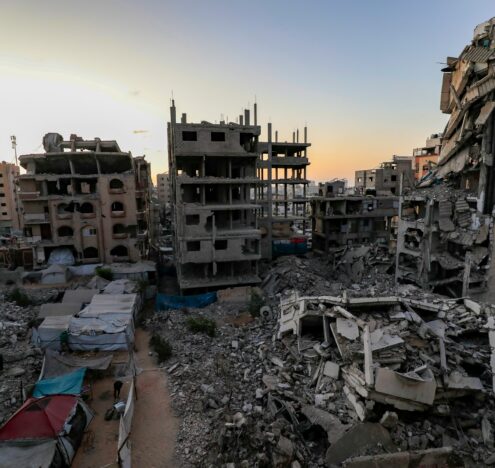
In the following year, Halima and her husband fled the bombardments until they were squeezed into the southern tip of Deir ez-Zor, in Baghouz. “Everything was bombed down to bits,” Halima said. “Dead bodies were everywhere.” In ISIS’s final days, she surrendered, and testified that she told Abu Ali then that they would divorce.
Prosecutors noted that on the day she surrendered, she still gave her husband’s surname, Nurzad, and his German birthplace as her own. Federal prosecutor Adam Amir said Halima lied and hid her nationality that day. If she were innocent, he said, she would have “run toward them,” and told the soldiers she was an American in need of help. “She did not want to return home,” he argued.
Halima spent the next five years in the detention camps Al Hol and Al Roj. During that time, HRW’s Tayler interviewed her brother, who was being held in a separate center for youth. He was worried about his mother and siblings and seemed deeply traumatized by his years under ISIS, she said. She confirmed his account of events was similar to Halima’s. To this day, Al Roj still holds over 2,000 people, largely foreigners. Hundreds there have been stripped of their citizenship, left to languish in indefinite detention. No one has had their day in court.
Upon Halima’s arrival in the US in 2024, FBI agent John Mauer interviewed her and told her she would be “free as a bird,” Halima testified. According to Mauer’s testimony, Halima claimed at first not to recognize the ISIS-issued weapons document and described her husband as “nice.” Halima said she was excited to go home. Prosecutors said her statements were contradictory and called her credibility into question.
After three days of deliberation, on Oct. 27, the jury convicted Halima of knowingly receiving military-type training from a foreign terrorist organization. Upon the jury’s announcement, Courthouse News reported that she wept alongside her defense team, and her mother fell to her knees sobbing. She faces up to 10 years in prison in the US, on top of the years she already spent in the Syrian detention camps.
Halima’s lawyers are asking the judge to throw out the verdict and acquit her, which federal law allows when the evidence at trial doesn’t legally support a conviction, AP News reported.
Such motions are common but rarely granted. For now, US attorney Joseph Nocella Jr. has applauded the conviction, insisting his office “will continue to prosecute those who supported [ISIS’s] murderous reign.”