









On a rainy day in Dallas this May, Sabah Mooswi was driving on the highway when someone shot a bullet through her windshield. It was the time of day when Mooswi, a mother, a community organizer, and a Muslim, typically drove her son. She didn’t pick him up that day, so he wasn’t in the car seat when the bullet pierced the glass and bore into the leather seat where the child usually sits. Police haven’t found the shooter and told her they didn’t believe her faith, activism, or the fact that she wears a hijab motivated the incident. For her part, she maintained that it was a “targeted shooting” when she later spoke to the press.
“That’s one of the reasons that makes it so hard for other Muslims to come to the forefront, is the fear of what kind of retribution they will receive,” says Shehla Faizi, a Muslim American running for Texas State Comptroller. “If nothing else, I can say for sure that I would presumably have a target on my back. And even with that, you have to keep pushing forward.”
From standing-room-only city council meetings debating the supposed “Islamization of Texas” to campaign ads warning of “Muslim mass immigration,” Islamophobia has become a fixture in Texas politics. Texas Republicans have claimed the state is at risk of an “Islamic takeover” and that Muslims are seeking to impose Sharia law, the moral and religious code drawn from the Qur’an. During a recent city council meeting in McKinney, for instance, US Representative Keith Self went as far as to describe plans for a new mosque as the manifestation of “political Islam.” Self has also introduced legislation in Congress to ban the implementation of the jizya, a religious tax on non-Muslims that no one has attempted to introduce in Texas or the rest of the country. At the same time, state Republicans have championed similar bills in the state legislature.
Meanwhile, data shows that anti-Muslim hate is increasing online at the same time that discrimination and hate crimes are on the rise in the US and abroad. In 2025, the Council on American Islamic Relations received complaints of more than 8,600 Islamophobic incidents. That tally includes violence, workplace harassment, and hate speech — and it marks the highest the advocacy group has ever recorded in nearly three decades. The many Muslim Americans interviewed for this story worry about both the violence and the mental toll the hatred takes on their community as a contentious primary election draws closer.
“It’s very disheartening and scary,” says Naila Syed, who lives in Dallas. “I have my two kids at public school, and then I have one son who goes to a private school at our mosque. It’s very scary to drop him off there every day when I know that there have been protestors showing up there, as well.”
What’s more, as anti-Muslim xenophobia creeps closer into everyday life, Texans worry that violence like the Mooswi shooting, the stabbing of an Austin man, or the attempted drowning of a three-year-old still isn’t being taken seriously enough by people in power. In fact, many argue there is a clear, underdiscussed link between a rise in public hate and Israel’s war in Gaza that many human rights organizations call a genocide.
“All forms of repression, all the hate crimes and the brutalization, these are not separate incidents, but rather they are connected,” says Sarah Khalid, an organizer for Students for Justice in Palestine at the University of Texas at Dallas. “And the justification for these incidents are manufactured by the same system: the US empire.”
Emad Salem, a board member and former president of the Muslim Democratic Caucus in Texas, vividly remembers the spike in hate crimes that happened after the terrorist attacks of Sept. 11, 2001. What we’re seeing now, he says, is much worse. “The Republicans are trying to tell you there is a boogeyman,” he says. “There is no boogeyman.”
That spike in hate crimes — an increase of over 1,600%, by one measure — was deeply felt in Texas. Near Dallas, Mark Stroman, a self-described Aryan Brotherhood member, went on a shooting spree in the weeks after 9/11. He killed two people and partially blinded Rais Bhuiyan, a 28-year-old and former pilot in the Bangladeshi air force.
“We’re at war,” Stroman told police when he was finally arrested. He later added that he was simply doing “what every American wanted to do” by attacking people he believed to be Muslim. (One of his victims was Hindu.)
After Stroman was sentenced to death, Bhuiyan spent years advocating for the man who shot him in the face. He didn’t want to see him die by lethal injection. When he learned all legal options were exhausted, he cried. Stroman was put to death in 2011.
Earlier that same year, Leo Berman, a Republican lawmaker in the Texas House of Representatives, introduced House Bill 911. His intent was to make it illegal for courts to consider “foreign law” when making decisions related to the Texas Family Code of laws. When discussing his bill with colleagues in the state house, Berman warned of the incoming influence of Sharia law.
“It’s starting in Europe because of a large population of Middle Easterners,” he said, “and it could spread through the United States.”
Four years later, Jeff Leach, a Republican lawmaker from Collin County, north of Dallas, filed a bill that The Dallas Morning News called “nearly identical” to the law Berman tried to pass.
“You will find there is starting to be an encroachment and a movement to chip away at the ability of judges to say no to certain foreign laws,” Leach said at a rally around the same time.
Berman and Leach’s bills failed to become law, but in Salem’s eyes, Texas Governor Greg Abbott picked up the mantle of Islamophobia when he entered office in 2015. Late last year, the governor issued a proclamation that dubbed the Council on American-Islamic Relations, a civil rights and advocacy group, a terrorist organization. At the same time, Attorney General and Senate hopeful Ken Paxton — whose campaign has aired the ads stoking fears of “Muslim mass migration” — has repeatedly filed suit against what was initially called EPIC City, a master-planned community in North Texas conceived by the East Plano Islamic Center. The community is now called The Meadow.
Journalist Rozina Ali recently authored Seasons of Fury, a book tracing the roots of Islamophobia in the US, including how anti-Muslim paranoia winds its way into policy. She notes that law enforcement has a long history of survelling Muslim communities, “not because they had a particular tip or anything, but because they believed that terrorist threats would arise from Muslim communities.”
“This conflation of terrorism coming from Islam or from Muslim spaces really contributed to this really flawed phrase, which I’m sure you’ve heard, that people love to repeat, including policymakers even today, that, ‘not all Muslims are terrorists, but all terrorists are Muslims,’” she says. “And this was a phrase that I was hearing back in 2009, 2010, and it’s 2026 and it continues to be peddled over and over again.”
At this summer’s Texas GOP convention, “Don’t Sharia Our Texas” was established as one of the party’s legislative priorities ahead of lawmakers’ next session. Several Muslims in attendance, all of whom are GOP voters, were called terrorists or told to convert to Christianity or leave the country. It remains unclear what precisely it means to curb Sharia law’s influence in Texas, but recent city council meetings across the state have drawn droves of Texans opposing plans for local mosques.
While these calls are only coming from one of the state’s two main political parties, several people interviewed for this story say neither Republicans or Democrats are doing enough to curb the rise of hatred in and out of politics.
Faizi, the Texas Comptroller candidate, is running as a member of the Green Party. So is Anissa Chilmeran, a Dallas-area resident running for the state’s House of Representatives. Neither candidate feels represented in the current state government, and they’re hoping their campaigns will, at the very least, draw attention to key issues. Chilmeran hopes her candidacy can help result in “centrist or corporate Democrats” holding true progressive positions.
“If the Democrats are going to survive, I think that they’re going to have to really reckon with where they stand with Israel and AIPAC, because the voters have shown where they stand,” Chilmeran says, referring to the influential lobbying group the American Israel Public Affairs Committee.
The atrocities in Gaza, in Chilmeran’s estimation, have “lifted the curtain on a massive scale for a lot of people.” She adds, “It’s a very good example of a major issue that changes things monumentally in American politics. I think the last time we saw something like this was the anti-war movement in the ’70s, with Vietnam.”
In spring 2024, students at the University of Texas at Austin and the University of Texas at Dallas (UTD) staged mass protests against their institutions’ complicity in the war in Gaza. The University of Texas system holds millions in stocks in defense contractors like Lockheed Martin and Northrop Grumman, both of which supply military equipment to Israel.
The fallout from the Dallas protests was especially brutal. Nine students and some faculty members were arrested; many were banned from campus and barred from attending their own graduation ceremonies. The following year, students staged a walkout during a graduation speech by the university’s president. Once outside, a student blew a bugle and was then tackled and placed in a chokehold by a campus police officer.
That incident — as well as the campus bans — are now at the center of a lawsuit filed by some of the protestors and the university’s chapter of Students for Justice in Palestine, which the university suspended earlier this year for its involvement in the protests.
“Even one student being placed in a chokehold, it just sets the precedent for further brutalization of students,” says Khalid, the student organizer. “UTD is willing to place their student in a chokehold to where their student is now placed in a life or death situation just for the sake of protecting their profit of blood money.”
UTD did not respond to a request for comment.
What she believes is clear “brutalization” and the precedent it sets is what ultimately worries Khalid the most. Just as the protests she was a part of were much bigger than a single campus or state, she sees the Islamophobia happening throughout Texas as inextricably linked to disdain, dismissal or outright contempt for people talking about Palestine.
In other words, to Khalid, Islamophobia is far from just a Texas problem. It’s perpetrated by the “US empire,” which, in her view, includes the government and universities. “The universities, when brutalizing their students, when arresting their students, they’re doing so in collaboration with the state,” she points out.
Elsewhere, Texas lawmakers continue proposing laws referencing tenets of Islam. A failed bill from state Representative Carl Tepper would have required high school students to take a course on “modern conflicts,” including instruction on the “concept of Sharia law” alongside the Taliban, Osama bin Laden, and ISIS. Another bill, coauthored by Jeff Leach, became law, creating new regulations for residential developments that are owned or operated through companies. The bill didn’t mention Sharia, but when Abbott signed it into law, he celebrated the move as a ban on “Sharia compounds.”
Like Khalid, Faizi, the comptroller candidate, argues that the crisis of Islamophobia is much bigger than a single state. To her, it’s clear that anti-Muslim hatred is one way everyday people are losing more power and opportunity. “One of the biggest things that even convinced me to run is that we are going in a direction that only brings in more power to the oligarchy and less power to the people,” she says. “And that always ends badly.”
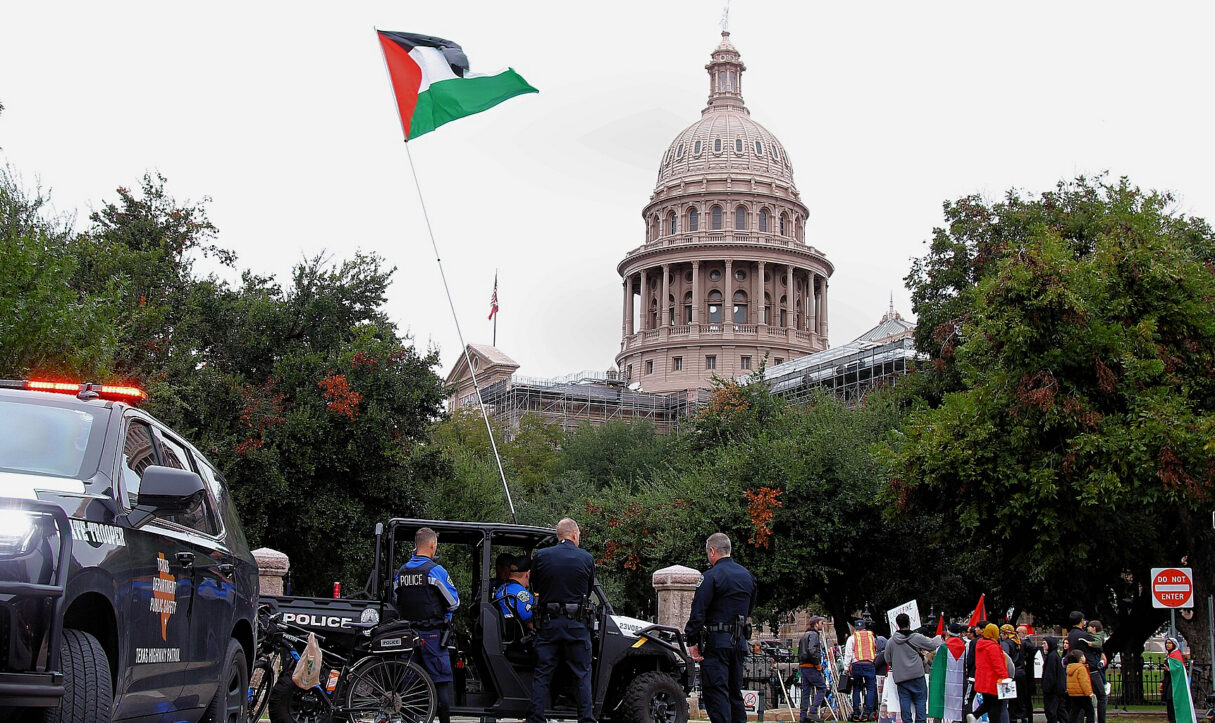
Top photo: In November 2023, pro-Palestine demonstrators rally outside the Texas State Capitol in Austin (Larry D. Moore, CC BY 4.0/Wikimedia Commons)