










“This administration started in blood and it’s ending in blood,” Samia El Khalfaoui says when asked to compare the current political moment with what’s unexpectedly become her life’s mission — ending police violence in France.
El Khalfaoui, 46, speaks with the wrought-iron precision of someone whose reality was frozen in time by an unplanned trauma, and who keeps coming back to that moment, picking it apart and reliving it. For El Khalfaoui, that turning point came on Aug. 4, 2021, when her nephew Souheil was killed by French police in Marseille, ostensibly for refusing to stop for a traffic control.
Five years after Souheil’s death, El Khalfaoui’s trauma has become a national one.
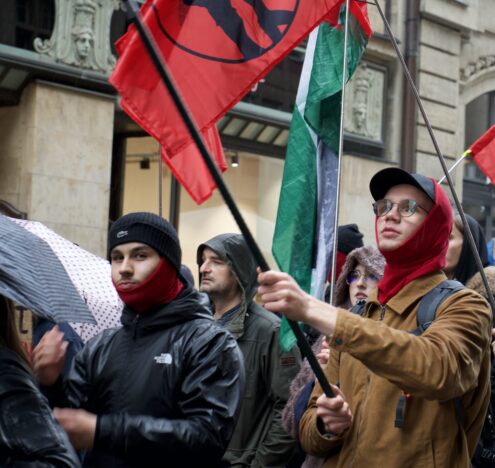
Since late September, French students have taken to the streets to demand better learning conditions. The movement, sparked by high schoolers in Paris’s working class suburbs, first spread around the Paris region and then nationwide. High schoolers organized blockades and protests, and were eventually joined by teachers, parents and university students.
Students were met with a heavily militarized response, with riot police known as CRS sent in to school blockades and protest sites. In just over one week, an estimated 6,500 students were arrested and around 215 were injured, some seriously, according to officials. In Lens, a 15-year-old’s hand had to be amputated after the teen came into contact with a stun grenade, which exploded. Near Paris, another teenager was struck in the face by a Cougar grenade launcher, losing teeth and suffering extensive injuries to his jaw. In Tours, a 16-year-old lost sight in one eye in injuries that forensics suggest were “consistent with” a rubber bullet projectile.
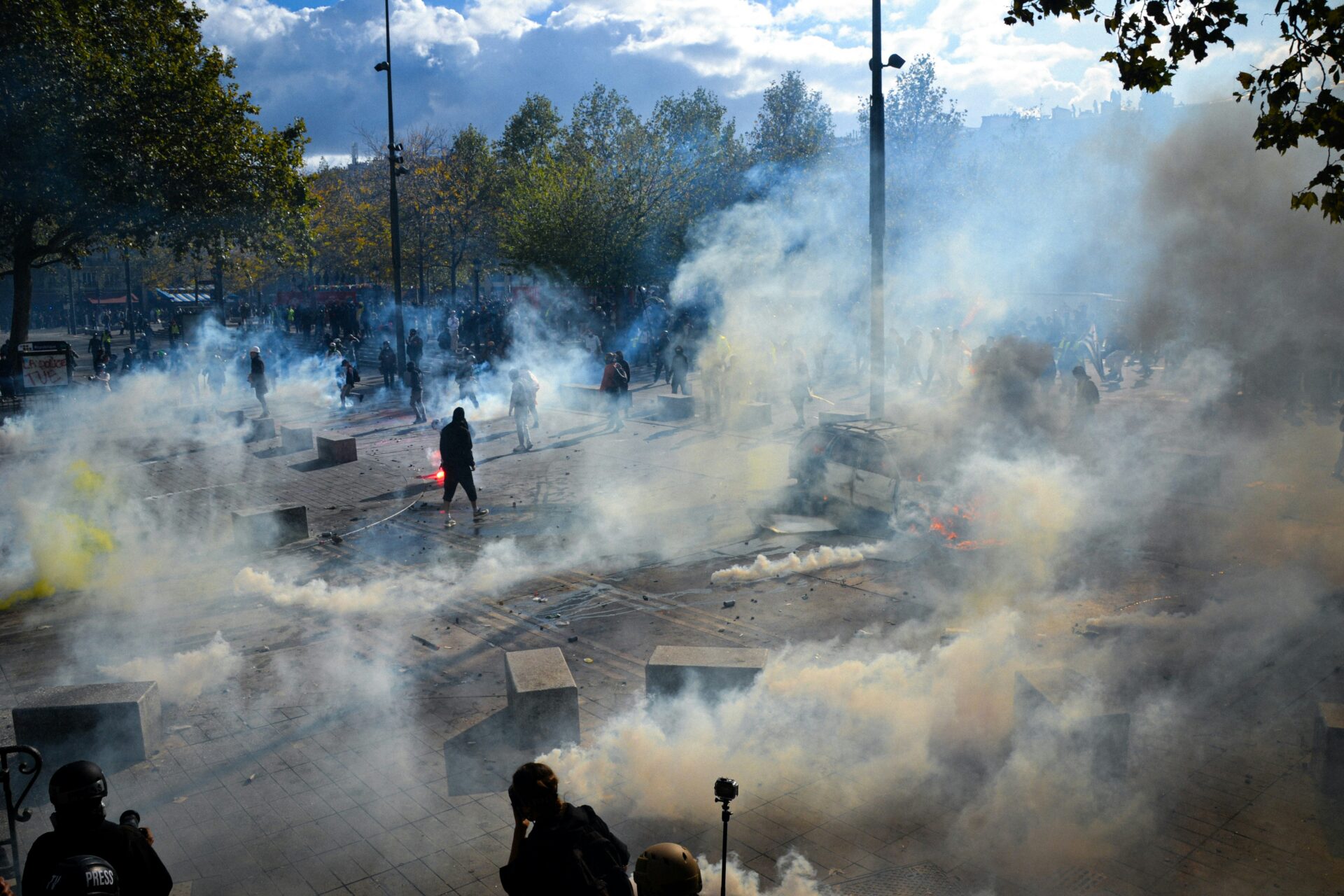
The movement drew in other parts of civil society, including health care workers, unions and people angered by rising costs. On Oct. 17, an estimated 550,000 to 800,000 people marched across France. Though largely peaceful, the protests also saw looters and rioters vandalize shops, burn cars and attack police with fireworks and bottles. Officers responded with tear gas and other projectiles.
Interior Minister Laurent Nuñez admitted later that law enforcement had been unprepared for the scale of the violence, saying 1,000 police officers were injured in clashes.
But to El Khalfaoui and other anti-police-violence advocates, the response to student protests has exposed the French police’s tendency to use brutal, sometimes deadly, force. “The government is only holding on today because it has the armed wing of the police, and whether it’s young people or not, they’re considered enemies from within,” she says. “Policing in France isn’t designed to de-escalate any situation. It’s just made to cause fear.”
Experts echo some of El Khalfaoui’s worries.
French police regularly “kettle” large demonstrations, a strategy of containing protesters that is supposed to be used only as a last resort, and deploy “less-lethal weapons” like rubber bullets, tear gas and stun grenades that can still cause serious injury or death. In Paris and Marseille suburbs, racial profiling is common: one investigation found that young men of color were 20 times more likely than the average French person to be stopped and frisked. During the first two months of the 2018 Yellow Vests protests, one activist group estimated that nearly 100 people had been badly injured by police, with 17 losing eyes to rubber bullets and other projectiles and four people having their hands blown off by stun grenades.
Experts are most concerned, however, by the tendency to use deadly force, which is embedded in French policing laws and codes of conduct. France has the highest number of people killed or injured by gunfire by law enforcement officers in Europe, according to the UN Human Rights Committee. In 2025, police interventions led to the deaths of 49 people, or one roughly every seven days.
Against this backdrop, a bill described by critics, including Amnesty International, as giving police officers a “license to kill” passed the French Assembly over the summer in its first major step toward becoming law.
If passed by the Senate and validated by the Constitutional Council, the draft bill would establish a presumption of legitimate self-defense for law enforcement officers who use force in the course of their duties. Supporters say the bill would give officers greater legal protections when acting lawfully. “The Republic has chosen to protect those who protect it,” said Eric Pauget, an assemblyman from the right-wing Les Républicains party.
Human rights groups see the bill and the violent repression of the current protests as part of the same continuum. “The bill is a sign of a shift towards authoritarian practices. It is another warning sign in France, in a context that is extremely worrying,” Anne Savinel-Barras, president of Amnesty International France, tells Inkstick. “We can see that France is very susceptible to the spread of authoritarian practices that are developing around the world.”
Samia El Khalfaoui was in Paris when she got the call from her mother that would change her life. Through her sobs, El Khalfaoui made out the words: “The police killed Souheil.” Her mother explained that Samia’s nephew, 19-year-old Souheil, had died that night in the hospital from a gunshot wound to the chest. “I didn’t cry, I didn’t understand what I was being told,” she remembers today. The next morning, she took the first train to Marseille.
Souheil, whom family and friends knew as gentle and kind, was father to 1-year-old Zach. “He could be somewhat of a fighter, but he was otherwise a gentle guy, a baba cool who occasionally smoked marijuana and was protective of his friends,” El Khalfaoui says. On that sweltering summer evening, Souheil had driven to the Belle-de-Mai neighborhood in Marseille’s working-class third district to meet a friend. Outside the apartment building, police pulled up and searched the vehicles, including his.
As El Khalfaoui tells it, Souheil calmly followed orders. But when he overheard police saying to one another that they were going to have to call a tow truck, he panicked. Souheil put the car into reverse and tried to peel out of the parking lot. Authorities say that Souheil reversed into one of the police officers on the scene, injuring his leg. That’s when another officer shot him in the chest. Souheil was rushed to the hospital, but it was too late. He died several hours later.
From the moment El Khalfaoui arrived in Marseille, it was clear to her that ensuring justice for her nephew would be difficult. The previous night, Bruno Bartocetti, a police union spokesperson, had gone on national television to present law enforcement’s side of the story: Souheil, the union rep said, “was determined to start a fight with the National Police,” after having been stopped for a control the night before. The police officer, Bartocetti added, had acted, “without any doubt,” in legitimate defense.
The judicial investigation, El Khalfaoui says, followed as a Kafkaesque series of procedural errors, with the burden of proof falling on the family rather than investigators. An initial investigation by France’s police watchdog, the IGPN, found that the officer had acted in self-defense, and the case was dismissed. Gathering additional witness testimony, and switching lawyers, the family was able to reopen the case in 2022. But the drama didn’t end there. El Khalfaoui said that the next judge who heard the case, a former nuclear submarine officer, told her that as a member of a “corporation,” he struggled to imagine a police officer killing someone without just cause, but that he would “nevertheless investigate.” He then proceeded to reject the majority of the family’s requests for further evidence probes, she says.
The officer who shot Souheil wasn’t formally questioned until August 2024, three years after the shooting, and only then as an “assisted witness” — someone suspected of involvement but not facing sufficient evidence to be charged. In June 2025, a new judge who had taken over the case when the original judge was reassigned found that nine evidence seals were missing, including CCTV footage, call recordings, video depositions of the police officer who had fired and the bullet. After the family appealed to national authorities, who pressured the Marseille court to find the evidence, the seals turned up – per El Khalfaoui’s telling – “behind a printer” in the office of the original examining magistrate.
Five years after the shooting, the El Khalfaoui family has no answers.
“Already with today’s laws it’s extremely hard to get justice,” Savinel-Barras, at Amnesty International, says. “So imagine if tomorrow, on top of that, there’s no systematic investigation as soon as a shot has been fired.”
Cases like Souheil’s have become increasingly common across France. The most prominent was the killing of 17-year-old Nahel Merzouk, who was shot during a traffic stop in the Paris suburb of Nanterre on June 27, 2023. His death sparked protests and riots nationwide.
Experts and advocates point to one article (435-1) of a broader 2017 security bill known as the Loi Cazeneuve, after the prime minister in office when it passed. The article authorized police to use force in four circumstances, including when a motorist flees a traffic stop and “is likely, while fleeing, to endanger their own lives or physical integrity or those of others.” In the first year after its passage, the number of people killed by police after refusing to comply with a traffic stop has increased fivefold, according to research by French experts Sebastian Roché, Paul le Derff and Simon Varaine.
For Thomas Portes, a Seine-Saint-Denis deputy from the left-wing La France Insoumise party who sits on the Assembly’s Law Commission, the 2017 law and the current draft bill represent the culmination of “20 years of legislative processes aimed at giving power to the police.” Successive French governments, he says, have passed “ever more security-minded laws, granting exorbitant powers to the police and turning law and order doctrine into a confrontational, violent apparatus.”
The new proposal — Draft Bill 691 — would further tip the scales toward law enforcement by presuming an officer’s actions were justified until proven otherwise, he says. Opponents fear it would scrap some of the few remaining mechanisms available to families of police violence to demand justice.
The presumption of legitimate defense of police officers, Portes explains, was once considered radical. The measure featured in the 2007 political program of National Front founder Jean-Marie Le Pen. Today, however, the measure is being pushed not by the far-right, but by the traditional right and center.
Introduced in December 2024 by a Les Républicains lawmaker, the bill was fast-tracked to the legislative agenda by France’s Interior Minister Laurent Nuñez. In July, Draft Bill 691 passed the French Assembly by a vote of 313 to 199, with support from most of the centrist camp.
Human rights groups quickly sounded the alarm. France’s National Consultative Commission on Human Rights (CNCDH) warned of a “likely risk of an increase in the number of people killed or injured” during police operations. Claire Hédon, former head of the CNCDH, warned that the bill would reverse “the burden of proof to the detriment of victims.”
“When a police officer uses their firearm during a stop or an arrest, they would automatically be presumed to have acted legitimately. That is precisely why we call this proposal a ‘license to kill,’” explains Savinel-Barras of Amnesty International.
Centrist, right-wing and far-right lawmakers, along with police unions, say the bill would not affect investigations, but would simplify the process for officers and protect their mental health after they fire their weapon.
“This law will in no way encroach on the investigation or on whether or not the officer acted in legitimate defense when firing,” explains Rudy Manna, who represents the law enforcement union UNSA Police. Officers found not to have acted in legitimate self-defense could still be taken into custody, he says. This assessment considers both proportionality — the relative power of each person’s weapons — and simultaneity, the timing of their use. Officers who did act in self-defense would no longer be automatically detained until preliminary investigations are completed, as they are now. “It’s not a license to kill,” Manna says. “That’s just the far left whipping up a fuss.”
Manna says being held in custody after using a weapon on duty is traumatic for officers. “You’re in shock from having used the weapon – it’s super complicated to live with,” he explains. “Now, imagine when you’ve used a weapon and on top of that wounded or killed someone. It’s 10 times more complicated.”
For victims’ families, however, the trauma of a police shooting never truly goes away. El Khalfaoui says the organization SAVE has counted roughly 50 people who have been killed by French police on grounds of legitimate self-defense since the Loi Cazeneuve passed in 2017. “Families call us, and every time it’s a Black or Arab man, or a Roma man, it ends in death,” she says. Police, she adds, always find a way to justify the killings, such as by saying the person had “superhuman strength” and could not be restrained.
Neither the statistics nor a petition of more than 732,000 signatures against Draft Bill 691 have slowed its progress. With half of its seats renewed in September, the French Senate – widely known to be more conservative than the Assembly – is unlikely to stop the bill. But victims and advocates hope the highly publicized repression of the high school protests might.
Portes, from La France Insoumise, warns the bill could have serious consequences if passed, particularly as police increasingly use their weapons against young people. “At this moment of political tension in the country, the bill is a real provocation,” he says. “Tomorrow, if an officer fires a rubber-bullet gun and a kid has a hand torn off or an eye put out, he’ll be covered by the presumption of legitimate defense. That is, there won’t be an investigation. You’ll have to go prove that he shouldn’t have [fired].”
“Insidiously, it further disinhibits a police force that already shoots a lot and kills a lot,” he concludes.