On a sunny day in April 1981, the Grand Dragon of the Texas Knights of the Ku Klux Klan strolled along outside of a United States federal courthouse with the confidence of someone who had no plans to see the inside of a prison cell. Louis Ray Beam Jr. was wearing checkered pants, a salmon pink button-up, and a dark blue tie, and although he surrendered himself to the criminal justice system without the fight to the death he so often promised, the 34-year-old Klan leader struck a defiant note with the press.
Beam was already a rising star in the country’s resurgent white nationalist movement. He wore his mustache neatly trimmed and had “Born to Lose” tattooed on his arm. A slight figure, he stood five seven and weighed around a buck fifty, but the Texas Klan leader had already built up an alarming resume in violence. Across the state, Beam had established a network of far-right paramilitary camps where he and his fellow travelers trained seasoned Klansmen and children alike in the guerilla warfare tactics he picked up while serving in the Vietnam war.
That day outside the courthouse in Fort Worth, Beam paused to address a camera. He stood accused of illegally holding military exercises for dozens of Klansmen on federal land in Wise County, around an hour’s drive from Fort Worth. Beam told Bill Hix, a reporter for the local Channel 5 Action News, he would plead not guilty to the misdemeanor charge.
“Were you in those maneuvers?” Hix asked.
“Oh, yes,” Beam admitted. “I was on military maneuvers and have been off and on for the last five years.”
In April 1981, Louis Beam spoke to reporters outside a federal courthouse in Fort Worth, Texas (University of Texas at Arlington/Fort Worth-Star Telegram Collection)
When the newsreel aired on TV, Beam’s words provided a voiceover to footage of camouflage-clad men toting guns through rough wilderness. According to court records, the Klansmen had blindfolded the reporter and two cameramen who recorded the training, drove them out to a far-flung corner of the LBJ National Grasslands, and put on a show that included mock patrols and gun battles. The Klansmen had war paint smeared on their faces, gunshots popped every now and then, and they trotted through brush, diving to narrowly escape make-believe ambushes.
“The reason they’re moving against us today is the Klan is becoming an effective fighting force here in Texas,” Beam told Hix, “and they’re trying to stop us before we get any stronger.”
When Beam eventually took the stand in that case, he testified for nearly an hour and claimed he had no clue he needed to obtain a permit to use federal lands. The charge could have put him in prison, but after a jury convicted him, the court issued a suspended sentence and put him on probation. Even that got tossed out when the US Fifth Circuit of Appeals overturned his conviction altogether. For neither the first nor the last time, the law had wanted to put him behind bars. For neither the first nor the last time, he vowed to continue his struggle.
Already an influential name in the Klan, Beam would go on to overhaul the white nationalist movement. He would weld ideology to violent action and leave his fingerprints on almost every offshoot of the far right. He would popularize a blueprint for so-called lone wolf attackers to evade federal attention before they got their kills. Then, after decades of war against the US government, he would disappear from public life — and hremain out of the public eye even as the violent strategies he once championed reached heights he could have never imagined.
“He redefined violence in the white supremacist movement,” Heidi Beirich, co-director of the Global Project Against Hate and Extremism and an expert on the American far right, told me. “He predicted and created the future we’re living in. He’s a big deal for this heinous movement’s trajectory, and he looms large over everything that is happening to us today.”
But when he was on trial four and a half decades ago, he had a message for everyone he considered his political enemies. In a speech around the same time he turned up at the Fort Worth court, he stood in front of a makeshift podium fitted with microphones, a Confederate flag tacked to the wall behind him, and issued a grim battle cry about the Klan’s future in Texas. Some 116 years had passed since the first hooded order’s founding, and Beam vowed that it would once again spread across the map of Texas. “We’re going to create a force in this state that all of the enemies of our Texas white folk will have to reckon with,” he declared. “We will step forward from the trenches. We will raise the standard on high, and we will shed our blood first, so that the rest of the race may follow.”
Across his eight decades, he has used one nom de guerre after another — Nathan Bedford Forrest, Jr., Turner Ashby, Lonestar, and Ken Harrison, to name a few — but when he was born in Lufkin, Texas, on Aug. 20, 1946, his parents named him after his father: Louis Ray Beam. The eldest of four siblings, he attended segregated schools in Lake Jackson, not far from Houston. His father, a World War II veteran, operated a motel in town. Even as a kid, he earned a reputation for his staunch racism against Black people.
Louis Beam in 1955 (Lake Jackson Intermediate yearbook)
A childhood friend later told reporters that Beam had strong feelings about the Confederacy early on. “We played Civil War, and he was always the Rebel and always said the south would rise again,” the friend recalled. By middle school, the friend added, Beam had become obsessed with the Klan and regularly tried to win over other 12-year-olds to his segregationist worldviews.
In the mid-1960s, Beam joined the US Army and was shipped across seas to fight in the Vietnam War. He served as a helicopter door gunner and claimed to have notched dozens of confirmed and probable kills onto his belt. When he returned stateside, he did so without the patriotic fervor you might expect from a committed nationalist. Certain that the soldiers who fought the war had been hung out to dry, he harbored a deep resentment for the US government.
Then, in the fall of 1968, he witnessed an incident that clarified the role he believed he was meant to take up. Fresh from the battlefield, he went to the US Capitol the same day a group of antiwar protesters were holding a rally. The demonstrators laughed and applauded as someone set a US flag ablaze, and Beam watched on with “mounting rage.”
In his telling, the flames shuttled his mind back to combat. He heard the “deafening roar” of his M-60 machine gun, the screams of a fellow soldier who burned to death, and the sobbing of troops as a “ball of orange flame” engulfed an armored vehicle. “I swore vengeance,” he wrote 15 years later, “deciding at that moment that, although the battlefield had changed and the rules were different, the war continues.”
Not long after that, he signed up for the United Klans of America, an Alabama-based group known for its violence against Black Americans and civil rights workers.
On the dark night of Oct. 29, 1970, Houston police spotted a vehicle chugging along without its headlights on. The officers pulled over the car and questioned the driver and passenger. It was Louis Beam and Jimmy Dale Hutto, a fellow Klansman and Beam’s roommate. Scattered on the floorboards were copies of the left-leaning Texas Observer magazine and the Space City! newspaper, as well as a smattering of Ku Klux Klan pamphlets. There were also gasoline containers, walkie talkies, a cache of ammunition, and three rifles.
Apparently suspicious, the police officers asked what the pair were doing in that part of town, according to a Texas Observer report published the following year.
They were there, Beam later recounted saying, to keep an eye on the nearby offices of Space City! He claimed that he had been collecting intelligence on the “local communist underground newspaper.”
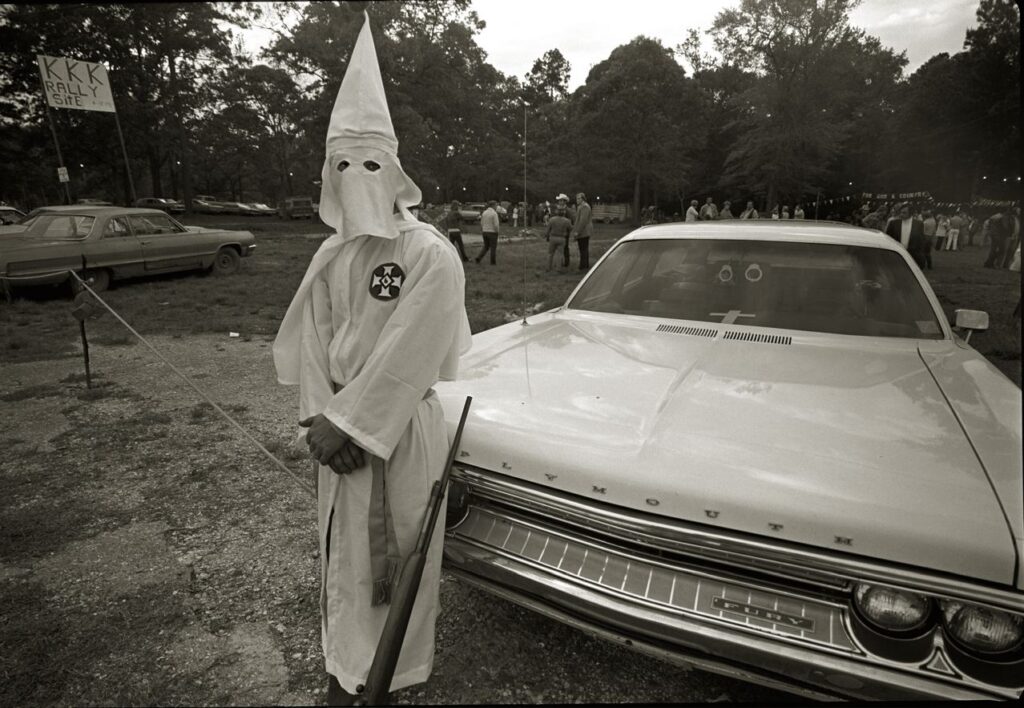
A photo shows an armed guard on the perimeter of a Klan rally in Vidor, Texas, in 1975 (Moody College of Communication/Wikimedia Commons)
That night came on the tail end of a sharp uptick in political violence in Houston. In the spring of 1970, the first of two explosions had erupted at the left-wing KPFT radio station, making it, according to some accounts, the first station to ever be bombed off the air. Another bomb tore through the Socialist Workers Party’s office, where Beam was accused of also opening fire with a machine gun. The attacks were among some 20 bombings and shootings that targeted leftists in Houston in 1970 and 1971. The assailants had reportedly disguised themselves and infiltrated Students for a Democratic Society, one of the leading left-wing antiwar groups of the time.
When a grand jury finally convened in June 1971, it indicted a handful of people, including Louis Beam. The Klansman eventually testified about the bombing at his roommate Jimmy Dale Hutto’s trial, though he never faced trial himself. Hutto was convicted on three counts, but while Beam was on the stand, he made a curious claim: He said he had been gathering intelligence and passing it on to the Houston Police Department, a claim another Klansman later echoed when he bragged that the hooded order had infiltrators working in both the police and the city government.
In 1976, Beam left the United Klans of America for another Klan group. He teamed up with David Duke, a Louisianan who had founded the Knights of the Ku Klux Klan in 1975. A savvy media figure, Duke advertised the Knights of the KKK as a hard break with the hooded order’s old guard. Under his command, the group presented itself as a “white civil rights” organization. When he made public appearances, Duke donned a suit and tie while behind the scenes he guided the Knights of the KKK’s members toward outright neo-Nazism. Beam first became a grand titan, then the grand dragon of the Texas chapter, effectively overseeing its entire operation in the state.
He soon caught law enforcement’s attention once again. In late 1976, Harris County hit Beam with charges of illegally carrying a firearm and false imprisonment, though prosecutors only secured a conviction on the gun violation. His sentence? A fine of $100. Though the details around those charges remain obscure today, the seemingly light punishment would go on to be a common theme throughout his life.
It wasn’t long before Duke and Beam made international headlines. In October 1977, the duo took to the press to announce that gun-wielding Klansmen would carry out patrols of the US-Mexico borderlands to hunt down “aliens” that had entered the country without authorization. The backlash was swift. Federal and state authorities issued stern warnings. The Mexican government complained. The Brown Berets, a militant anti-racist Chicano group, threatened to dispatch 1,500 people to confront the Klan patrols.
Beam dubiously told the press that his vigilante squads supplied authorities with information that helped prevent more than 150 people from crossing, but Border Patrol said only that it had received a few reports of Klansmen walking around in Laredo and other far-flung parts of the state. Nor were there any clashes between Klansmen and anti-racists. “There’s been nothing,” Jim Curr, a Border Patrol official in McAllen, told reporters. “And I seriously doubt there will be.”
If Beam was out for publicity, the plan was working. In the late 1970s, Washington and Beijing were in the final phase of normalizing ties. When Chinese vice premier Deng Xiaoping visited Houston in February 1979, Beam didn’t miss the chance to make a spectacle.
One day on that trip, Deng and his entourage visited the Johnson Space Center, dined on Texas barbecue, and enjoyed a private rodeo show. When the delegation returned to the hotel, Beam was outside passing out fliers that said, “Smash communism, support Christian resistance.” Beam followed the delegation into the hotel garage, lunged at Deng, and was stopped in his tracks when a Secret Service agent slugged him and knocked him to the ground. The attempted attack landed Beam in jail, where, he later claimed, the authorities stuck him in a cell with African Americans and Chinese communists, “hoping they’d kill me.”
After the incident, Beam once again used the press attention to cast himself as the hero. It was Deng, he insisted, who had assaulted him. “He came to America,” he told reporters. “That was his assault.” Beam admitted he planned to get payback on behalf of American troops who died in Vietnam. “I had every intention of avenging their deaths.”
The more stunts Beam pulled, the more alarmingly broad the Klan’s reach became. Toward the end of the decade, Beam and Duke hatched another plan: They would recruit active US military members into the Knights of the KKK.
In June 1979, the pair traveled to Euless, a Texas city not far from Dallas, and attended a Klan ceremony. Sheathed in white robes, the Klansmen performed Nazi salutes, wrapped kerosene-soaked sacks around a cross staked in the earth, and tossed their lit torches at its base. The cross went up in flames, and a handful of armed men dressed in fatigues stood guard nearby. As it turned out, they were soldiers from the nearby Fort Hood military base, where Beam and Duke had been making inroads. Fort Hood, Beam told a reporter a month later, had “one of the strongest [Klan] chapters in the country.”
In June 1979, David Duke and Louis Beam joined a KKK ceremony in Euless, Texas (University of Texas at Arlington/Fort Worth-Star Telegram Collection)
This push to recruit soldiers caught the government’s eye. Two years later, the US Commission on Civil Rights would warn in its annual report that the hooded order had “succeeded in recruiting servicemen in the Army, Navy, and Marine Corps.”
Like the Klan border patrols, it was a strategy the government would have been wise to keep a closer eye on across the decades that followed.
Whenever Beam spoke to the press, he didn’t mince words about his plans. He had no faith in democracy, he would explain, and the country could only become a white ethnostate through armed rebellion. Later, he expanded on his intentions: The goal, he admitted to another reporter, was “to return the government to the hands of those who have the white majority at heart,” a project that would be carried out by “whatever method is necessary.”
In 1980, both the press and law enforcement caught wind of the way Beam was putting his own military experience to use in advancing that plan. At a handful of paramilitary camps around Texas, Beam and other veterans were preparing Klansmen for war. Beam founded a group he called the Texas Emergency Reserves, and at its height, it claimed to have some 2,500 members. The news broke when John Allen Mosier, a former marine who was serving a life sentence after murdering his father-in-law in exchange for $800, told the Houston Post that he had trained Klansmen in “commando-style killing” at Beam’s request.
Mosier described underground bases, tunnels, and makeshift ammunition factories, and he admitted that children were among his trainees. “Louis Beam told me he wanted everyone in the Klan to go through this kind of training,” he said, adding that the Klan was “more combat-ready than our regular armed forces.”
That the Klan was conducting paramilitary training didn’t go unnoticed. Texas-based leftists from the John Brown Anti-Klan Committee, the Brown Berets, and the Black Citizens Task Force promised to arm themselves against Beam’s white nationalist militia. In late November 1980, anti-Klan activists gathered outside the State Capitol in Austin. “Are we to believe that the Klan can actively train boys and young men to wage race war,” one asked a reporter, “and the State of Texas can’t do anything about it?”
The answer to that question was apparently that neither Texas nor the federal government could, in fact, do much about it. When Beam broke his silence on the paramilitary camps, he explained that the Klansmen stayed within the confines of the law by only using semi-automatic weapons, at the same time bragging that he owned a grenade launcher. “I’ve been stopped by the Houston police when I had that grenade launcher so many times I can’t tell you,” he told a reporter, “and there’s nothing they can do about it.”
The Anti-Defamation League filed a complaint asking federal authorities to keep a closer watch on the Klan, but Beam was right. “The fact that people get together and have some guns is not a violation of the law,” a Justice Department spokesperson said. “Somebody has to do something first.”
As it turned out, the feds wouldn’t have to wait long for Beam and others to do something. As Beam himself said around that time, “Where ballots fail, bullets will prevail.”
On the shores of Texas’s Gulf Coast, in Seabrook and Kemah on Galveston Bay, a community of Vietnamese refugees had set about building new lives after fleeing the same communist forces Beam so often bragged about fighting. Marooned in a new country, many of the refugees found work as shrimpers, a fact that upset some local white shrimpers who felt their incomes were suffering at the hands of newcomers. In 1979, tensions between locals and refugees boiled over after a tussle ended with Vietnamese men shooting a white shrimper. A court later ruled that the Vietnamese men had acted in self-defense, but that judgment only sharpened tensions.
Starting in 1981, men in white robes rode into town. The Klansmen marched with Confederate flags and tossed up Nazi salutes. Beam soon followed, and that spring, he turned up in Galveston Bay on a “fact-finding” mission. He gathered crowds and called protests. He oversaw paramilitary training — the Klansmen learned hand-to-hand combat, the proper way to carry out an ambush, and how to handle grenades — and spoke to the press whenever the opportunity presented itself. Klansmen issued death threats, and crosses were burned in front of the homes of Vietnamese families. Boats went up in flames. Soon, the spectacle turned even grimmer: Beam’s armed Klansmen, draped in robes and hoods, took a boat out on the water. A cannon equipped to the vessel fired blanks, and the men hanged an effigy of a human figure.
Beam had already sparked a relationship with Richard Butler, the leader of the neo-Nazi Aryan Nations group, earlier that year. In May 1981, Beam brought down Butler and a group of Aryan Nations members who made the trip to Galveston Bay for a rally. Cindy Cutler, a spokesperson for Aryan Nations, told the Houston Post: “There will be a day when I have to lose my life for my race. There will be a day when my two little girls will have to be sacrificed for my race on a field of battle.”
Also in attendance was Jerry Paul Smith, one of five Klansmen who’d been acquitted after a deadly shootout with members of the Communist Workers’ Party in Greensboro, North Carolina, two years earlier. The rally organizers in Galveston Bay that day distributed pamphlets that described Smith as “Greensboro’s answer to John Wayne.”
During the months-long raucous, the Southern Poverty Law Center came to the defense of the Vietnamese fishermen. The watchdog filed a lawsuit naming Beam, the Knights of the KKK, and several members of the American Fishermen’s Coalition as defendants. In court, a seafood company owner testified that he’d received threats to stop servicing dozens of Vietnamese-owned fishing boats. “I was told I’d better watch my boats, that they were easy to burn,” he said. “I said if I caught anyone burning boats there, I’d shoot them.”
Eugene Fisher, whom he’d accused of making the threat, denied the precise characterization of his comments. Elsewhere, though, he’d admitted to wanting Vietnamese boats burned. Speaking to CBS, Fisher had complained that the federal government had done nothing to help white fishermen in the area. “So, I’m a white American,” he said. “I went to the KKK. Those boats have to be taken out of the water. Destroyed.”
Soon, a judge for the US District Court of the Southern District of Texas granted the plaintiffs a preliminary injunction against the Knights of the KKK. Nearly a year later, the judge struck another blow to Beam’s Klan with a permanent injunction. Citing a law that barred private armies, the judge then ordered the Texas Emergency Reserves to abandon paramilitary training and disband all its camps.
It was a win for the Vietnamese fishermen and a defeat for the Klan, but Beam had never placed stock in what the courts had to say. Beam resigned from Duke’s Knights of the KKK, then left Texas heading northwest.
Part II: The Ambassador
The town of Hayden Lake, Idaho, was only home to a few hundred people. Nearby was the nearly eponymous Lake Hayden with its acres upon acres of timber-studded shores, hemmed in by mountains and known for its deep, clear waters. It was the kind of place one might have put a past like Beam’s behind them, but the former Klansman had plans to take his movement to a new level of violence and militancy.
Invitation in hand, Beam soon arrived at a ranch property perched on the edge of town. That property was home to the Aryan Nations compound. The group’s founder, Richard Butler, was a longtime fascist and retired aeronautical engineer who moved to Hayden Lake several years earlier. In Idaho, Butler now led a cultish neo-Nazi group. Butler lived on the property in a garden-encircled home, and a sign tacked to his door made clear who was welcome: “White kindred only.”
Richard Girnt Butler speaks at the Aryan Nations church in 1984 (Steve Pike/San Fracisco Examiner/Wikimedia Commons)
Founded in 1977, Aryan Nations operated as the political wing of the deceptively named Church of Jesus Christ Christian. The lifeblood of Butler’s operation was Christian Identity, a bizarre, hardline ideology that is as fascistic as it is messianic. Butler dreamed of carving out a white ethnostate in the American northwest, a place where white farmers formed the spine of a supposedly racially pure enclave. To that end, Hayden Lake made sense: land sold for pennies on the dollar, and the population clocked in at 98% white. Visitors to the compound couldn’t have missed the neo-Nazism at the center of it all: white nationalist newsletters and leaflets blanketed the tables, and stocking the shelves were books with titles like The Life and Times of Adolph Hitler and Racial Hybridity.
Not long after Beam turned up, Butler hosted the annual Aryan World Congress, a who’s who gala of neo-Nazis and white supremacists from North America and Europe. Throughout the years it was held, the Congress attracted high-profile attendees including Klan leader Don Black, White Aryan Resistance’s Tom Metzger, and neo-Confederate lawyer Kirk D. Lyons. Black would later found the national socialist messaging board Stormfront, Metzger would welcome into the movement violent neo-Nazi skinhead gangs, and Lyons would represent in court some of the most militant figures on the American far right. Others made the journey from as far as Canada and Germany. Attendees of the Congress bonded over meals, listened to sermons, and participated in summer camp-like activities. Some slept in bunks, others outside in tents, and many people brought their children. Armed guards patrolled the perimeters of the compound, and a watchtower looked out over the property.
For the Aryan Nations, Beam was an obvious asset. Already a gifted orator, the Texan could scare up controversy — plus the attention and exposure that came with it — on a dime. Butler anointed Beam the group’s “ambassador at large,” and Aryan Nations newsletters and books routinely advertised cassette tapes of Beam’s speeches. Beam ramped up his antisemitism, and his speeches and writings from that period became intensely focused on a supposedly shadowy Jewish cabal that he claimed controlled the US government. In many articles and essays he wrote in the 1980s, the former Klansman made liberal reference to the “ZOG,” or Zionist-occupied government.
Primed for leadership or not, Beam couldn’t stay out of trouble. In early 1982, he reportedly made a brief return to Texas. That March, a warrant was issued for his arrest, this time for aggravated kidnapping. According to court documents, he stood accused of kidnapping his two-year-old daughter from her mother’s home in North Dallas. The way the press told the story at the time, Beam had sent a friend disguised as a florist to his ex-wife’s home, had her tied up, and had the daughter kidnapped and whisked away to meet him in Idaho. Speaking to the media, police warned that Beam was likely armed and ran in paramilitary crowds. Years later, his ex-wife would say she had declined to pursue charges, telling a reporter she had received threats and feared Beam’s associates.
In 1983, Beam published one of his most influential pamphlets, Essays of a Klansman. The booklet includes 11 essays and poetry — Beam published his own poem, as well as one by Klansman Robert E. Miles, alongside the work of Rudyard Kipling and Lord Byron.
In several of the essays, Beam could not decide whether the Confederacy was populated by warriors or defenseless victims, and his frequent attacks on the civil rights movement and the political left sank into rank antisemitism.
Beyond the run-of-the-mill neo-Nazism, Essays offered a prescriptive element that Beam had already tried to put into action in the years leading up to his time in Idaho. First, Beam urged his readers to seek out, recruit, and elevate US military veterans. Second, he declared that there was no white nationalist struggle without open warfare against the federal government.
In one essay, he wrote, “They called us up, placed a rifle in our hands, transported us 12,000 miles, planted us in the jungles, and told us to kill or be killed.” In another, he addressed his fellow veterans directly: “Yes, now I know — and so do you. That American political leaders committed us to a war they were determined to lose.” Traumatized combat veterans suffering from substance abuse and political despair should “get straight, get prepared, and get ready,” he insisted. “If you are a Vietnam Vet and would like to join with other Nam Vets who have a mission, if you have had enough of these bastards who call themselves our leaders, then let us hear from you.” At the bottom of that essay was an address for an Aryan Nations post office box in Hayden Lake, followed by an ominous threat: “The next laugh will be on them.”
But the essay with the most enduring impact, “Understanding the Struggle, or Why We Have to Kill the Bastards,” attacked the US government’s legitimacy in its entirety. Americans, the essay argued, live in “an occupied territory that is controlled by the enemies of our race and our culture.” Neither liberalism nor conservatism offered hope for white nationalists, Beam maintained, and all white Americans, whether they knew it or not, were locked in an existential struggle with Washington. “Out with the conservatives and in with the radicals!” he wrote. “Out with the plans for compromise and in with plans for the sword!” In no uncertain terms, Beam advised his readers: “Kill the bastards.”
Luke Baumgartner, a US army veteran and expert on far-right extremism, explained that Beam’s strategy of recruiting active military and disaffected veterans was not novel — military veterans had played a role in “basically every fascist movement” in the 20th century, including in Italy and Germany. At the height of the American white power movement, though, it proved an effective recruitment strategy. “It’s not that the concept … or the process was novel, but it was more pronounced and had greater impact during the time of Louis Beam,” he said.
The strategy was also important for what it offered those who had no military experience. “One thing to consider is the air of legitimacy that somebody with military experience can lend a movement,” Baumgartner said. “The majority of people have an overwhelmingly positive view of the military … If somebody like [Beam], somebody with his resume, comes along and tells you they can offer you this training you can’t get anywhere else because you are not a veteran or aren’t affiliated with the military, then that kind of speaks to the person who never really got to live out that fantasy of combat or that romanticized vision of it.”
The same year Essays of a Klansman first appeared, Beam made waves at the Aryan World Congress. He railed in defense of Rhodesia, the white supremacist state that occupied present-day Zimbabwe between 1965 and 1979, and hosted a workshop on the “effective use of propaganda,” a topic on which he was no doubt already an expert. When he gave a speech to the attendees, he promised violence. “I’m here to tell you that if we can’t have this country, as far as I’m concerned, no one gets it,” he said. “The guns are cocked, the bullets are in the chamber. … We’re going to fight and live or we’re going to die soon.”
There at the 1983 Congress, Beam also hatched a scheme to use the early internet to help white nationalists and fellow militants organize far from the watchful eye of the federal government. A year later, Aryan Nations would found the Liberty Net bulletin board, where movement activists could stay in contact and trade recruitment material. Beam announced Liberty Net to the movement in the Inter-Klan Newsletter & Survival Report, informing readers that they could access the bulletin board 24 hours a day. Technology previously only in the hands of “the government and others who sought the destruction of the Aryan people,” he wrote, was now available to white nationalists. In her book Bring the War Home, historian Kathleen Belew sums up the legacy of Beam’s plans to utilize the internet: “It enabled the forging and maintenance of the social connections that sustained white power activism and violence.”
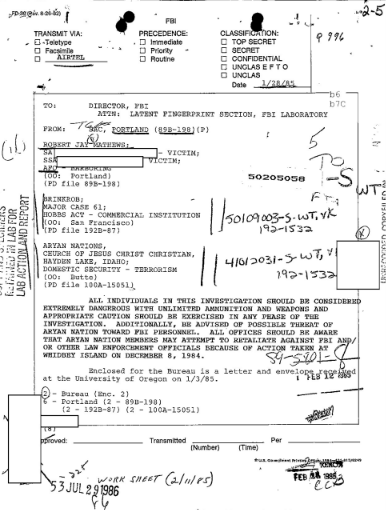
More frightening still, the 1983 Congress included a closed-door meeting between several of the movement’s most prominent and most militant leaders. The discussion, in part, drew inspiration from The Turner Diaries, neo-Nazi William Luther Pierce’s novel that envisioned a band of white supremacists overthrowing the US government and sparking a race war. Informants would later tell the FBI that that meeting was the moment when the movement outlined plans to support underground cells that would put Beam’s call to wage war against the federal government into action. The names of who precisely attended the meeting were always disputed, but the months after the 1983 Congress saw a group of ultra-right zealots follow Beam’s advice. As heavily redacted FBI investigative files later put it, that year’s Congress marked the beginning of a vast “conspiracy” involving far-right hardliners from around the nation.
In September 1983, Robert Jay Mathews, who visited the Aryan Nations compound earlier that summer and had been on the FBI’s radar since the 1970s, founded The Order on his farm in the northwestern tip of Washington state. Sometimes referred to as the Brüder Schweigen (German for the “Silent Brotherhood”), The Order would go on to stake its claim to join the list of the most infamous neo-Nazi groups in US history. Early on, Mathews and the other Order members toyed with petty stickups and counterfeiting to fund their insurrection, but within months, they had turned to ambushing armored vehicles and robbing banks. Hits on armored cars in California and Washington put more than $3.5 million in the Order’s coffers.
In the summer of 1984, the Order put Alan Berg, a Denver-based Jewish radio host who often sparred with antisemites and neo-Nazis on his talk show, squarely in its crosshairs. On the evening of June 18, Order members fatally shot Berg 12 times after he returned from a dinner date, leaving him dead in the driveway of his townhome. In December 1984, after a months-long manhunt, Mathews died of asphyxiation and burns when the house he was hiding in caught on fire during a shootout with federal agents on Whidbey Island, off the coast of mainland Washington. Throughout the end of 1984 and well into 1985, sweeping FBI arrests pulled in dozens of neo-Nazis around the country. Time and again, FBI investigative files from that period warn: “All offices be aware that Aryan Nation[s] members may attempt to retaliate against FBI and/or other law enforcement officials because of the action taken at Whidbey Island on Dec. 8, 1984.”
Beam’s connections with Mathews and his group, whatever they were, are not certain even today. What is certain is that The Order had distributed copies of Beam’s Essays of a Klansman, and at one point, Mathews provided members with a document that suggested Beam — new nom de guerre: Lone Star — would serve as the “civilian leader” of the “western district” of the white ethnostate they hoped to establish.
In November 1987, Mexican federal police and the FBI tracked down Beam and his then-wife, Sheila, in Chapala, a little less than 30 miles from Guadalajara. Supposedly surviving on donations from other white nationalists, the couple had been in hiding in Mexico since earlier that year, fleeing the country not long before a grand jury returned an indictment against Beam and 13 other white supremacists accused of seditious conspiracy. The white supremacists, the government said, planned to launch a violent rebellion to topple the US government, a goal they hoped to fund through counterfeiting money, armed robberies, poisoning water supplies, blowing up infrastructure, and assassinating federal officials and members of groups they didn’t consider white.
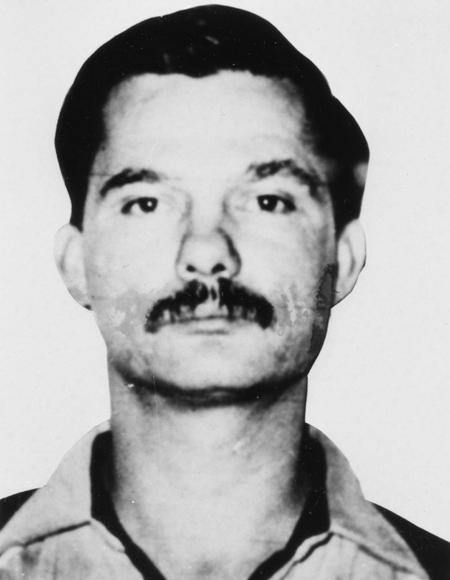
Shortly after Beam’s name entered the fray, the FBI placed him on the top-10 most wanted list. David Berg, a Houston lawyer who had served as co-counsel on behalf of Vietnamese fishermen and had helped win injunctions against the Klan in Galveston Bay in the early 1980s, responded to the news when the Associated Press phoned him: “I was just as surprised by Louis Beam’s making the 10 most-wanted list as I was waking up this morning to discover the sun.”
Throughout the fall of 1987, according to a sympathetic account of Beam’s time in Mexico, the couple became worried over a spate of crimes targeting Americans in the area. The first week of November, Sheila phoned her husband one day to let him know that a Mexican man she sized up as suspicious had been loitering under a tree across the street from their home. By the time Beam made it back, the man had already disappeared.
The next day, on Nov. 6, Beam and Sheila joined a group of Americans who gathered to discuss growing crime in the area. The way that account put it, Beam and Sheila grabbed groceries after the meeting and made their way home. Beam went inside alone to make sure the house was safe, and once he got back outside, the pair began unloading their groceries. Then, Mexican federal police and the FBI suddenly swarmed them. An FBI agent slammed Beam’s head on the car. Gunfire rattled. Sheila grabbed a weapon and fired back, hitting and critically injuring a Mexican police officer, and by the time the exchange ended, both Beam and his wife were in handcuffs.
A mugshot of Louis Beam from his time on the run in the 1980s (FBI/Wikimedia Commons)
A Mexican judge would later rule that Sheila had acted in self-defense, but Beam had no such luck. He was shipped back to Fort Smith, Arkansas, to stand trial. When Beam appeared at a bond hearing shortly thereafter, he admitted that he couldn’t make bond in any case — Mexican police, he claimed, had confiscated all of his money. Then, he falsely claimed that he had never been convicted of a crime. He was, he told the court, the victim of “political persecution.” At the hearing Beam entered no plea, and when a reporter asked whether he had schemed to overthrow the US government, he made a joke out of the allegation: “What else is a country boy to do on a Saturday night when the only drugstore in town is closed?”
The case against Beam and 13 others would become known as the Fort Smith sedition trial, and the list of defendants included a prominent lineup of hardline white supremacists. Among the accused were the likes of Richard Butler of the Aryan Nations; Robert E. Miles, a former Michigan Klan leader who did time for bombing school buses in 1971 as part of a bid to prevent desegregation; David Lane, a member of The Order who was already serving 150 years for his role in murdering radio host Alan Berg; and Richard Snell, who had killed a Black state trooper and a pawn shop owner he erroneously believed was Jewish. The charges were steep: 10 of the 14 defendants stood accused of attempting to overthrow the government, and five faced allegations of plotting to kidnap and assassinate a federal judge and an FBI agent. Beam, now 41, was charged with seditious conspiracy, part of a plot the prosecution alleged dated back to the Aryan World Congress four years earlier.
In pretrial lockup, Beam fell back on what he did best: seeking attention. He launched a hunger strike as part of a bid to gain recognition as a political prisoner. He was moved from an Arkansas jail to the US Medical Center for Federal Prisoners in Springfield, Missouri, and when he appeared in court before the transfer, he said that the US government was “vile” and deserved to be toppled. He soon sent a desperate appeal to Amnesty International, describing himself as a “prisoner of conscience,” and his lawyer claimed that Beam was the victim of “a sustained, malicious campaign of prosecutions which are designed to punish him” for his political views. An Amnesty International researcher sent back a clinical reply: “I have studied the information you have sent and regret to inform you that the case of Mr. Beam does not fall within Amnesty International’s mandate.”
As it turned out, Beam didn’t need Amnesty International’s help — the prosecution’s repeated missteps would prove more than enough. In February 1988, the trial kicked off with an all-white jury. A chain-link fence with barbed wire atop it came up around the courthouse. SWAT teams posted up on rooftops with rifles. Dozens of police cars posted up outside. Skinheads turned up to protest. Each day, US Marshals hauled the defendants, most of whom represented themselves, into the courtroom and removed the shackles from their hands and feet.
Across seven weeks, the government introduced more than 100 witnesses. Prosecutors put forth evidence that alleged to show that Beam had once published a guide for a point system based on killing government officials, Black people, and Jews. But the judge blocked key evidence, and prosecutors relied on witnesses who provided shaky testimony. The defense convincingly argued that one star witness, Glenn Miller, had provided unreliable testimony in exchange for a plea deal. Another setback for the prosecution came when James Ellison, a witness already imprisoned on racketeering and weapons charges, confessed that he believed he was king of the Ozarks, could levitate, and was receiving personal messages from god.
Judge Morris Arnold struck down charges against one of the defendants along the way, and in April 1988, the trial came to an end when the jury acquitted the remaining 13. After smiling and waving to the jury, Beam walked out of the courtroom and carried Sheila across the lawn. Then, he found a spot in the shadow of the Confederate monument opposite the courthouse. Reporters gathered to hear what he had to say. The government, Beam declared, “suffered a terrible defeat here today.” He went on, “I think everyone saw through the charade and saw that I was simply being punished for being a vociferous and outspoken opponent of ZOG.”
Years later, when Judge Arnold reflected on the outcome, he would admit that Beam and the others “were obviously all in cahoots,” but he was not surprised the jury didn’t buy the prosecution’s version of events. “Remember, you have to believe that these 14 people actually agreed to overthrow the government of the United States. That’s a hard charge to prove because … it’s the no-sane-man defense. Why would 14 people think they could do that?”
Part III: The Seditionist
No longer a wanted man, Beam soon launched a newsletter he described as a “quarterly journal of political thought.” He named the publication The Seditionist, a ham-fisted nod to the Fort Smith trial. The white nationalist movement was enjoying a boost thanks to neo-Nazi skinhead gangs cropping up around the country — the Anti-Defamation League (ADL) had recently warned that the number of racist skinheads had doubled in recent years — and Beam used the pages of The Seditionist’s first issue to double down on his calls for widespread rebellion.
While he continued to stoke the flames of race war, he also acknowledged that internal shifts in the movement and the federal crackdown had taken a toll. “Ideologically, the movement has changed more since 1983 than it has since the rest of this century combined,” he wrote. “Doctrine so long espoused by all of us is out the window and in a six-foot grave. No one will come to the funeral for the memorial service. There will be no requiem for dead dogma.” In American patriotism’s place, he argued, white nationalists should apply a global perspective to their struggle. “Narrow-minded provincialism, displayed by so many groups in the past, will fade away,” he went on. “A concept of the Universal Aryan, who lives for, fights for, and struggles for all his people, everywhere on planet earth, will take hold.”
Equipped with this new perspective or not, Beam didn’t abandon his fondness for the Confederacy. In 1989, Beam addressed a procession of demonstrators who had gathered in Pulaski, Tennessee, to commemorate the founding of the first iteration of the Klan in 1865. Many in the crowd wore Klan robes, others military-style fatigues. State troopers in riot gear gathered nearby, and police erected cordons to block off the streets. A police helicopter buzzed overhead. “Hail Sam Davis,” Beam chanted, referring to the Confederate war figure Union soldiers executed in Pulaski. A photo from the rally showed him standing next to Butler and a man holding a sign that said, “Thank god for AIDS.”
Beam continued to show up at rallies and events — a Klan demonstration here, an Aryan Nations gathering there — but the focus of his ire drifted more and more toward the federal government. Back in Pulaski in January 1992, he delivered a fiery screed to hundreds of Klansmen and skinheads. He said he “spit” on the “dogs” in the federal government and urged the crowd to take up arms. “If you want to give us terror, we’ll give you terror back,” he shouted in a direct address to the government. “If you think we’re going to take this lying on our backs, you’re wrong, federal dogs.”
In 1992, Beam retired The Seditionist. Before he put the newsletter to rest, he reiterated his thoughts on “leaderless resistance.” In the essay, he drew on a strategy Ulius Louis Amoss, a former US intelligence officer, first put forward in a 1962 essay about CIA-backed, clandestine anti-communist groups in Eastern Europe. In Beam’s version, though, the strategy was modified to lay out a blueprint for white supremacists engaged in a struggle against the US government.
Rather than signing up for a Klan chapter or the American Nazi Party, Beam advised, white nationalists should act alone as “phantom cells” and create “an intelligence nightmare” for the government. “A single penetration of a pyramid type of organization can lead to the destruction of the whole,” he wrote, while leaderless violence made it difficult for law enforcement to “destroy a significant portion of the resistance.”
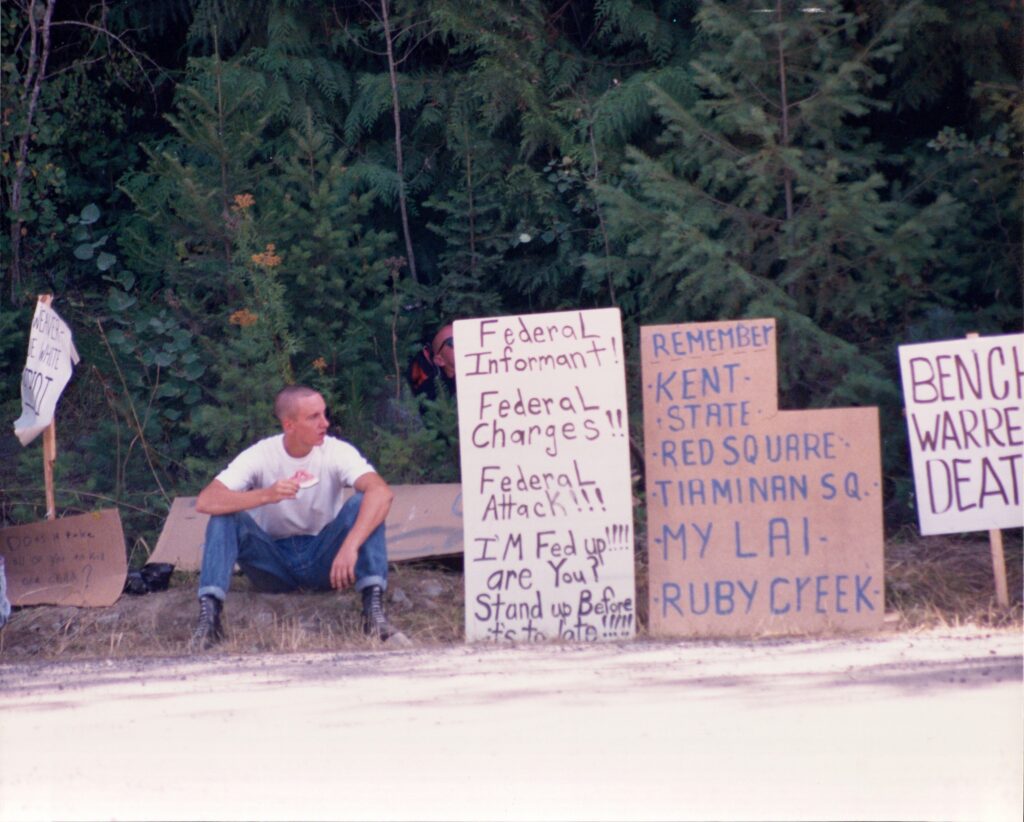
A skinhead sits near signs during protests against the siege at Ruby Ridge in 1992 (Dave Hunt/Wikimedia Commons)
Mike German, who would serve in the FBI for 16 years before leaving the Bureau, worked undercover in neo-Nazi skinhead circles in the early 1990s. At the time, he noticed that Beam’s leaderless resistance strategy was already being put to work within the movement. Would-be attackers read white supremacist literature and listened to popular far-right radio broadcasts, but they rarely, if ever, communicated with leaders of the movement. In one instance, a skinhead drove him around Southern California picking up bomb-making materials — an outing that took half an hour and cost around $20, all told. “Leaderless resistance was discussed as a methodology to avoid law enforcement surveillance and to protect the broader movement,” German recalled.
Christian Picciolini, who had joined the Chicago Area Skinheads in 1987, saw the same shift happening inside the movement. He recounted the late 1980s and the early 1990s as a “critical” moment for the American far right. While the Klan, Christian Identity groups, and other longtime outfits in the movement had previously been skeptical of neo-Nazi skinhead gangs as “thugs,” he explained, “they realized they needed us to fight in the streets and intimidate.”
Picciolini, who later disavowed the white power movement and became a prominent anti-racist activist, explained that Beam’s ideas were “instrumental to the movement in those days.” The leaderless resistance strategy Beam advocated for was “all we talked about” in the late 1980s and early 1990s. “Granted, the late ‘80s wasn’t long after The Order did what they did, so it was a fresh and exciting concept.”
Beam’s fears about membership in organized groups and far-right parties weren’t unfounded. Alongside left-wing pushback and internal power struggles, law enforcement campaigns broke many far-right outfits around the country in the late 1980s and early 1990s. In 1981, there were around 11,000 Klan groups in the US, but by the 1990s, that number had been cut in half. New hate crimes laws were now appearing on the books in states from the Deep South to the Northwest. Federal and state prosecutions secured convictions in cases involving violent skinhead groups from Texas to Oregon.
David Duke, Beam’s old Klan ally, served in the Louisiana House of Representatives between 1989 and early 1992. Since 1988, he had put his name forth in both Democratic and Republican primaries for the US presidential nomination, the Louisiana gubernatorial race, and the US Senate. In December 1991, Duke tried his luck again, running in the Republican primary for the presidential slot, a stunt that thrust the white nationalist movement into the spotlight. Beam, though, still saw the movement’s future outside of the political system.
The next major flashpoint came in Idaho’s Boundary County in August 1992, when federal law enforcement sparked a standoff while trying to arrest white separatist and survivalist Randy Weaver on weapons charges at a secluded cabin where he and his family resided. What became known as the Ruby Ridge standoff quickly went south, and neo-Nazis from the nearby Aryan Nations compound and far-right hardliners from around the country flocked to rally in Weaver’s defense. Exchanges of gunfire through the standoff killed a US Marshal and Weaver’s wife and 14-year-old son.
Two months later, Beam traveled to Estes Park, Colorado, where a meeting of far-right leaders from around the country was taking place. Known as the Rocky Mountain Rendezvous, that gathering provided early guidance to the burgeoning militia movement. Speaking to around 160 attendees, Beam seized the anti-government sentiment spreading throughout the movement. “I warn you calmly, coldly, and without reservation that over the next 10 years you will come to hate government more than anything in your life,” he reportedly said.
One day in March 1993, reporters gathered at a press conference in Waco, Texas, to hear from the FBI and other law enforcement about the standoff between federal and state authorities, on the one hand, and the people holed up inside the Branch Davidian religious group’s compound. Law enforcement’s siege of the obscure religious sect was entering its third week, and federal authorities were still hoping to enter the compound to serve a warrant related to allegations of sexual abuse and illegal weapons violations. When the feds opened the floor to questions from the media, Louis Beam emerged equipped with press credentials.
Claiming he was on assignment for Jubilee, a Christian Identity newspaper out of California, Beam said he had a question for Dan Conroy, the deputy director of the ATF. Did not the ongoing siege of the compound, Beam asked, signal to the American people that they were now living under a police state?
Flustered by Beam’s hostile presentation, Conroy shot back, “I won’t even address answering that question.”
As Beam tried to leave, he later said of that day, law enforcement stopped him on his way out and asked if he would go with them. He refused to go with the officers, and when they ran his name for active warrants, the search came back empty. “It was wonderful,” he said. “They played right into our hands.”
Newspapers ran with the story, and once again, Beam was back in the headlines. Waco police sergeant Malissa Sims banned Beam from press conferences, and when Beam complained that it was evidence of the supposed police state, Sims defended the decision in comments to the papers. “He’s a Klansman,” she said. “I’m not letting anyone like that in.”
Beam used the opportunity to rail against the other reporters on site, griping that they only asked softball questions, and despite the ban, he showed up to another press conference a few days later. When he complained yet again of the emerging police state, officers handcuffed him and hauled him out. A month later, the Cause Foundation filed a lawsuit on Beam’s behalf against the government and the City of Waco, alleging that his removal violated the right to freedom of the press.
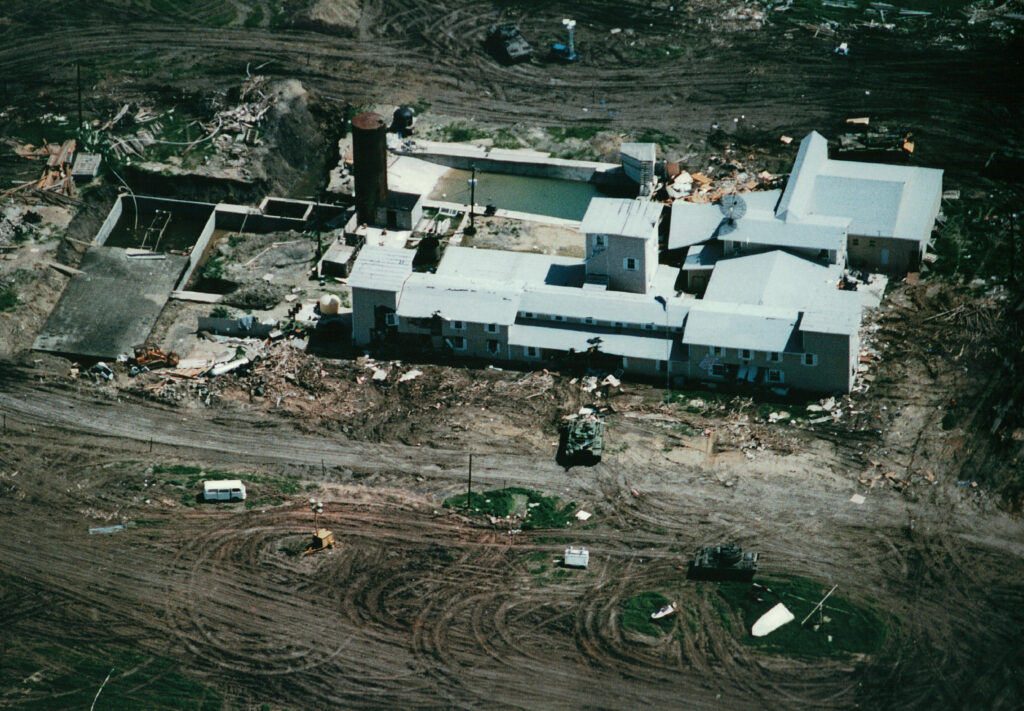
An aerial photo shows the Branch Davidians compound shortly before a fire broke out on April 19, 1993 (FBI/US Government/Wikimedia Commons)
Meanwhile, the standoff lasted 51 days. It came to an end in April, when federal authorities tried to swarm the compound. By the time it was all said and done, nearly 80 Branch Davidians, including at least 20 children, and four ATF agents had been killed. In his Jubilee dispatches, Beam seized the violence to present his case that Americans were now the victims of “police state terrorism,” but he also exploited the tragedy to promote the genocide denial that had long been his trademark. Nazi Germany had never carried out a Holocaust, he wrote, but the feds had done far worse in Waco than anything Hitler ever stood accused of: “A shattered Jewish fable has been replaced with a reality that I and 25 million other Americans were witness to.”
In 1996, Mike German went undercover again for the FBI, this time in a militia group in Washington state. What he observed now was a shift that, in part, mirrored Beam’s own. While the skinhead gangs of the past had harped about race war, anti-government militias cloaked their white nationalism and racism in rhetoric that could appeal to a broader audience — people incensed by taxes, gun control, and abortion. Rather than presenting themselves as white supremacists, militia members called themselves patriots and described the United States as a country at risk of being swallowed by a supposedly shadowy cabal of groups like the Bilderbergers and the Illuminati.
The underlying logic, he explained, “was to broaden the movement by recruiting people who would’ve been offended by Swastikas and antisemitism, with the idea that once they were part of the movement they could be educated.” At the same time, he said, the militia movement “certainly” followed Beam’s leaderless resistance as a “tactic and used that phrase.”
Despite the strategies he championed being put to work, Beam’s time as a prominent leader of the white nationalist movement was running out. Though antisemitic as ever, he focused his ire on the government more and more. He’d attended a militia gathering in Idaho in 1994, then appeared at a Christian Identity conference two years later, but he would make fewer and fewer public appearances in the years to come. Rumor had it that he had a falling out with the Aryan Nations leadership, while some guessed health complications stemming from Agent Orange exposure in Vietnam had led him to the cusp of death.
In 1996, Beam addressed speculation in an open letter to the movement. Nearly 10 years after the Fort Smith sedition trial, he said that the last decade of his life in the white nationalist movement had come “at great expense” to his family. “Since 1969, I have been in the struggle,” he wrote. “For a year and a half prior to that I was in Vietnam, and it truly seems to me as if the war there has never ended.” He explained that he intended to devote the rest of his life to his family, adding: “Additionally, as a result of exposure to Agent Orange while in Vietnam, my health declines. I have concealed this for years but now find myself less than fit to continue as in days before. I have for 30 years given my all. I pray others will do the same.”
In 1997, Aryan Nations leader Richard Butler addressed Beam’s absence directly when he wrote a letter to his followers confirming that Agent Orange exposure was catching up with Beam. The onetime ambassador-at-large of the Aryan Nations, Butler explained, was “forced by poor health to withdraw from active participation” in the movement.
That same year, Beam delivered a eulogy at a fellow anti-government hardliner’s funeral in Idaho. The ceremony ended with Nazi salutes and chants of “heil victory,” but the man who had rarely missed an opportunity to put on a show for the press now disappeared through a back entrance to avoid journalists.
Part IV: The Disappeared
Across nearly three decades since Beam quietly disappeared out of the backdoor of the funeral in Idaho, the violence and racism he once championed has hit heights the former Klansman likely could never have imagined. In 1995, Timothy McVeigh, who, like Beam, had traveled to Waco during the standoff and had been incensed by the deadly events, blew up the Alfred P. Murrah building in Oklahoma City, killing more than 160 people. In 2014, Glenn Miller, the controversial star witness in the Fort Smith sedition trial, killed three people in a pair of shootings targeting Jewish community centers in Kansas.
Federal crackdowns have at times tamped down on the militia movement, but armed vigilantes have remained a constant since the 1990s. With the election of Barack Obama to the Oval Office in 2008, the number of anti-government groups surged once again. Anti-immigrant militias patrolling the American borderlands, whether they knew it or not, were following in the footsteps of Beam and his former Klan associate David Duke. At times, these armed anti-immigrant groups have used chilling violence. In 2009, for instance, militiamen raided what they believed was a cartel stash house in Arivaca, Arizona, then shot and killed 29-year-old Raul Flores, Jr. and his nine-year-old daughter.
Meanwhile, a broader far right flourished throughout the Obama presidency. In 2009, an intelligence analyst at the Department of Homeland Security produced a report that demonstrated how influential Beam’s different strategies had been throughout the years. Although the report did not name Beam, it noted that far-right groups could find willing recruits among veterans returning from war. The analyst warned that antigovernment hardliners and other extremists could exploit conspiracy theories, discontent over immigration, and fears over the “rise of foreign countries,” including Russia and China. He also noted that since the 1990s, the internet “has given domestic extremists greater access to information related to bomb-making, weapons training, and tactics,” while encrypted modes of communication had become “much more difficult for law enforcement to deter, prevent, or preempt a violent extremist attack.” To anyone familiar with Beam, the report might read like a rundown of his life as much as it was a summary of the tactics he promoted over the years.
Throughout the years leading up to and during Donald Trump’s climb to power saw the rise of an audience willing to cling to white nationalism, far-right militancy, and raw racism. During his first presidential campaign, in 2015 and 2016, Trump hardly concealed it when he gave a nod and a wink to the most hardline subsections of the white nationalist movement. He referred to Mexicans as “rapists,” defamed many migrants as “terrorists,” and employed rhetoric — at times the language was overtly fascistic, other times unconvincingly veiled — that framed the human need to cross borders in search of safety as a coordinated foreign “invasion.” Whenever Trump sounded the dog whistles, white nationalists, militiamen, and neo-Nazis the nation over inevitably took notice.
In August 2017, hundreds of white nationalists and neo-Nazis traveled to Charlottesville, Virginia, for “Unite the Right,” a rally against the city’s plans to remove a Confederate monument. Violence between the far-right demonstrators and anti-racist counter-protesters ripped through Charlottesville, and one white nationalist march participant rammed his car into a crowd, injuring dozens and killing a thirty-two-year-old antiracist activist named Heather Heyer. Trump rushed to condemn “both sides,” but only a few days after Heyer’s death, the president effectively endorsed the far-right faction’s cause: “Sad to see the history and culture of our great country being ripped apart with the removal of our beautiful statues and monuments,” he wrote on Twitter.
A little more than a year later, during the 2018 midterm elections, armed militia members rushed to the country’s southern border with Mexico after Trump described a caravan of migrants and refugees as an invasion that included supposed criminals and “unknown Middle Easterners.” In April 2019, in southern New Mexico, a militia called the United Constitutional Patriots made national headlines after its armed members rounded up and detained migrant families at gunpoint.
Yet, it is Beam’s popularization of leaderless resistance that has made the most lasting impact. In the decades since he published “Leaderless Resistance,” that essay has been translated into Czech, Greek, Russian, and Spanish, among other languages, and has provided a roadmap for the gruesome kind of white nationalist violence that has become commonplace in recent years. That blueprint was at work when a white nationalist shooter killed 23 people at a Walmart in El Paso to stop the “Mexican invasion” in August 2019, and it was at work again when a far-right mass shooter gunned down 11 people at a grocery store in a predominantly Black neighborhood in Buffalo in May 2022.
On Jan. 6, 2021, Trump supporters stormed the US Capitol in Washington, DC (Tyler Merbler/Wikimedia Commons)
In the months before and after Joe Biden won the November 2020 presidential election, Trump drummed up claims that the election had been rigged. On Jan. 6, 2021, Trump supporters rallied in DC to “stop the steal,” and thousands stormed the US Capitol to prevent the certification of Biden’s victory. Some reportedly had plans to kidnap politicians, and the following year, a court found Oath Keepers leader Stewart Rhodes, along with other militiamen, guilty of seditious conspiracy for their role in the Capitol riot. Rhodes and other far-right hardliners had tried to overthrow the government, an effort that soon brought comparisons to the 1988 sedition trial.
That trial nearly four decades ago “taught the movement a lot of lessons,” explained Heidi Beirich, the co-director of the Global Project Against Hate and Extremism, “but it also had an impact on the government, which was that [authorities] sort of backed off.” The long-term impact was that far-right sentiment “metastasized” over the years, she added.
Since Trump returned to office in January 2025, his second administration has routinely incorporated white nationalist rhetoric into its public relations strategy, arrested immigrants en masse, vowed to prosecute leftists, and even launched a legal crackdown on nonprofit watchdogs including the SPLC. On his first day back in the White House, he also pardoned some 1,500 defendants from the 2021 Capitol riot. Then, in February 2025, the Pentagon’s inspector general issued a directive that nixed an assessment of the military’s counter-extremism training, effectively ending efforts to track service members who may be affiliated with hardline groups such as the Klan and the Oath Keepers militia.
Still, Louis Beam has not reemerged. Even as his legacy looms large over the present, the onetime Klan leader has drifted into obscurity since the late 1990s. Beyond a court document here and there, his paper trail largely tapered off years ago. A letter to a post office box in his name years ago never received a response, and calls to a publicly listed phone number went unanswered. He maintains an antiquated website, but years have gone by since it was updated.
Nearly six decades have passed since Louis Beam returned from the frontlines of Vietnam and happened upon an antiwar protest outside the US Capitol. Nearly four decades have gone by since he emerged from a federal courthouse in Fort Smith, stood in the shadow of a Confederate monument, and declared a victory in his battle against the government. “He was certainly famous in the movement and infamous in law enforcement before the sedition trial,” Mike German, the former FBI agent, said. “I think the sedition trial gave him and the others a platform that allowed them to spread the message better and more effectively. … But where was Louis Beam trained? He was trained in the most powerful military in the world.”
He added, “It’s a hard life being in the movement because you’re on this constant alert that the race war is not starting at some undefined point in the future — it’s literally right around the corner. You’re constantly worried about informants. You’re constantly being blamed for being an informant. I can see how a lot of guys, once they start to get up in years, decide it isn’t worth it.”
Note on sourcing:In addition to interviews, this article’s sourcing includes court records, Beam’s own writings, primary historical documents, television newsreels, declassified FBI files, oral history repositories, and newspaper archives.
To learn more, please check out this rundown of recommending reading and resources at Inkstick’s newsletter. It includes books, academic analysis, and journalism.
Top photo collage:Image oneshows Louis Beam outside a courthouse in 1981 (University of Texas at Arlington Special Collections);image twoshows a Ku Klux Klan cross-burning ceremony in Euless, Texas, in 1979 (University of Texas at Arlington/Fort Worth Star-Telegram Collection); andimage threeshows Louis Beam’s mugshot on the Ten Most Wanted list (FBI).
Author bio
Patrick Strickland
Managing Editor
Patrick Strickland is the Managing Editor of Inkstick Media. He's the author of several books about borders and the far right and the fiction debut A History of Heartache (Melville House, 2026). In the past, he has worked for Al Jazeera English, the Dallas Observer, The Dallas Morning News, and Syria Deeply. His reportage has appeared in the New York Review of Books, Politico EU, TIME, and The Guardian, among others.