







Deep in the occupied West Bank, a Palestinian village known as Khirbet Susiya dates to the early 19th century. Historically, its residents resided in caves pocking the rolling, rocky hillsides. By the time I first visited in the summer of 2011, the village had already endured decades of violence and displacement at the hands of the Israeli soldiers and settlers alike. After Israeli bulldozers destroyed their caves, they also crushed their makeshift shacks, tents, water cisterns, and solar panels. More recently, vigilantes from the Israeli settlement next door had stuffed an already collapsed water well with mangled old car parts. I glanced in and spotted a detached tailpipe, next to it twisted scraps of rusty steel. Whether it was soldiers or settlers, locals explained, the goal was the same: to drive Khirbet Susiya’s residents away from their land for good.
Khirbet Susiya sits in the South Hebron Hills and, at the time, was home to a few hundred people. I’d traveled there with a group of foreign correspondents and solidarity activists. The ruined well belonged to the family of Nasser Nawaj’ah, a local activist whose family had been displaced time and again since the neighboring settlement came up in 1983. In 1986, Israel had declared a swath of Khirbet Susiya’s land a protected archeological site and evicted the Palestinians who lived on it. “We’ve been displaced and kicked off our land five times,” Nawaj’ah told me. “We’re not leaving again.”
The settlement is called Susya, an Hebraization of the village’s name, and as it has grown significantly over the decades, encroaching on more Palestinian land each year. When I visited 15 years ago, many Palestinians in the village resided in ramshackle structures pieced together with cinderblock and tarps. The settlement, though, looked like a housing development airlifted in from suburban America: smatterings of green trees and homes with sloping rooftops, streetlights and bus stops, electricity lines and a water tower connected to Israel’s public network.
Khirbet Susiya’s residents were the first people I’d met who’d experienced settler violence firsthand, but they were far from the last. Living there throughout the next four years, I’d find myself reporting on similar abuses and worse: Palestinian homes and schools set ablaze; olive trees and crops uprooted; children bludgeoned with stones or beaten. In most cases, I noticed, Palestinians who were threatened or beaten by vigilantes said the Israeli military had tagged along to protect the assailants, more times than not joining the attacks if anyone tried to defend themselves or fend off the settlers.
Since Israel occupied East Jerusalem and the rest of the West Bank in 1967, hundreds of settlements and settlement outposts have been built across the territory. Though these settlements are illegal under international law (and outposts are illegal under Israeli law), Israel has invested billions of dollars in them over the decades. The Israeli government also provides financial incentives and tax benefits to settlements to encourage more people to move to occupied territory. Khirbet Susiya is in Area C, a part of the West Bank that remained under full Israeli military control after the Oslo Accords agreements in the 1990s. Meanwhile, Palestinians in Area C, more than 60% of the West Bank’s territory, are rarely granted building permits for development or homes. In fact, Israeli authorities rejected nearly 98% of Palestinian permit requests between 2009 and 2018, according to Peace Now. At the same time, settlers have attacked Palestinians and their property at alarming rates.
One night earlier this year, a group of hardline settlers stormed Khirbet Susiya under the cover of darkness. They hurled stones and set fire to homes, cars, chicken coops, and tents. The raid, according to the Israeli watchdog B’Tselem, was “part of Israel’s broader onslaught against Palestinians, who remain defenseless in the face of unchecked violence by militias and the Israeli military.” Such assaults have soared since the beginning of the Gaza war in October 2023. By August, 2026 had already become a “record year” for settler violence, according to Human Rights Watch. These attacks have completely or partially displaced nearly 6,000 people from at least 107 Palestinian communities since January 2023. Last month, the United Nations said it has recorded an average of more than six settler attacks per day so far this year.
When Donald Trump returned to the White House in January 2025, his administration removed Biden-era sanctions targeting far-right Israeli settler groups accused of violence. Now, the attacks have hit a fever pitch. Even US Ambassador Mike Huckabee, a Southern Baptist who has described himself as an “unapologetic, unreformed Zionist,” recently issued a rare rebuke. After settlers besieged the West Bank village of Qusra and attacked Turmus Ayya, Huckabee blamed a “tiny minority” of Israeli vigilantes but described them as “terrorists.”
Even as the attacks stack up, pro-Israel outlets in the US and right-wing Israeli media have attacked criticism and press coverage of settler violence. In April, an American outlet known as the Jerusalem News Syndicate claimed that these incidents were, in fact, either “acts of self-defense” or “Palestinian information operations.” In early August, Arutz Sheva (or Israel National News) insisted “there is no epidemic of ‘Jewish terrorism’” in the West Bank. Earlier this month, an op-ed in the American outlet Tablet concluded: “As with previous antizionist libels, the campaign against ‘settler violence’ will surely license further attacks on Jews across the globe.”
Denials or not, this violence continues at a blistering pace — and attacks almost uniformly take place with the full protection of the Israeli military. Earlier this month, a group of settlers stormed al-Mughayyir, a village near Ramallah, and attempted to seize sheep from local herders. From rooftops nearby, military snipers opened fire and killed two teenage boys. The Israeli military defended the slayings, calling the Palestinian teens “key instigators” of a “violent disturbance.”
During the June 1967 Middle East war, Israel occupied the Syrian Golan Heights, Egypt’s Sinai Peninsula, the Gaza Strip, and the West Bank, including East Jerusalem. From almost the moment Israel took control of these territories, its government made it clear it had no plans to cede them. Nearly six decades later, the only territory that has been returned is the Sinai, while Israel and Egypt have maintained a suffocating blockade on Gaza for nearly two decades.
In September 1967, only three months after the war ended, Israeli Prime Minister Levi Eshkol announced the government’s plans to establish settlements in the West Bank and the Golan Heights. That November, the UN Security Council unanimously adopted Resolution 242, whose preamble stresses “inadmissibility of the acquisition of territory by war and the need to work for a just and lasting peace in the Middle East in which every State in the area can live in security.”
The United States continued to provide cover for Israel, though, and throughout the 1970s, Jewish settlements spread across the occupied territories. In March 1979, the UN Security Council passed a resolution concluding that Israeli settlements had no “legal validity” and served as “a serious obstruction to achieving a comprehensive, just and lasting peace in the Middle East.” Along with Norway and the United Kingdom, the US abstained from that vote. The following year, the UN voted on a resolution calling on Israel to dismantle settlements in occupied territories. This time, the US voted in favor of it, though President Jimmy Carter later insisted that the vote had been a mistake and that “this call for dismantling was neither proper nor practical.”
It was around that time that settler violence began to garner attention. In May 1980, a bombing in Hebron killed six Israeli students. Israeli forces soon arrested two Palestinian mayors, accusing them of incitement, and deported the pair to southern Lebanon. In a joint letter to Newsday, Halhoul Mayor Muhammed Milhem and Hebron Mayor Fahd Kawasmeh attempted to explain the context of the bombing. “Those killed in Hebron were not simply worshippers,” the mayors wrote. “Many of them were armed settlers, violent vigilantes who nightly invaded Hebron and Halhoul. Some came with clubs and guns and attacked our children, broke windows in our shops and homes, and smashed our cars. They openly declared that it was their intention to drive all Arabs out of the West Bank.”
The following month, a group of Israelis, including many settlers, that would become known as the Jewish Underground carried out a series of car bombings targeting Palestinian mayors across the West Bank. Ramallah Mayor Karim Khalaf lost his left foot, while Nablus Mayor Bassam Shakaa lost both legs. When Palestinians responded to the violence by launching a general strike, Israeli soldiers with crowbars and bolt cutters pried the shuttered shops open. In early reporting on those bombings, the Washington Post’s wire service said they were believed to have been carried out “ultranationalist settlers, some of whom have formed small terror groups bent on killing Arabs in reprisal for the May 2 ambush killing of six settlers in Hebron.”
In July 1983, three Jewish Underground assailants armed with automatic rifles and grenades attacked the Islamic College in Hebron, killing three and wounding 33. The following April, Jewish Underground members were caught attempting to bomb five buses that serviced Palestinian neighborhoods in East Jerusalem. When more arrests were made in 1984, it was revealed that the group had planned to blow up the Dome of the Rock, a holy place for Muslims and one of the world’s oldest enduring forms of Islamic architecture. They believed the explosion would spark a regional war and lead to divine intervention in their favor.
“They openly declared that it was their intention to drive all Arabs out of the West Bank.” – Muhammed Milhem and Fahd Kawasmeh
Although Israeli courts eventually convicted 25 Jewish Underground members of these crimes, all had been released within five years. When Menachem Livni, the group’s leader, left prison in December 1990, a group of settlers gathered outside to celebrate his release, throwing candy and welcoming him.
When the first Oslo Accords were signed in 1993, it laid out a plan for a permanent agreement by 1999. Meanwhile, the Israeli government blocked the plan’s implementation by deepening the military occupation and building more settlements across East Jerusalem and the rest of the West Bank. (Since 1993, the settler population has grown from 250,000 to between 600,000 and 750,000 today in both official settlements and outposts.)
Neither peace negotiations nor international pressure put an end to settler violence, though. An exceptionally deadly attack came during the peace talks in February 1994, when a 32-year-old Israeli American settler opened fire on Muslim worshippers at the Ibrahimi Mosque in Hebron.
Baruch Goldstein, a Jewish Defense League member who left the US for an Israeli settlement in 1983, dressed in his military uniform and opened fire on Palestinians who were praying inside the mosque. By the time he was overpowered and beaten to death, he had gunned down 29 people, including several children, and wounded at least 125.
Israeli officials condemned the massacre, with then Foreign Minister Shimon Peres calling the murders a “frightening expression of cruelty,” but Goldstein soon became a hero to the most hardline segments of the settler community. By 2000, a settler and far-right politician told the BBC that 10,000 people had visited Goldstein’s grave since the massacre.
In fact, national security minister Itamar Ben-Gvir, a hardline nationalist who lives in the same settlement where Goldstein resided, has organized annual commemorations for him in the past. During an Israeli Independence Day event in 2023, Ben-Gvir delivered a speech in front of a poster bearing the faces of Goldstein and Meir Kahane, founder of the Jewish Defense League in the US before moving to Israel and establishing the hardline Kach Party. (Kahane was assassinated in Manhattan in 1990.) Describing Goldstein and Kahane as “martyrs,” the sign behind Ben-Gvir read: “Their blood will rise … For I will avenge their blood,” adding: “For the Lord dwells in Zion.”
The first time I visited Hebron was in 2012, 18 years after Goldstein’s massacre, but the Old City still bore the scars he left behind. Settlers had tacked up signs on the walls of the Old City. “This land was stolen by the Arabs in 1929,” one read. During the British Mandate, in August 1929, the city had erupted in deadly unrest, during which rioters killed 67 Jewish residents. During the riots, several Palestinian families sheltered hundreds of their Jewish neighbors, but the violence ultimately drove out the city’s Jewish population.
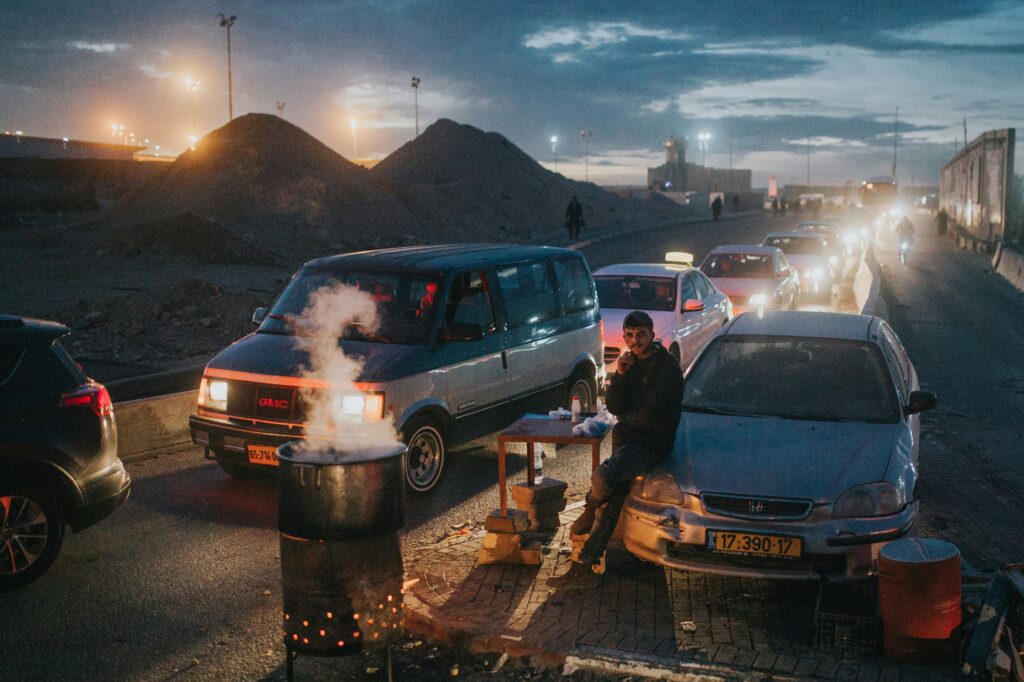
In 1997, Hebron was divided into two areas, H1 and H2. Most of Hebron’s Palestinians live in H1, but H2 includes the entire historic Old City and is now home to both hundreds of settlers and some 33,000 Palestinians. To reach their homes or move between areas, Palestinians in H2 must present their identification at Israeli military checkpoints and pass through metal detectors. When I walked the area that first time, the Old City’s main artery, Shuhada Street, was a ghost town. Lining the street were empty shops whose steel doors the military had welded shut.
On that trip, Palestinians in the Old City’s open-air market recalled routine harassment and violence. Settlers lived in buildings directly overlooking the market, and a canopy of wire netting had been strung up over the market to stop the larger rocks they sometimes hurled from windows. What the netting didn’t stop was smaller rocks, feces, and cups of urine. I was still chatting with a vendor in the market when, almost as if on cue, a cup of urine flew from a window and landed on a friend I was traveling with.
Elsewhere in H2, graffiti on the walls of an elementary school read “Gas the Arabs” and “Death to Arabs.” Palestinians were stopped and checked while simply walking along the street, and settlers with rifles slung over their shoulders moved around unimpeded.
The scene was no less unsettling in the Ibrahimi Mosque where Goldstein had slain 29 people. The mosque had been split into two to make half into a synagogue, and just as the Muslim call to prayer sounded off, a group of settler children began banging their fists on the door and singing, “Jerusalem, oh Jerusalem, is ours.”
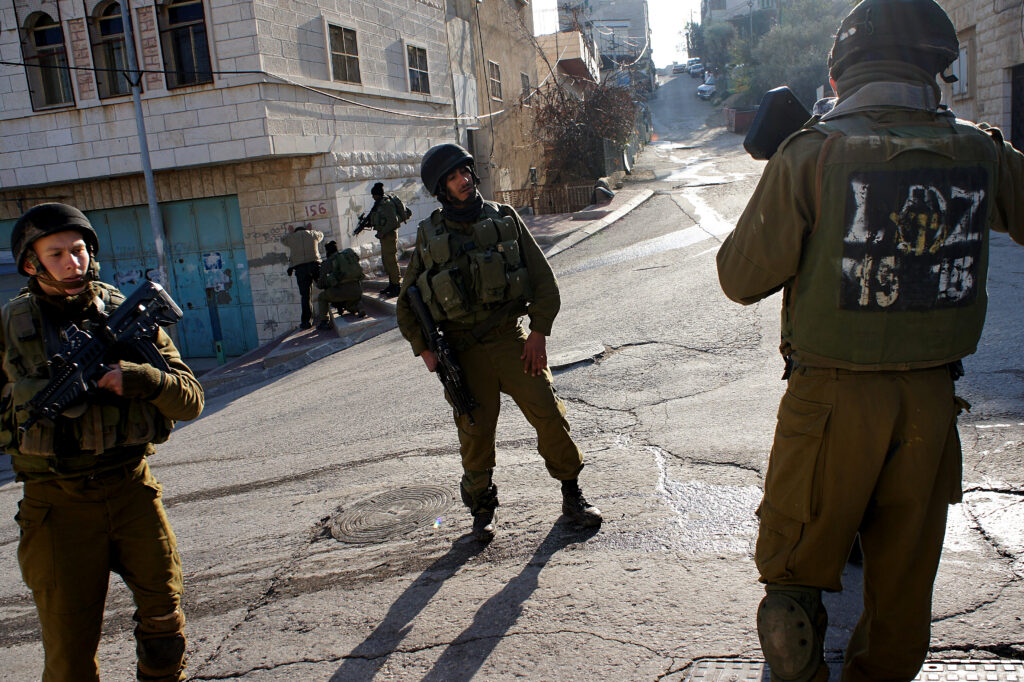
In 2014, while working on a report for Defense for Children International, I traveled much of the West Bank and interviewed Palestinians who lived next to settlements. Israeli and international press dubbed these incidents “price-tag attacks,” using language from settlers themselves, and they were often framed as revenge for Palestinian attacks in the region. The truth, of course, is that the attacks were indiscriminate.
In Sinjil, a village northeast of Ramallah, a Palestinian American mother named Ruwaida Dar Khalil recounted the night in late 2013 when four settlers stormed into her family’s home. After bashing the windows out with crowbars, the men forced their way inside, doused the entrance in gasoline, and lit the home on fire. Ruwaida’s family escaped, but her six children had to be treated for smoke inhalation. Months later, one of her daughters still woke up any time she heard a noise in the middle of the night, convinced the settlers had returned. “She won’t take a sip of water, nothing, without me standing by her like a guard,” Ruwaida said.
In Urif, a village in the northern part of the West Bank, Nabil al-Najjar told me settlers and soldiers had attacked the school where he served as principal six times in a four-month period. One of the most recent attacks, he explained, started when settlers turned up outside and pelted the school with stones as students sat for their exams. By the time the students left, Israeli troops had cut the school’s security cameras and posted up outside the front entrance. Clashes broke out, and several students had to be treated for tear gas inhalation and wounds from rubber-coated steel bullets.
Around 30 kilometers (18 miles) south of Nablus, Palestinians residents of a village called Jalud endured similar violence. Jalud sits near a settlement and four outposts. A 12-year-old boy named Omar told me that in October 2013, a group of settlers broke into his school and flung rocks at students in the classrooms. On their way out, they poured gasoline around the school and lit it on fire. “Even our teachers were scared after that,” Omar recalled. “It was hard for us to come to school and think about our studies.”
In the years that followed, the violence only escalated. In July 2014, a month after the Defense for Children International report was released, a group of Israeli hardliners that included settlers kidnapped 16-year-old Mohammad Abu Khdeir off a street in East Jerusalem. A few hours later, his charred corpse was found in the Jerusalem Forest. A forensic expert concluded that, based on fire dust found in the boy’s respiratory system, he had been burned alive. When the defendants went on trial that November, settlers gathered at the courthouse spat on members of the Abu Khdeir family. Three men were eventually convicted and sentenced to prison, but in most settler attacks, punishment is an exception.
Between 2005 and 2024, only around 3% of cases involving settler violence have resulted in convictions. Since Itamar Ben-Gvir became Israel’s national security minister in 2022, the number of police cases opened against settlers after violent attacks has sunk by some 70%. Still, Israeli Prime Minister Benjamin Netanyahu recently offered muted criticism of settlers. After settlers besieged Qusra, Netanyahu condemned the group as a “small handful of rioters” who harm the reputation of the “law-abiding settler public.”
How many settlers actively participate in the violence is, of course, unknown. Over the more than four decades since the Jewish Underground launched a campaign of car bombings and deadly shootings in the West Bank, though, settler violence has continued without pause. Now, as it spirals out of control once again, I’m reminded of the Palestinians who told me what life was like in the shadows of settlements all those years ago.
In early 2014, a then 47-year-old father of five named Mufeed al-Sharabati sat down with me and ticked through a long list of all the times settlers had attacked his home. He lived in Hebron’s Old City, on Shuhada Street, and settlers had recently thrown rocks and glass bottles at the house. The incidents were so frequent that his family had to put up steel bars in their windows. Only a couple of months before that, soldiers had detained and severely beaten him. Unable to obtain the treatment he needed in the West Bank, he had to borrow thousands of dollars to travel to Jordan for back surgery. As he worked on a cigarette, he thumbed through his X-rays and winced. “There is no difference between the violence by soldiers and the violence by settlers,” he said.
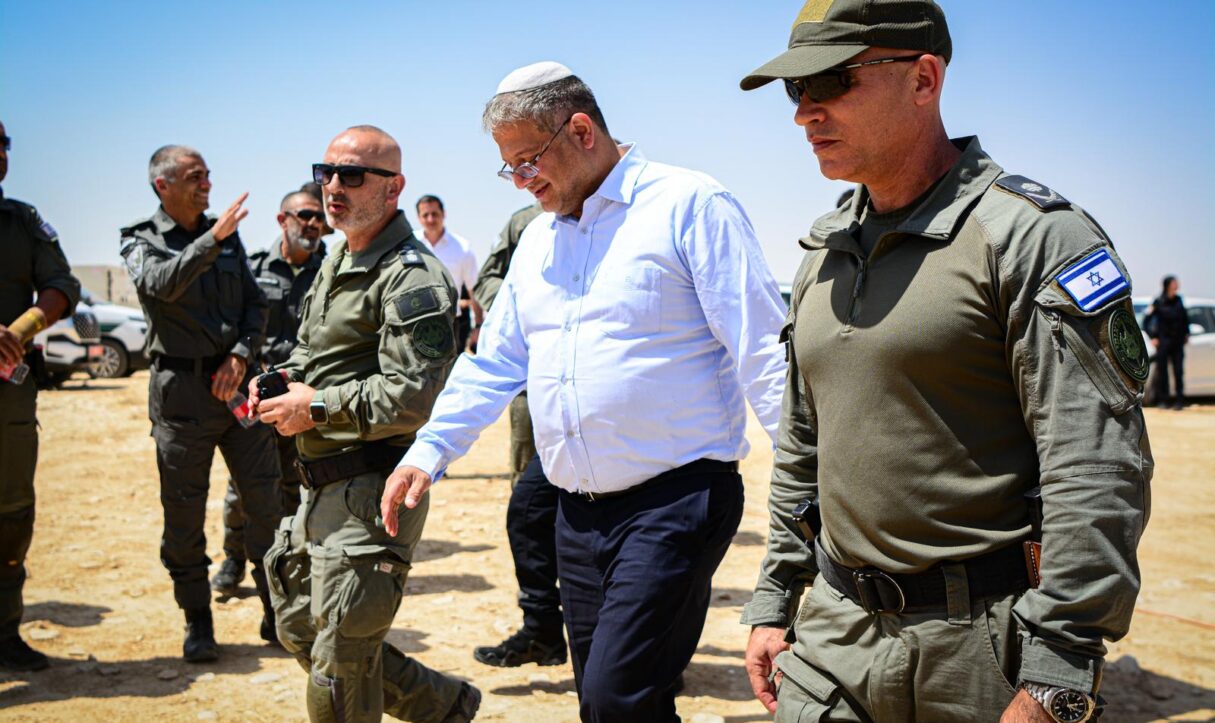
Top photo: Israeli National Security Minister Itamar Ben-Gvir walks alongside police in May 2025 (Israel Police/Wikimedia Commons)