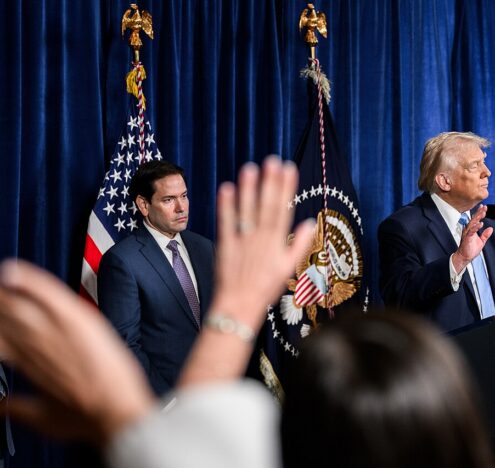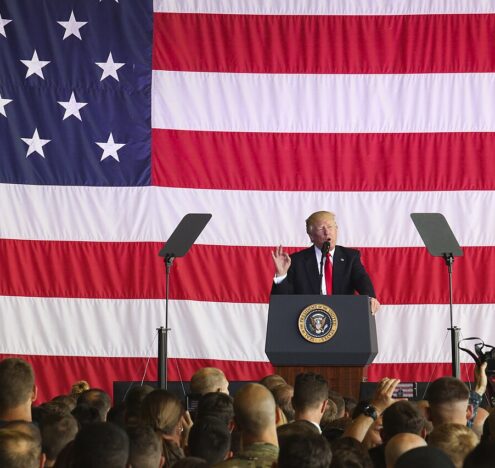












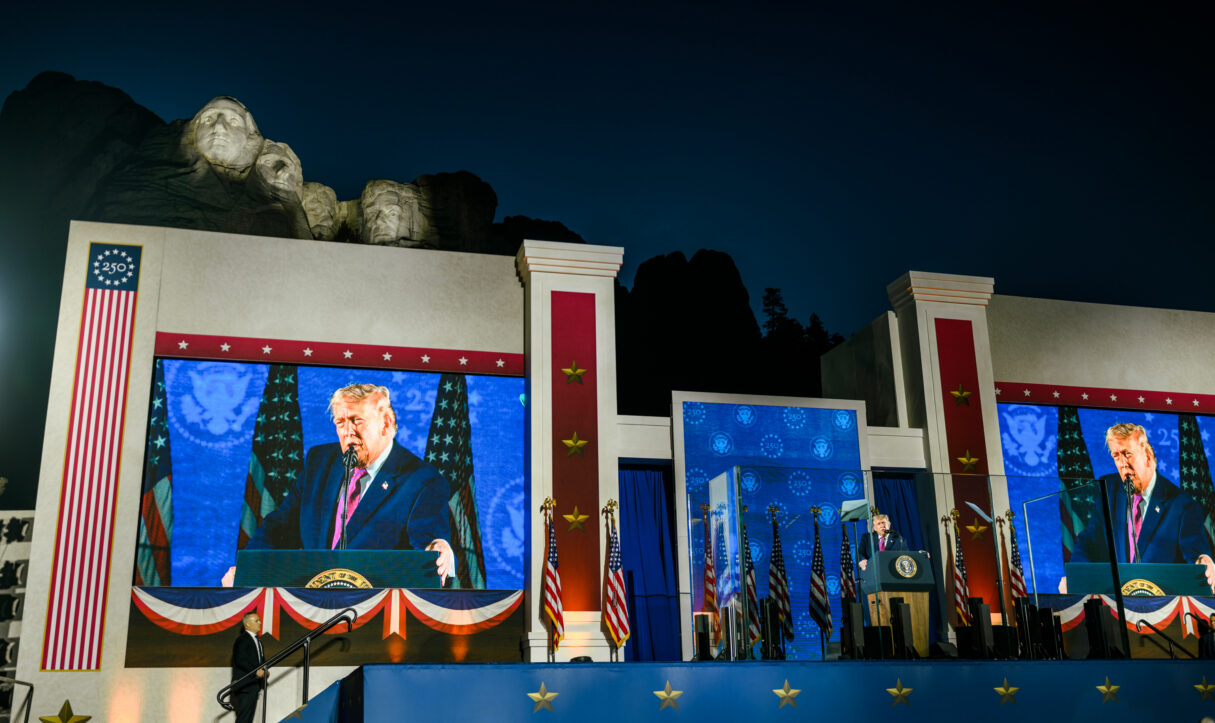
The night before the country’s 250th anniversary this July, US President Donald Trump took a podium in front of Mount Rushmore and told the audience what he considers the biggest threat the country faces: communism. “You can be loyal to Karl Marx, or you can be loyal to America,” the president said. “You can be a communist or you can be a patriot. You cannot be both.” Later in his speech, he added: “So, on the eve of this 250th anniversary of American heritage, we resolve and swear for all to hear that the citizens of the United States of America will vanquish communism quickly.”
Later that month, Trump, who has spoken of his hope that his face one day joins others on Mount Rushmore, called back to that address while speaking in Marietta, Georgia. He claimed communists had tried to “take down” Mount Rushmore and still hoped to “blow it up.” Then he insisted that communism presented “the single greatest threat to our country in its history, including even World War I and World War II, Pearl Harbor, and 9/11.” At risk, he warned, are national security, freedom of speech, and the future of the country’s democracy.
Since returning to office in January 2025, Trump has time and again vowed to crush the political left. His administration has deported tens of thousands of people, discussed stripping nonprofits of their tax-exemption status, gone after media outlets and cable news, and targeted anti-fascists at home and abroad with legal threats and terrorism designations. All the while, the US military has issued annexation threats to longtime allies, bombed countries from Latin America to Africa, and twice joined Israel in launching war on Iran.
Now, as upcoming midterm elections all but guarantee Republicans will no longer control both chambers of Congress, the president has escalated the anti-communist rhetoric. The GOP has predictably followed suit, centering much of its campaign strategy on this supposed communist threat. Meanwhile, many media powerhouses have zoned in on the recent primary successes of the Democratic Socialists of America (DSA), with right-wing and liberal outlets alike cycling through a series of often sensationalist headlines. As DSA-backed candidates won a slate of high-profile primaries, the media uproar has gone into overdrive. Fox News has warned of the “quiet socialist takeover” of the country, while The Atlantic, for instance, has published attacks on the group under headlines like “There’s Nothing Democratic About These Socialists” and “The DSA Is a Parasite.”
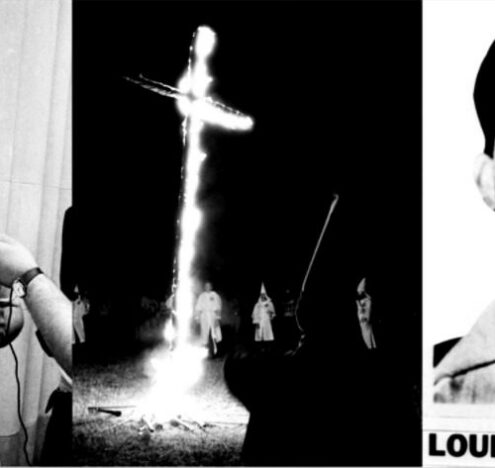
Anti-communism, of course, has a long, often violent history in the United States — one that has almost always been coupled alongside anti-immigrant and xenophobic campaigns. As far back as the late 19th century, warnings of the “communist menace” fueled attacks on the organized labor movement. Following the Paris Commune, a revolutionary government that led the French capitol for a little more than two months in 1871, American newspapers around the country warned of the alleged threat domestic communists posed to the US.
A pivotal anti-communist flashpoint came during the Great Railroad Strike of 1877, when railroad workers in Martinsburg, West Virginia, and elsewhere stopped work to protest wage cuts during a suffocating economic depression. As the work stoppage soon spread to Pennsylvania, Maryland, Illinois, New York, and Missouri, unrest and rioting also broke out in several places. Local police, state militias, and federal troops were dispatched to crush what historians now know as the country’s first major nationwide labor strike. By the time it was all said and done, more than 1,000 people were arrested and more than 100 killed. The anti-communism hit such a fever pitch that President Rutherford Hayes attempted to ease tensions by insisting communism had played no part in the strike.
Anti-communist paranoia, though, persisted, and whenever labor unrest erupted, accusations of communist and other radical subversion routinely followed. On May 1, 1886, labor organizers around the country held a general strike to demand an eight-hour workday in place of the 12-hour or 14-hour workdays many endured at the time. In Chicago, some 10,000 people rallied on the first day of the strike. Police soon shot and killed several demonstrators. On May 4, anarchist activists and others took to the streets, and a bombing in Haymarket Square killed seven police officers. When police opened fire and confusion ensued, at least four civilians were killed.
“Whenever there is reason to suppose that the Anarchist element is to be met, it should be met with rifles and Gatling guns beyond the reach of their inhuman bombs.” – New York Times
Newspapers the country over seized the opportunity to fan the flames of hysteria over political radicals. On May 6, the New York Times called for the expansion of police departments in major cities. “Their numbers should be increased, and, whenever there is reason to suppose that the Anarchist element is to be met,” the Times argued, “it should be met with rifles and Gatling guns beyond the reach of their inhuman bombs. In such treatment there is no danger of involving the innocent with the guilty.”
Eight men were subsequently put on trial. Some historical accounts say one may have taken part in making the bomb, while others have it that it was publicly known none had made the bomb or thrown it. In any case all eight were convicted. Several were executed by hanging. During the trial, the New York Tribune lamented what it viewed as overly tolerant American hospitality toward immigrants. In an editorial, the paper claimed that “foreigners of the Anarchist type” believed they could “generally proceed on the principle that the land of the free is a land one can abuse with impunity.”
The consequences lived on throughout the rest of the 19th century, and in the years following the deadly Haymarket incident, both the US government and the business class exploited the affair as justification for attacking organized labor. “In the decades that followed, there would be other moments like May 1, 1886, when laboring people would strike and march and demonstrate their desire to create a new world of work, moments when they could even imagine the coming of a new cooperative society,” the late historian James R. Green reflects in his 2006 book Death in the Haymarket. “But never again would there be anything quite like the feeling thousands of American workers experienced on that first May Day, that day when they believed that their dreams of freedom would really come true.”
In the early 20th century, labor unrest was often blamed on immigrants, and in many quarters, communism and labor organizing became a boogeyman for myriad forms of discontent over severe class inequality. It was the advent of World War I, though, that led to the most intense wave of anti-communist hysteria to grip the country at that point.
While seeking reelection in 1916, President Woodrow Wilson’s campaign vowed that, under his watch, the United States would not join the war spreading across Europe and beyond. In fact, one of the Wilson campaign’s most frequently used slogans was “he kept us out of the war.” Americans largely opposed the prospect of joining a foreign conflict, and voters put the Democrat back in office. Three months into his new tenure, the president promptly reversed course and declared war on Germany, formally involving the US in World War I.
Though millions of Americans rejected the idea of entering the war, according to journalist Adam Hochschild’s American Midnight: The Great War, a Violent Peace, and Democracy’s Forgotten Crisis, “Nowhere was anti-war feeling stronger than in the Socialist Party, whose members had long dreamed of a workers’ commonwealth that transcended national borders.”
In June 1918, longtime socialist leader Eugene V. Debs, a storied labor activist who had already run for president four times, delivered a passionate speech against the war at an annual convention in Canton, Ohio. Almost a year to the day prior, Wilson had signed into law the Espionage Act of 1917, which made it a federal crime to encourage insubordination in the military, publicly back the country’s wartime enemies, or even encourage Americans to resist mandatory conscription. A savvy and skilled orator, Debs attempted to choose his words carefully. “The master class has always declared the wars; the subject class has always fought the battles,” he said. “The master class has had all to gain and nothing to lose, while the subject class has had nothing to gain and all to lose — especially their lives.”
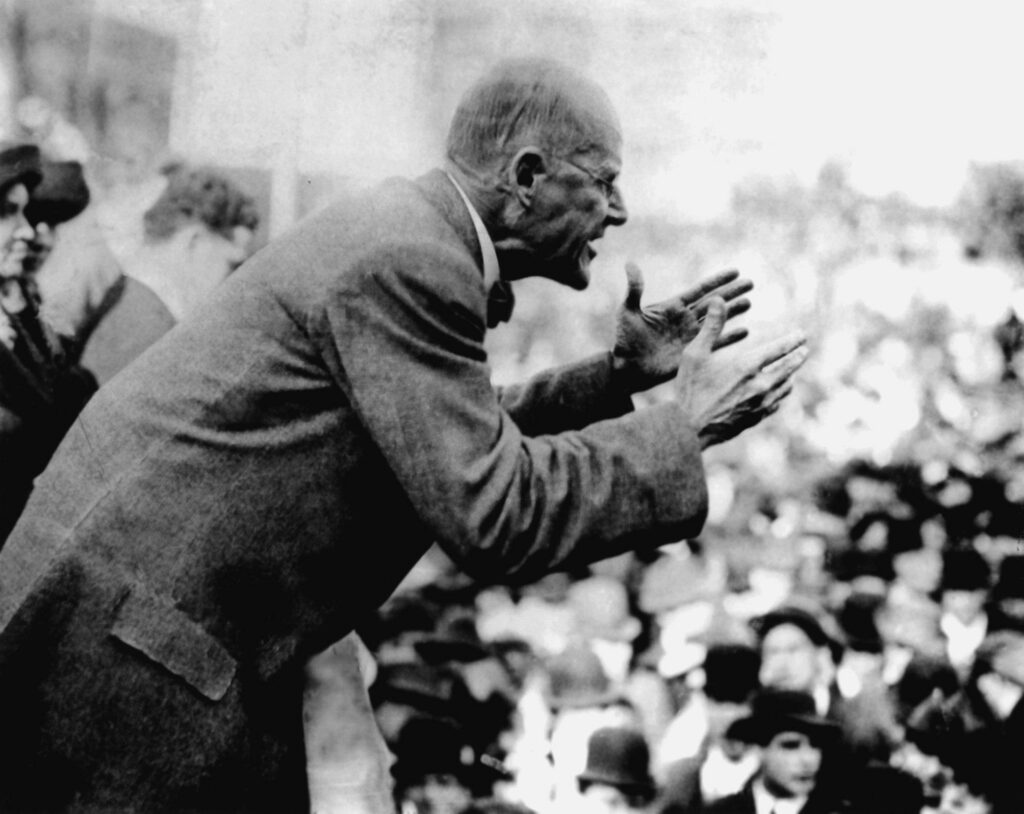
Without explicitly encouraging his audience to resist the draft, he defended the pacificists who had already been imprisoned or lynched for their refusal to take up arms. “Do not worry over the charge of treason to your masters, but be concerned about the treason that involves yourselves,” he said. “Be true to yourself and you cannot be a traitor to any good cause on earth.”
Several hundred people were in the crowd, but among them were dozens of federal agents and members of the American Protective League, a quasi-official assortment of private citizens who, with the Justice Department’s backing, surveilled citizens and sought out so-called subversives. With such company listening closely, Debs’s careful words didn’t help. He was charged with 10 counts of violating the Espionage Act and eventually sentenced to a decade in prison.
Unsurprisingly, newspaper editorials celebrated the sentence as proof that anti-war activism presented a grave threat to the country. In the wake of the 62-year-old socialist’s detention, the Washington Post reported on the speech under the headline “Debs Invites Arrest.” In a later editorial, the Post announced that his conviction “serves notice to all that disloyalty and sedition, even though masquerading under the guise of free speech, will not be tolerated.”
The war would end in November 1918, but such wartime repression would stretch on for years. During and after the war, leftists, pacificists, and immigrants found themselves in the Wilson administration’s sights for holding anti-war views. The postmaster general’s office was weaponized to effectively shutter dozens of anti-war newspapers around the nation. Thousands of suspected socialists, communists, and anarchists were swept up in mass arrests known as the Palmer Raids. More than 550 so-called “alien radicals” were deported, including 249 who were put on the USAT Buford — what the press deemed the Soviet Ark — and shipped to Russia.
Again, many newspapers rushed to demonize socialists and other radicals. Ahead of the mass deportation, the Daily News mocked Emma Goldman, Alexander Berkman, and other anarchists set to be sent to the Soviet Union. “They’re taking no chances on the food supply in [S]oviet Russia,” the paper wrote. “Fearing that their preachings there may not produce such a wealth of good edibles as the US affords, the Goldman-Berkman contingent has packed trunks and suitcases with canned goods and heavy clothing.”
More than a century on, the second Trump administration has mirrored Wilson’s repressive rule in surprising and alarming ways. Trump’s campaign to rid the government of diversity, equity, and inclusion policies, for instance, echoes Wilson’s resegregation of the federal government during his first term. Similarly, Trump has weaponized the US post office — his reason for doing so, he claims, is to prevent voter fraud, though watchdogs and observers say his true aim is voter suppression. And much like Wilson, Trump has attacked the press, detained and attempted to deport immigrants for anti-war advocacy, and targeted critics with legal retribution.
Though the first Red Scare eventually died down after 1919, anti-communism reared its head in ebbs and flows throughout the following decades. With the end of World War II and the beginning of the Cold War came a second Red Scare. In 1947, only around 75,000 people had membership in the Communist Party of the USA (CPUSA), but President Harry Truman faced allegations that his government was rife with communist spies led to another prolonged period of political repression. In response, Truman required federal employees to sign a loyalty pledge disavowing “totalitarian” ideologies, including communism and fascism.
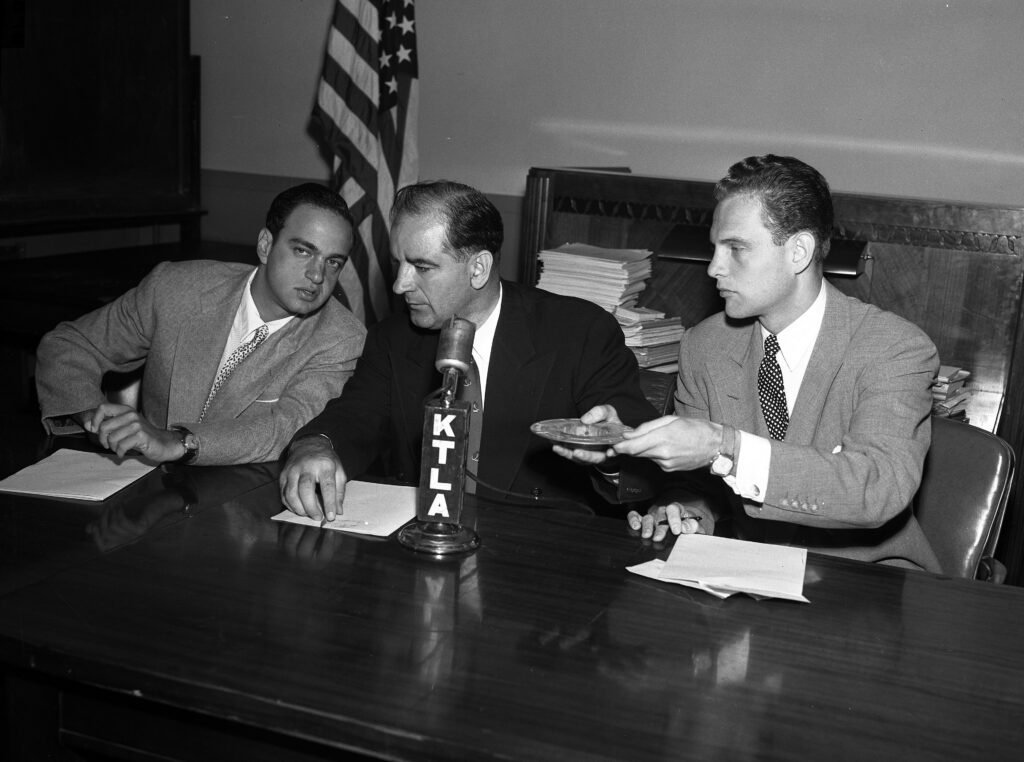
US Senator Joseph McCarthy, a Republican from Wisconsin, was a heavy drinker with a reputation for lying, but he utilized media sensationalism to become the face of ultra-nationalist paranoia. As the Foundation for Individual Rights Expression points out, “McCarthy had realized that in a media landscape of headlines and radio clips, allegations mattered more than proof. One could make terrifying accusations, keep them vague, and force everyone else to defend themselves.”
At the same time, the Federal Bureau of Investigation, now under the leadership of J. Edgar Hoover, created a division focused solely on surveilling and cracking down on political radicalism. In Congress, the House Un-American Activities Committee (HUAC) and other committees worked closely with the FBI to investigate “subversives,” while state and local governments as well as private industry mimicked this effort. (Incidentally, Roy Cohn, who served as HUAC’s chief counsel, later went on to become a mentor and legal advisor to none other than Donald Trump.)
Hollywood screenwriters, actors, and directors were forced to testify in front of HUAC. Blacklists meant many lost their jobs. Yet, the backlash also extended to government employees and others. All told, tens of thousands of government workers were investigated, and thousands lost their jobs or quit to avoid being terminated, many ostensibly only because they supported civil rights or happened to be members of the LGBTQ+ community.
As historian Wendy Hill has written, “In practice, people could lose their jobs for being on the wrong mailing list, owning suspect books or phonograph records, or associating with relatives or friends who were politically suspect.” Even as they faced the loss of their livelihoods, according to Hill, they “almost never learned the source of the allegations against them.”
The playwright Arthur Miller later compared the McCarthy-era Red Scare to “being trapped inside a perverse work of art.” In 1956, HUAC gave Miller a subpoena to testify, and he refused to name names, a decision that initially led to him being cited for contempt.
“In today’s terms, the country had been delivered into the hands of the radical right, a ministry of free-floating apprehension toward anything that never happens in the middle of Missouri,” he wrote nearly five decades later. “It is always with us, this anxiety, sometimes directed towards foreigners, Jews, Catholics, fluoridated water, aliens in space, masturbation, homosexuality, or the Internal Revenue Department. But in the ’50s any of these could be validated as real threats by rolling out a map of China. And if this seems crazy now, it seemed just as crazy then, but openly doubting it could cost you.”
More than a century after the First Red Scare, scarcely a moment has passed without a prominent politician claiming that the United States was under communist assault. In fact, even campaigns against militant environmentalists (such as the Green Scare of the early 2000s) and the post-Sept. 11 anti-Muslim hysteria resembled the red scares of the past. And on all accounts, these campaigns have enjoyed the support of both Republicans and Democrats.
In early September, eight House Democrats crossed the aisle and voted alongside Republicans to condemn socialism and the DSA — at a time when the US is more than six months into war in Iran, economic inequity is deepening, and the far right has increasingly cozied up with the White House.
In late July, HBO host and prominent liberal pundit Bill Maher confessed that, if a socialist became the Democratic candidate for president in 2028, he would rather cast his ballot for Trump’s vice president, JD Vance. Calling Democrats “cowardly” for not expelling DSA-backed candidates, Maher told Fox News: “My vote is in play because it can’t be Trump running, so I’m not living in a communist America.” (Like many in the GOP he so frequently chides, Maher ostensibly believes socialism and communism are synonyms.)
A growing number of voters see it differently. In September 2025, a Gallup poll found that just 54% of Americans hold a positive view of capitalism, a seven-point decrease from 2010. According to that poll, 66% of Democrats and 14% of Republicans viewed socialism favorably.
As midterms get nearer by the day, Trump and his team have only intensified claims of a communist threat. Speaking to voters in Maine recently, Vice President Vance likened Democrats to socialists and alleged they’re “trying to tear down this country, tear down our young people, tear down our military.” He added: “And what’s left over with the ashes of what they’ve torn down is socialism.”
To fend off this alleged socialist putsch, the vice president promised the Trump administration would “defeat socialism by giving you a stake in the American Dream.”
Of course, Trump and Vance likely don’t understand that this strategy has a long history of failure. In 1918, when Eugene V. Debs was awaiting trial in lockup, his brother Theodore predicted that anti-communism would, in fact, drive more people to radical politics. “Yes, it’s hell — and even worse, that in this country, which boasts of its democracy, there is less freedom of speech and press than ever prevailed in Germany under the rule of the Kaiser,” he wrote in a letter to the Texas socialist newspaper editor Thomas Hickey. Still, he argued the intense anti-communist fervor would do more “to organize and solidify the workers by the suppression of every constitutional right than all the propaganda we could carry on in a [quarter century] with untrammeled freedom of speech and press.”
He concluded, “Every time they deport or lock up a few more of us, the propaganda is given an impetus; and whenever the court issues an injunction … a million eyes are opened and even the blind are made to see as if by a miracle.”
He may very well have been right. Campaigning from a prison cell in Atlanta, Debs ran for president a fifth time in 1920. The country was fresh from the far-reaching horrors of the first Red Scare, with many political prisoners still languishing behind bars, but when Americans cast their ballots that November, nearly one million voted for Debs.
Woodrow Wilson had repeatedly denied requests to pardon Debs, calling him a “traitor” to the country, even as he quietly ordered the release of many wartime prisoners. Republican President Warren G. Harding would eventually commute Debs’s sentence in late 1921, but before that, Debs was asked of Wilson’s stubborn refusal to set him free. In response, the socialist only said, “It is he, not I, who needs a pardon.”