










Guided missiles, warships, and fighter jets across the US arsenal rely on a constellation of about 31 satellites orbiting high above the Earth. The Global Positioning System tells American forces where they are, where their targets sit, and what time it is, and the Pentagon depends on it so heavily that a new Government Accountability Office report calls GPS a potential single point of failure for the entire Department of Defense.
When Russia invaded Ukraine, its forces jammed GPS signals and degraded some of the precision-guided munitions the United States supplied to Kyiv, and both sides used spoofing to fake GPS signals. In eastern Ukraine, intensified jamming made one type of guided munition up to 80% less effective, and another still missed its targets up to 40% of the time even with countermeasures in place.
The Pentagon’s answer to this threat has been a decades-long effort to build a jam-resistant, encrypted military signal known as M-code, along with the satellites, ground systems, and receivers needed to use it.
GAO found that after more than two decades and billions of dollars, the department remained years away from fielding the capability. The clearest example is the ground control system. Development of the Next Generation Operational Control System, or OCX, began in 2010, and the Space Force originally planned to have it ready for operations by June 2017.
The service finally accepted the system from its contractor in July 2025, but only after granting multiple waivers, including one for a timing feature the system failed to deliver. Pentagon testers also flagged its cyber survivability as a high-risk area. In April 2026, the Pentagon killed the program and chose to modify the existing ground system instead. That fix carries its own costs. Cybersecurity upgrades now lag until 2030, and the new GPS IIIF satellites, already running an average of nine months behind schedule, need ground control software by early 2027 to support a planned 2028 launch.
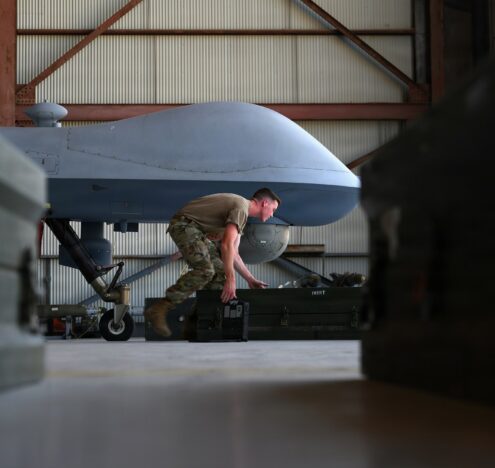
The receivers meant to pick up the new signal face their own troubles. When the Air Force tested an M-code receiver card on a drone, the card worked but failed to meet its accuracy requirements, so in June 2026 the program lowered those requirements to match the older standard it was supposed to replace. The contractor also shut down the production line for the M-code chips that many munitions programs depend on, leaving a limited supply as the services wait for a next-generation card.
The Tomahawk is not expected to reach initial operational capability with M-code until 2028, the Standard Missile 6 until 2029, and the Precision Strike Missile until 2031. Aircraft have proved even harder. One Air Force aviation receiver program lost a contractor in 2024 and does not expect initial fielding until March 2032, while the Army does not plan to finish equipping its full aviation fleet until 2049.
Backup systems offer partial relief. The Army already uses a navigation signal from commercial satellites in low Earth orbit, but to fully field it, the service needs permission from several foreign countries to install ground monitoring stations.
Other alternatives, such as visual, magnetic, and celestial navigation, are generally less accurate than GPS and depend on conditions. Visual navigation becomes largely unusable over oceans, deserts, and dense forests, and celestial tools need a clear sky.
GAO traced much of the delay to how the Pentagon organizes the work. Congress created a PNT Oversight Council to manage the portfolio, but the council can only recommend priorities, while each military service controls its own budget and can ignore that advice. Program officials blamed missed development goals on the Air Force’s “chronic underfunding” of its aviation receivers. The mismatch also creates practical risks, since some munitions may receive M-code before the ships and aircraft that launch them.
At a May 2025 meeting, one council official put the problem plainly, citing a “need to designate a single owner to the entire PNT value chain.” The House version of the fiscal 2027 defense bill would replace the council with a single official, though that person would lack direct budget authority.
GAO pointed to a model that already works. The Air Force merged several aircraft receiver efforts into a single joint program office, which now faces regular reviews and independent cost estimates. The watchdog recommended that the Army, Navy, and Air Force each assess similar consolidations.