








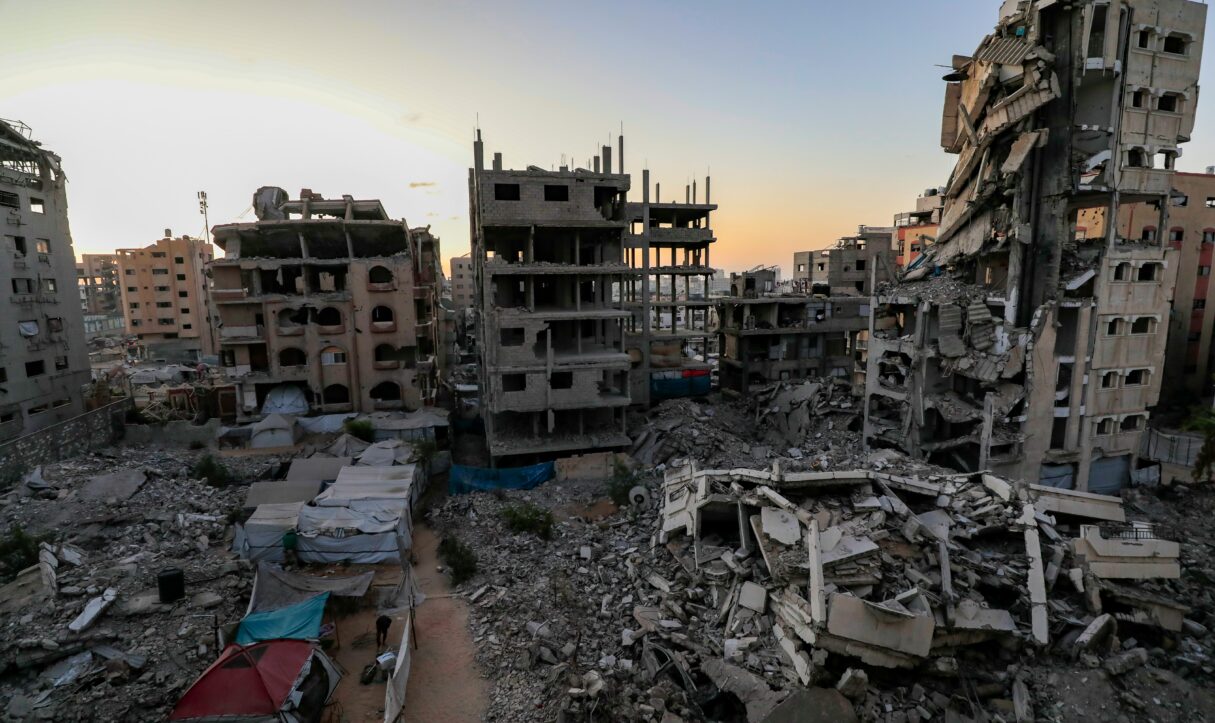
An old solar panel is the single source of power for the tent where Basma Shaheen lives in Deir al-Balah. It charges with the sun, from about nine in the morning until the afternoon, storing electricity for the small LED lights the family uses after dark. Shaheen worries about rodents entering the tent and wants everyone to be able to see when they maneuver the small space at night.
The family shares one phone between them. Her daughter needs it for university work; the other relatives take their turns. Sometimes they use it as a flashlight inside the tent as well. Shaheen says they pay 50 cents to charge it twice a day.
The arrangement works only by limiting the use of the battery. As winter approaches, Shaheen is worried about whether it will continue to supply even the lights. She bought a small flashlight for days when there is too little solar power.
Before the war, Shaheen, 41, had a complete solar installation at home in Jabalia refugee camp. It included panels, a battery and an inverter. Despite power shortages extending to more than 12-hour cuts per day due to the Israel-enforced siege since 2008, Shaheen wasn’t planning her days around electricity availability.
When the war escalated on Oct. 7, 2023, most people believed it should be a matter of weeks. But it turned into years, and by the ceasefire in early 2025, they returned home to nothing.
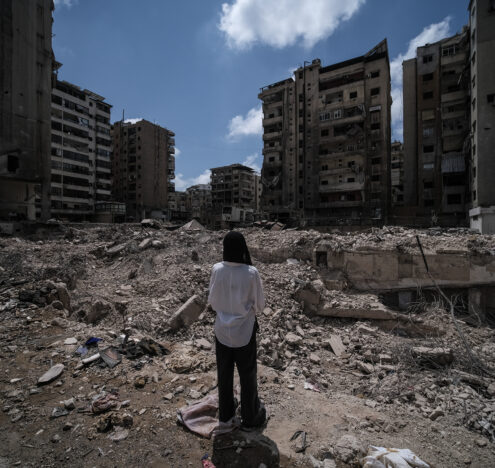
Shaheen, along with thousands, had been living in Jabalia refugee camp. She fled during the first week of the war, five months pregnant, after a neighboring house was bombed. At the time, Israel started what later was known as the “generals’ plan”, which wiped out massive areas in northeastern Gaza, including Shuja’iyya, Jabalia, and Beit Hanoun, where hundreds of thousands of residents had lived for decades.
Fleeing with nothing, Shaheen passed through checkpoints under falling bombs and moved several times before reaching Deir al-Balah, where she now shares a tent with her parents and siblings.
“I had a whole solar power system at home, with a battery and an inverter, but because of the bombing and the fear, we couldn’t carry it during the repeated displacements,” she says.
The family eventually obtained the panel and battery they have now. They collect water manually and pay for phone charging outside. Most of the daily solar charge is used up each night.
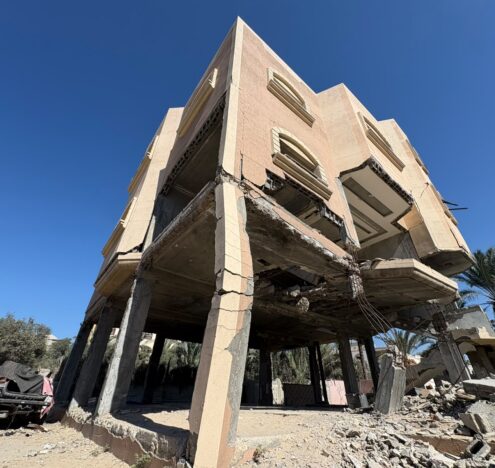
Across Gaza, small solar installations and paid charging businesses are supplying some of the electricity people previously received through the grid. The World Bank reported in May 2026 that more than 90% of electricity infrastructure assets had been destroyed or rendered inoperable by the Israeli military, with physical losses estimated at $560 million. Restrictions on electrical equipment have continued to hamper efforts to stabilize the system since then. Only one feeder line, supplying four megawatts to a desalination plant, remained operational. Restoring the electricity sector is expected to require between $2.7 billion and $4.7 billion over five years.
Three years into the war, the impending winter threatens to strain the survival techniques people have implemented. Cloudy days mean less electricity, while batteries must still supply lights and devices after sunset. A household can pay to charge a phone elsewhere, as Shaheen’s does, but the business providing that charge may also depend on solar panels.
More than 90% of electricity infrastructure assets in Gaza have been destroyed or rendered inoperable by the Israeli military, with physical losses estimated at $560 million.
Waseem Farajallah runs one such business from his family’s tent in Deir al-Balah. Beside the sweets he sells to children is a phone-charging point powered by three panels.
In summer, he says, he charges between 40 and 50 phones a day, at one shekel (32 cents) each. He can also run a small refrigerator and sell cold water.
In winter, the number falls to ten phones at best.
“If the sun disappears, everything will stop, and my livelihood will suffer,” says Farajallah, 37.
He brought the panels when he fled Nuseirat refugee camp and has moved them with him through successive displacements. They supply his family as well as his customers. His laptop, his phone and his wife’s phone need charging; the tent needs light at night.
He limits his winter business hours to 9 am until 4 pm to preserve charge for the family. The panels need maintenance, he says, after three years of being carried from place to place.
Replacing them is beyond his means. A panel he bought for $200 at the beginning of the war would now cost $2,000, he says.
Nor are generators an easy alternative. Reuters reported in September that shortages of fuel, engine oil and spare parts were disrupting their operation and making electricity from neighborhood generators increasingly expensive. The shortages affect the machinery people turn to when solar power is insufficient.
At Farajallah’s stall, a reduction in charging means a reduction in his family’s income.
For many students, the struggle is far worse. When Gaza’s general secondary school examinations began in June 2026, roughly 6,000 of the 37,000 registered students were unable to participate on the first day. The main difficulties included inadequate access to electronic devices, unreliable internet connections and insufficient electricity to charge equipment, according to the UN.
Haya Khalaf has borrowed money for her university fees. She is studying physiotherapy at the Islamic University of Gaza and completing practical training at the Deir al-Balah Rehabilitation Association, hoping to find work that will support her two children.
She does not have a phone of her own. She lost hers during the war and has been unable to buy a replacement. “Often, I have time when I could study, but there is no phone available to help me do that,” says Haya, 24.
She relies on her husband’s device during the limited hours when he is at their tent. During the day, she looks after the children. When he returns at night, she can use the phone to open the university’s Moodle platform, follow lectures and complete assignments.
There may be little charge left by then. Her husband also struggles to find somewhere to charge it.
“Often, my husband cannot charge his phone because there is no suitable source of electricity,” she says. “As a result, I submit assignments late, which affects my cumulative average.”
Winter will bring fewer hours of daylight for solar charging, but her time to study will still come at night. She has to fit the work into the period when the phone is both available and charged. In a survey reported by OCHA in March, residents in 76% of assessed displacement sites relied on mobile phones for light at night. Only 10% of sites had communal lighting.
Getting online presents an additional difficulty. Khalaf has missed exams because the internet access point was too far away or too weak. At times she goes to her parents’ home to borrow a sibling’s phone for a test. The distinction matters to her progress: finding a charged phone can get her as far as opening an assignment, but completing it also requires an internet connection that lasts.
During an exam, her connection failed midway through. She says the university did not accommodate her circumstances. She had to repeat the whole course and pay the fee again.
Even the journey to her practical training is affected by her lack of a device. Khalaf says the transport she needs uses payments through a mobile banking application. Without her own phone, she walks 40 minutes each day to reach the center. Cash liquidity is another issue created by Israel’s restrictions on bringing new cash into Gaza, forcing people to reuse already worn-out cash, pay fees of up to 40% to withdraw cash, or rely on unreliable online transactions.
“I am trying hard to balance my life with my children and my studies so I can reach my goal,” she says.
For now, those efforts include borrowing a phone, arranging internet access and working at night before the battery runs out. She also worries about keeping her children warm through winter in a tent without heating.
Shaheen’s winter preparations are similarly limited. She has bought the small flashlight, but the tent itself has grown old and she doubts it will keep out the rain. She cannot recover the solar system she left at home. Charging the shared phone outside remains an expense, and the panel beside the tent spends the day charging their battery.
Farajallah wants batteries and panels allowed into Gaza so that people can replace their worn equipment. He is still working with the three panels he brought from Nuseirat. Before the war, he owned a large supermarket there. The charging point and sweets stall are now his family’s only source of income.
“I never imagined I would end up doing work like this,” he says.
Throughout the working day, he stays beside the customers’ phones. He fears one might be stolen, leaving him with a debt he could not repay.
“Phones are extremely expensive, and if one were stolen, I wouldn’t be able to compensate its owner,” he says.
For one shekel (32 cents) per charge, he earns money from the panels while taking responsibility for devices worth far more. He cannot leave the stall while they are there. In winter, he also has to stop accepting work early enough to leave electricity for his own family.
By 4 pm, the battery’s remaining charge is for the tent.
The winter ahead is likely to expose those limits more sharply. The same clouds that threaten charging stations will hang over tents already ill-equipped for heavy rain, while aging batteries and damaged panels will have less energy to store.
**Thanks to journalist Besan Shomer in Gaza for collaborating on the interviews.