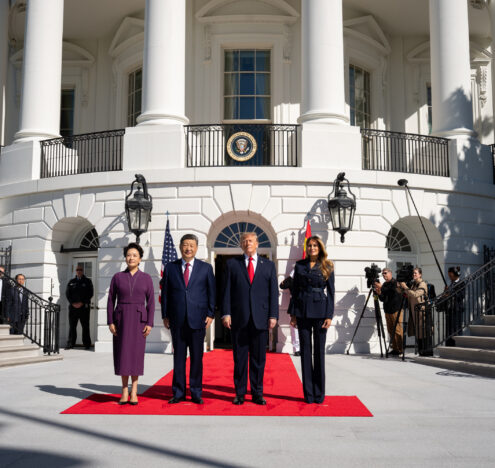









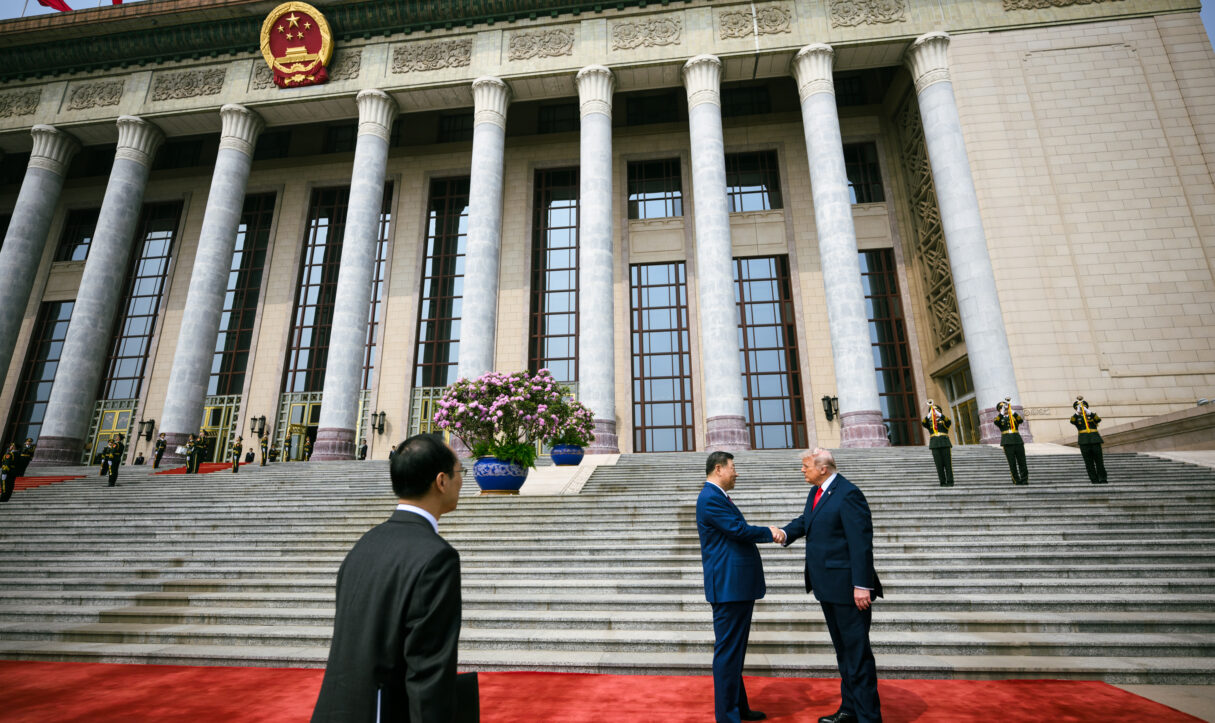
Across Washington, strategic competition between the United States and China is one of the most hotly contested foreign policy issues among politicians, military decisionmakers, and national security experts. Since the 2010s, policymakers and successive administrations have labeled East Asia a priority region in the face of a rising China, and tensions between both countries have intensified as trade wars and regional gray zone activities become commonplace. Yet the recent Trump-Xi summits and expanding public attention on US military operations in the Middle East have raised questions about the future of US-China competition and how Washington should approach Taiwan’s security.
September’s Reimagining US Grand Strategy roundtable brought members of the foreign policy community together to debate US strategy in East Asia. Two guest speakers provided opening remarks on the current state of US-China relations and American public opinion toward Beijing. The group then discussed the likelihood of a cross-strait war and whether Americans support US security commitments in the region.
Feng Zhang, Senior Research Fellow, East Asian Institute, National University of Singapore
There is a curious paradox in the current US debate over Taiwan. Fears of a catastrophic war with China have led some analysts to argue that Washington should rule out military intervention in Taiwan’s defense. Yet the same fears have fueled increasingly urgent efforts to strengthen military deterrence across the Taiwan Strait. The two prescriptions point in opposite directions but share a common premise: that war is becoming increasingly likely.
That premise deserves scrutiny. The United States may be overestimating the likelihood of a Chinese attack while adopting too narrow a conception of what is required to prevent one.
Beijing’s ideal strategy for Taiwan resembles one proposed by Sunzi more than 2,000 years ago: to win without fighting. Its actual strategy is correspondingly multidimensional, combining military pressure with political influence, economic inducements, cultural ties, and psychological operations. China’s military buildup is formidable, but Beijing has hardly abandoned nonmilitary means of pursuing unification. Its recent courtship of KMT chairwoman Cheng Li-wun is a case in point. Changes in Taiwan’s domestic politics can significantly affect Beijing’s policy toward the island.
To match Beijing’s Taiwan strategy, Washington needs an equally sophisticated approach to preventing war. Deterrence has an important but limited role. Its purpose is to manipulate an adversary’s cost calculus: a good deterrent strategy should convince Beijing that using force against Taiwan would be prohibitively costly. But deterrence cannot accomplish the equally important task of convincing Beijing that force is unnecessary.
That requires a distinct strategy of reassurance. Beijing continues to describe “peaceful reunification” as its preferred approach, even as it refuses to renounce force. US policy should therefore combine deterrence with reassurance: make the military option as unattractive as possible while maintaining political conditions under which Beijing can still believe that peaceful options remain open.
This does not require abandoning Taiwan or weakening its defenses. It requires recognizing that more deterrence is not always better deterrence. Military threats and preparations may discourage aggression, but they may also intensify insecurity and persuade an adversary that waiting will only leave it worse off. Deterrence fails when Beijing thinks it can win a war. Reassurance fails when Beijing concludes that it has nothing left to gain by waiting. Preventing war across the Taiwan Strait requires avoiding both failures. The optimal strategy for Washington is to increase Beijing’s costs of fighting without simultaneously increasing its costs of waiting.
Stephen Wertheim, Senior Fellow, American Statecraft Program, Carnegie Endowment for International Peace
For decades, America’s Taiwan policy has aimed at one central objective: to prevent cross-strait war or coerced unification. But preserving peace is only getting harder. China has grown far more powerful, and the people of Taiwan have come to see themselves as distinct from the mainland. These trends make armed conflict plausible over the next decade. Although war remains unlikely, the odds are high enough to warrant adopting a second fundamental policy objective: to minimize the harm to US interests should a cross-strait conflict occur. To my mind, that means planning to avoid direct military combat with Chinese forces, provided Beijing does not attack US forces first. As I have outlined in Foreign Affairs, it also means reinforcing the US commitment to regional allies and reducing America’s dependence on semiconductors made in Taiwan.
The second objective should complement, not override, the first. Washington should avoid any step that would maximize one goal but undermine the other. It should not, for example, pledge to defend Taiwan or station large numbers of US troops on the island. Even if these moves would strengthen deterrence — a big if — they would also entangle the United States in a potential Chinese invasion or blockade.
Conversely, some steps that would help the United States stay out of a cross-strait conflict would run too great a risk of inviting one. Several strategists have recently proposed that the United States end its policy of “strategic ambiguity” by officially declaring that it would not defend Taiwan. Once Washington ruled out intervention, Beijing might coerce Taipei into capitulating or attempt to compel unification by force. Perhaps it would instead stand pat, thinking time was on its side, but it would have compelling reasons to act before a less accommodating US president could come to power and Taiwan could build up its defenses. If China gained control of Taiwan, it could well restrict US access to the island’s semiconductor fabs, dealing a major blow to the US economy.
America’s Taiwan policy should now balance preventing a war with preventing an American war. This framework will not produce decisive answers, but perhaps it offers the right approach to a problem that, for the foreseeable future, is better managed than solved.
Nick Hawkins, Research Associate, China Program, Stimson Center
Strategic debates in Washington over Taiwan revolve heavily around the often over-indexed threat of a Chinese military invasion. This framing generally anticipates a sharp escalation that would elicit a US response (or not). While the nature of a US response in this scenario is worthy of deep consideration, this should be balanced by a recognition that non-peaceful “reunification” is not China’s first choice. Beijing is already actively pursuing other pathways to take control of Taiwan. Increased focus on these longer-term, “frog in boiling water” threats would confer greater strategic coverage to debates over Taiwan’s role in US East Asia strategy.
While kinetic threats are uncertain, China is already advancing its preferred outcome of peaceful reunification through numerous systemic, coercive approaches. From “gray zone activities” and military drills to economic coercion to cyberthreats to disinformation and misinformation campaigns to election interference to isolating Taiwan from the international community to flooding Taiwanese social media with content and more, Beijing’s options are extensive. While no individual action would likely trigger a direct US response, these tactics have the collective potential to gradually erode Taiwan’s confidence in the United States and in an independent future. Culmination of these efforts in a tangible outcome would also force the United States to assess any resolution as either peaceful or coerced, determinations carrying different implications under the Taiwan Relations Act.
While a potential invasion of Taiwan should inform US strategy, a comprehensive strategy must also adequately consider the potential drivers and consequences of Taiwan’s capitulation without fighting. What would happen next, and how would a nonviolent takeover differ from a post-war scenario? What preemptive actions in line with existing policy can or should the United States take to prevent this outcome? How does conduct towards other allies and partners affect Taiwan’s confidence in the United States?
The role of Taiwan in US regional strategy and whether the United States should defend Taiwan are ongoing debates. Greater consideration of “peaceful reunification” scenarios inject further complexity into these debates, but fully contemplating a more comprehensive range of eventualities may be necessary to develop a sufficiently broad and resilient strategy.
Lami Kim, Korea Chair in Advanced Technologies, National Security and Defence, International Institute for Strategic Studies
In arguing that defending Taiwan is not in Washington’s interest because doing so would risk a major conflict with China that could escalate to the nuclear level, some assume that China, whether or not it achieves unification with Taiwan, would not pose a significant threat to US security, largely due to the “stopping power of water,” and nuclear deterrence. However, will these longstanding assumptions in international relations continue to hold in an era of artificial intelligence (AI) and other emerging technologies that are challenging much of what we have traditionally taken for granted about warfare and deterrence?
Could these technologies enable China to disrupt or paralyze US command, control, communications, computers, intelligence, surveillance and reconnaissance (C4ISR) systems? What if China could conduct AI-augmented cyber operations to disable or disrupt US nuclear forces before they could be employed through so-called “left-of-launch” operations? What if advances in Chinese quantum sensing undermine the survivability of US nuclear forces and, consequently, the credibility of its second-strike capability, even without making the oceans fully transparent? What if these technological developments, taken together, embolden China to believe that it could successfully execute a disarming first strike through precision counterforce attacks?
Admittedly, the United States currently leads China in AI and several critical emerging technologies, although some argue that China is poised to take the lead in certain quantum technologies. However, US export controls on advanced semiconductors—essential for training sophisticated AI models — have helped constrain China’s technological progress. Will this advantage endure if the technological gap continues to narrow, particularly if China gains control of Taiwan’s semiconductor industry intact following unification? Even if the United States succeeds in establishing sufficient domestic semiconductor manufacturing capacity to reduce its dependence on Taiwan — not an easy task — China could still gain a significant competitive advantage if it could produce advanced chips more cheaply and at greater scale. Under such circumstances, it is not difficult to imagine China overtaking the United States in critical areas of AI and emerging technologies.
None of this necessarily invalidates the argument that defending Taiwan is not in the United States’ interest. One could reject the assumption that China would pose little threat to US security, while still agreeing with this policy conclusion. Even if China’s acquisition of Taiwan would significantly increase the security threat to the United States, that threat might still not justify risking a nuclear war with China. That is a legitimate subject for debate. However, the debate should be informed by a clear understanding of the alternative risks and a careful weighing of those risks against the risks of defending Taiwan.