










Rawaa Shallah remembers her daughter Bayan holding on to the metal posts at a school shelter as she learned to walk.
“My heart was breaking for her,” Shallah says.
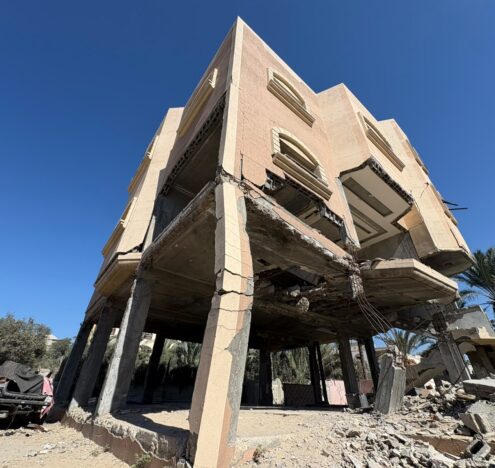
The family had been displaced from Shujaiya, one of the many neighborhoods the Israeli army leveled. Shallah also remembers bathing Bayan in a cooking pot in a school shelter because she could not find anything suitable to wash her baby. For diapers, she used pieces of cloth. She remembers washing her daughter’s clothes and crying.
“One of the things that hurts me most is remembering how I didn’t have nappies, the most basic thing,” she says. “When I washed her clothes, I cried bitterly.”
In winter, she arranged the one blanket she had for Bayan in layers to keep her warm.
Like hundreds of other babies, Bayan will turn three on Oct. 7 this year. Her mother, 26, now has three daughters and is pregnant again. She and her husband, Hatem Shallah, 29, are unemployed. They live with the children, Hatem’s father and his sister, on a staircase at a school that has been turned into a shelter in Deir al-Balah. Nearly 90% of those schools were destroyed or partially damaged within the first six months of the war.
For Shallah, her pregnancy passed in 2023 in what then felt like normal life. Gaza was under Israel’s blockade, but Shallah, like many Gazans, adapted to the ongoing pressure. Filled with hope of her third baby arriving soon, Shallah dreamed of many plans for her daughters.
On Oct. 7, 2023, as the war started, she went into labor. She reached Al-Shifa Hospital in a donkey-drawn cart. Bombs were falling, and she struggled through her labor pains. She says the doctor decided on a cesarean because of her poor health at the time of giving birth. At 2 pm, Bayan was born.
In Gaza’s culture, breastfeeding is avoided in times of fear or sadness, as it is believed to impact the health of the child. But in times of war, survival is instinctive. There was no formula at the hospital. Amid the chaos of the influx of patients at the hospital, Shallah grasped her baby girl to breastfeed her.
The baby weighed two kilograms (4.4 pounds) at birth, according to her mother. About two weeks later, she developed breathing problems and spent several days in the hospital. Shallah says this illness has continued. When Bayan cries, the difficulty breathing becomes worse.
Just a few days after giving birth, the family, along with 1.1 million other civilians, followed Israeli evacuation orders and fled. They moved between tents and schools, eventually reaching Deir al-Balah in the middle of the Gaza Strip. Shallah remembers the prices of baby supplies she could not afford. Bayan never used a cot or a baby walker, her mother says. She played with empty water bottles.
It was around a year and a half before she began saying “Baba.” Shallah describes her daughter as stubborn. There are bouts of crying she cannot always account for. When Bayan hears bombing or aircraft, she is frightened.
Ten days after Bayan was born, another family welcomed new life amid the turmoil. Asmaa Amer, 24, gave birth to baby Nael Salah. She had been nine months pregnant when, she says, the Israeli military ordered the family to leave Gaza City for the south. They also moved into a tent in Deir al-Balah.
Her labor began Oct. 17, 2023. Transport was difficult to find. After a long struggle, she reached Al-Awda Hospital in Nuseirat, where she remembers spending a whole night afraid that the hospital would be bombed.
Her husband and mother-in-law were with her. Amer remembers seeing groups of wounded people and the dead being brought into the hospital while she was on the delivery bed.
“When I first heard Nael cry, I cried a lot,” she says. “I thought, ‘How will this child live in a tent? What if they bomb the hospital while I’m inside?’”
Over the ensuing years, the family moved again and again, seeking an illusion of safety. Amer recalled moving to Sheikh Radwan, al-Karama, al-Shati, along with Deir al-Balah. And she remembered the stress when a piece of baby clothing or a blanket would go missing in the moves. Nael’s father was out of work. Formula and diapers were expensive, and the family relied on his grandfather to help provide for them.
Amer repeatedly went to clinics run by UNRWA to ask about her baby’s vaccinations. Sometimes the vaccines were unavailable, she says, and Nael’s vaccinations were delayed. In winter, she says, he frequently had severe coughs and congestion in the cold tent.
His first word was “Teta,” grandmother. Amer remembers him saying it at eight months. His grandfather managed to get him a small ball, his only toy. He also played with kitchen utensils and plates. Amer was careful about letting him play in the sand: She feared contamination and viruses.
Nael began walking at a year and eight months. He now attends a nursery program, something his mother considers an achievement after the difficulties the children in the family have experienced.
The birth journeys of mothers in Gaza during the war have been fraught with suffering, and not just labor pains. Since the ceasefire announcement in October 2025, more than 300 children were killed, bringing the total tally to more than 21,280 children killed since the war began.
Wafaa al-Bairuti’s mother, Maha al-Bairuti, 26, also found herself worrying about how a baby would play when even basic supplies were difficult to obtain. “I kept thinking about Wafaa’s toys: how would she play with so little available?” she says. She tried making dolls herself.
Wafaa was born on Nov. 17, 2023. Al-Bairuti remembers labor beginning at 11 pm, while she was displaced in a tent in Nuseirat. There was bombing and artillery fire. Travel at that hour was dangerous, as the Israeli military tends to target moving vehicles at night. Instead, Asad al-Bairuti, her husband, decided to call an ambulance from Al-Awda Hospital. This service, at such a time, was like a luxury dream. They were mostly denied to civilians due to fuel shortages or concerns that ambulances would be targeted, but luckily, this time it worked.
Amid the thundering of bombs across the area, Wafaa arrived, screaming loudly. Before the delivery, her parents had not been able to get even simple clothing for the baby. The next morning, Wafaa’s maternal grandmother came to see her daughter and granddaughter. The hospital gave al-Bairuti a bag containing some of the basic supplies for herself and the baby.
Like many mothers, al-Bairuti breastfed her because the family could not afford formula. She says she did not have enough nutritious food for her own recovery after childbirth. Flour was particularly expensive, and there was too little to eat.
“My husband Asad refused to eat so he could provide his share for us,” she says.
They appealed to organizations for milk and supplies. Al-Bairuti says UNRWA schools provided more help, including nappies and vaccinations. She describes her daughter as underweight.
The family has been displaced more than three times since giving birth — some Gazans would consider them lucky to be displaced just “a few times.” Wafaa struggled to adjust to the different places they stayed, her mother says. For the winter, she took her children to her parents’ house in Al-Maghazi. She feared the cold in the tent and the possibility of flooding.
Wafaa’s first word was “Mama,” but it was always muttered with fear. She began walking at two. When the sound of bombing frightens her, her mother holds her and tries to find something that will distract her. She has been trying to take Wafaa to nurseries, play areas and learning spaces, and to get coloring materials and notebooks for her.
In Deir al-Balah, Amer is excitedly planning Nael’s third birthday. His first passed without a celebration. She says hunger and the family’s circumstances made it impossible. For his second, she tried to make a simple cake with insufficient ingredients during Gaza’s starvation, when babies died of malnutrition.
“This year I’ve decided to get him a cake and have a special birthday party to make up for what he has lived through,” she says. “I’ll get him a nice toy.”
She also describes the room she would like to give him if the war ends and the family can live in a safe home: a room filled with toys he likes.
Wafaa’s mother is planning a gift for her daughter’s third birthday too. She wants places where Wafaa can play and learn safely.
“I wanted a safe life for Wafaa like her brother Ayan’s,” she says, “and for her to live a settled life, and for me to give her all the fruit and delicious food she asks for.”
Shallah has never been able to celebrate Bayan’s birthday. She has wanted to get her a cake, something she thinks would make her daughter happy.
“I hope the war ends and we go back to our warm home,” she says, “and that Bayan is settled and safe.”
She has also wanted photographs of the stages of Bayan’s childhood. Shallah does not have a phone of her own. Sometimes she used a relative’s phone to take pictures, but she has not been able to keep the photographic record she wished for. Of the memories of bathing her daughter in a cooking pot and washing her clothes while crying, she says, “These bad memories will not leave me until I die.”
A whole generation of children has now lived through three years of war. Their past birthdays have been marked by displacement, hunger, and death. The third birthday is no longer a hope for what is approaching, as their parents still live in tents and schools that were never safe.
Thanks to journalist Besan Shomer in Gaza for collaborating on the interviews.