








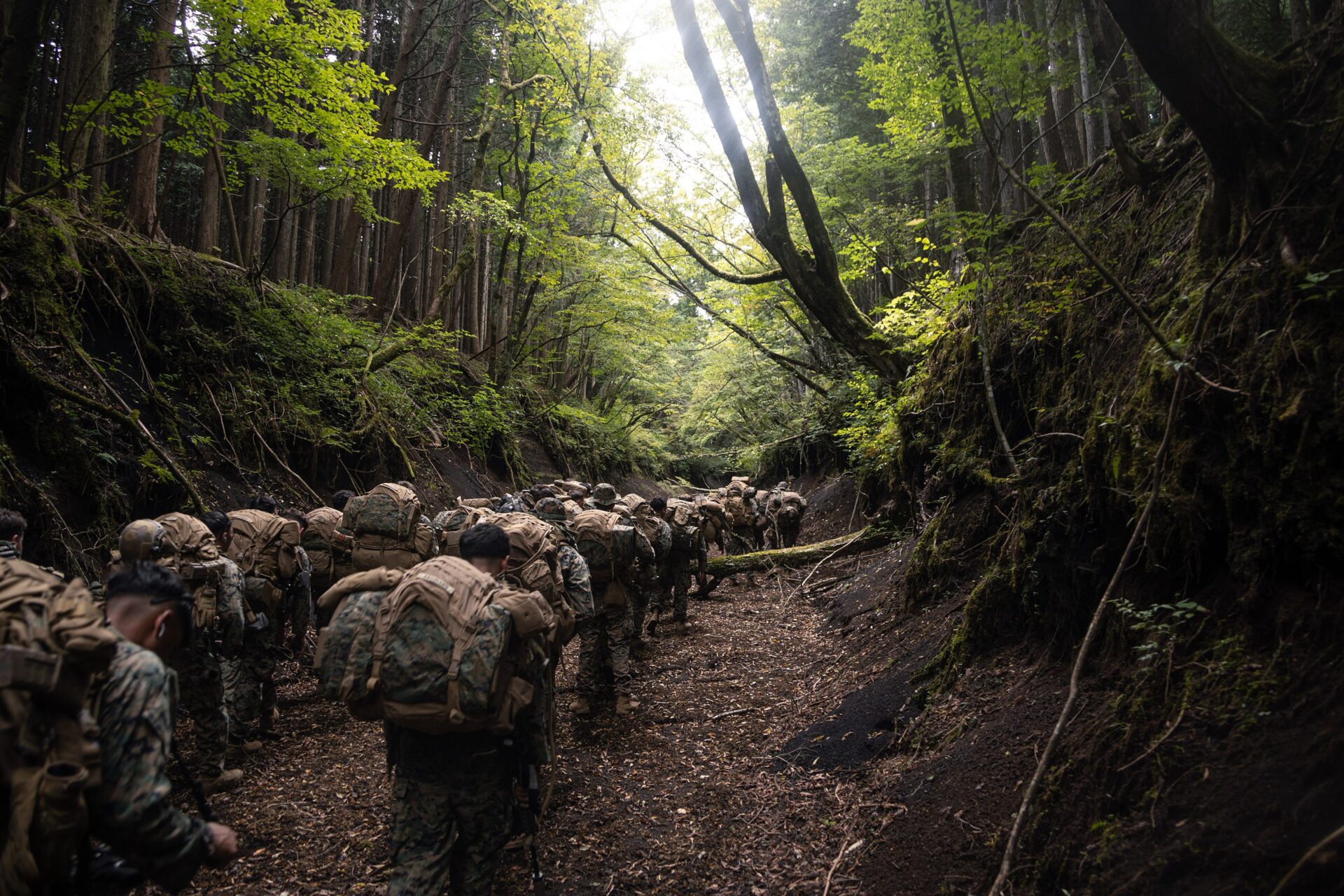
Fifteen years ago, a young Marine infantry officer named Ian Campbell arrived in Okinawa to help plan operations for the III Marine Expeditionary Force. He expected orders, exercises, and readiness drills. Instead, he found Pacific Command running what looked like a foreign policy operation, coordinating everything from disaster response to diplomatic outreach across an entire ocean. The gap between what he had trained for and what he actually saw stayed with him for more than a decade.
That experience became the seed of a new dissertation submitted to American University’s School of International Service, in which Campbell builds what he calls a Theory of Presidential Military Belief Transmission. The theory seeks to probe whether a president’s personal beliefs about how the military should be used actually flow down into the daily work of the regional combatant commands, or if those commands operate largely on their own institutional momentum regardless of who occupies the White House.
To test it, Campbell examines the roles of Southern Command and Pacific Command across the Clinton, Bush, and Obama administrations, drawing on congressional testimony, formal military reports, and more than 30 interviews with senior officials who served during those years.
The puzzle Campbell set out to solve was first laid out two decades earlier. In September 2000, Washington Post reporter Dana Priest published a three-part exposé portraying the Pentagon’s regional combatant commanders as officers who wield outsized political influence with little day to day oversight from civilian leadership.
Priest, who later expanded the series into a book, reported that the commands had been directed to “shape, prepare, and respond” across the globe without ever receiving clear guidance on how to do it.
The dissertation’s findings complicate a simple story of presidential control. Campbell reports that combatant command roles have varied by administration in ways that defy both structural realist explanations, which emphasize the international system’s pressures, and path dependent accounts, which assume institutions change only gradually along established tracks.
Each president arrived in office with distinct beliefs about the military’s proper role and the degree of civilian control it required, and each administration did craft policies reflecting those views. But Campbell found that presidential beliefs have not reliably or automatically translated into changes in what the commands actually did on the ground.
Instead, Campbell identifies a more tangled set of causes. Presidential beliefs carry more weight in regions where conventional security threats are already salient, meaning a president’s views matter more in a place like Korea than in one where the military’s role is largely humanitarian or diplomatic.
In regions that receive less presidential attention, combatant commands tend to keep doing what they have always done, a pattern of path dependency that outlasts changes in the White House. And in some cases, presidential beliefs themselves shift abruptly in response to external shocks rather than evolving on a fixed ideological trajectory.
Campbell’s account also pushes back on the broader claim, common in the militarization literature he reviewed, that the Defense Department has effectively taken over the conduct of US foreign policy. He writes that his own experience in the Pacific did not match the picture painted by many scholars, and that the puzzle motivating his research is precisely that gap between the academic narrative and what he witnessed firsthand inside the command structure.
Presidents, he concludes, retain the constitutional authority to direct how the military is used, and that authority continues to matter even when its effects are indirect and difficult to trace. As Campbell puts it, “Presidents, and their beliefs about the military, matter.”
The dissertation’s implications extend beyond the historical case studies. Campbell argues that his findings offer context for military policymakers navigating a period of greater uncertainty and tighter resources, suggesting that expecting a new president’s stated views on the military to produce immediate, uniform change across every region would be a mistake.
Still, where security concerns are acute, a president’s beliefs are likely to shape command activity quickly. Where they are not, existing patterns of behavior, and the institutional inertia built into commands like the Pacific Command and Southern Command, are likely to prove more durable than any single administration’s stated intentions, according to Campbell’s research.