











Home to a little more than 32,000 people, the Greek island of Samos draws hundreds of thousands of tourists each year. Situated in the eastern Aegean Sea, the island boasts of 159 kilometers (99 miles) of coastline, famed locally produced Muscat wines, and a UNESCO World Heritage Site, the Pythagoreion and the Heraion of Samos. Because of its proximity to Turkey, though, it also sits along the busy migration route to Europe. In September 2021, a deadly crime allegedly took place in the azure waters off the island’s coast.
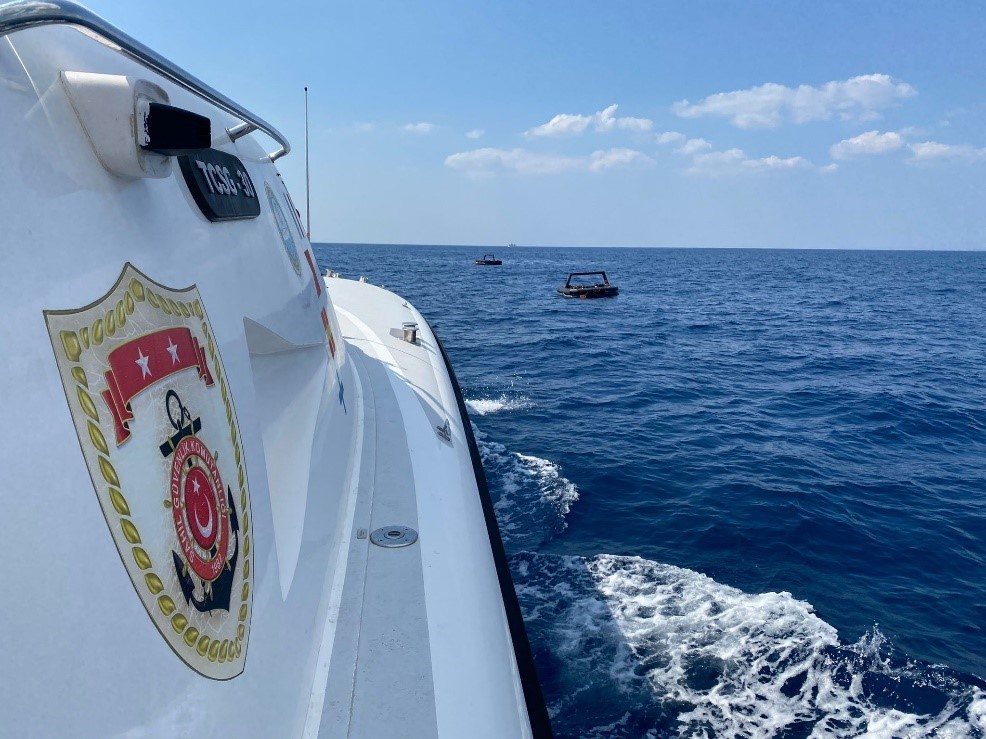
The summer heat was beginning to ease that month, and a group of 36 people reached the coast of Samos with the hopes of seeking asylum. Masked individuals apprehended 28 of these displaced people, robbing and brutalizing them before shuttling them back out to sea and abandoning them in orange life rafts in Turkish waters. Among those forced off the island were children, infants, and pregnant women. The Turkish Coast Guard later documented their rescue. But it was only one of the crimes that befell the desperate people who had reached Samos that day.
Four of the passengers who had evaded capture eventually reached the island’s refugee camp, while three men who had broken away from the group slept in the forest. Later, while walking along one of Samos’s roads, these men were allegedly apprehended by people who identified themselves as police officers.
As hoards of late-season tourists ate meals at the island’s seafood tavernas that day, a Greek coastguard boat pushed off from one of the nearby ports. Aboard were the three men captured on the road. They had been handed over to a group of masked individuals. In violation of the Geneva Convention as well as national and international law, the men were not only denied their right to request asylum — they were ferried out to sea and thrown overboard.
The two men who drowned that day, Didier Martial Kouamou of Cameroon and Sidy Keita of the Ivory Coast, joined the ranks of the more than 35,000 people who have died or gone missing while crossing in the Mediterranean Sea since 2014, according to the International Migration Organization’s data. Since the spike in arrivals in 2015, a period known as the European refugee crisis, countries across the European Union have ramped up border enforcement. Across the last 11 years, Europe’s far right has lobbied for stricter border controls while countries including Greece have stood accused of widespread violence on their frontiers.
Effectively left for dead, one of the three men miraculously survived the ordeal. Ibrahim managed to reach Turkey, and he later returned to Greece on a dinghy, armed with the story of what happened. In February 2022, he recounted his version of events to a consortium of journalists who reported on the incident, drawing on the testimonies of other survivors, officials, and lawyers to reconstruct the grim details that unfolded in the waters of Samos.
By September 2021, the practice of pushbacks — the forced expulsion of refugees and migrants who are denied the opportunity to apply for asylum — was already widely documented in Greece. Pushbacks are prohibited under international law, but lawyers and journalists had increasingly sounded the alarm on their use. In response, the Greek government issued blanket denials. Though the EU occasionally offered muted criticism of the measures Greece used on its land and sea borders, pushbacks continued unabated. After all, Ursula von der Leyen, the president of the EU Commission since 2019, had described Greece as Europe’s “shield” only a year and a half before the Samos incident.
Five years on from the deadly incident off Samos, no one has been held accountable in court for the pushback that took place that day or the deaths of the two men.
Venant Olinga, a 38-year-old from Cameroon who was cast adrift at sea in Turkish waters that day, witnessed the events. Once in Turkey, he was eventually able to reach Europe again and now lives in Paris, where he has refugee status. The sense of impunity, he said, still haunts him. “I’m terrified to know that, for nearly five years, no action [and] no judgement has been taken on this serious case,” he said.
The people in his group, he explained, had “hoped to find refuge in a country that ratified the Geneva Convention,” but they “set foot on European soil only to be brutalized by border guards. How can people like that remain unpunished to this day? Where have human rights gone? Can we still truly believe in human rights?”
He added: “Were those people really police officers or bandits? Because, from what I was taught, a police officer is first and foremost a man of the law; yet they denied us the right to asylum — a right available to everyone.”
There are a “variety of reasons,” according to lawyer Dimitris Choulis, that no one has been held accountable in this case or others like it. Working with the Human Rights Legal Project and based on Samos, Choulis helped collect testimony from survivors after the incident. One reason is the fact that pushbacks, by their very nature, often make it difficult to find survivors. A more chilling reason, he said, is that “the authorities responsible for doing the crimes are the ones investigating them,” adding that “the core of the problem is [that] this is the policy of the government.” With authorities uninterested in punishing themselves, the hard work of collecting forensic evidence falls on the survivors’ lawyers. “There should be specialists doing this, but we are the ones doing it all.”
Choulis pointed to the example of the deadly June 2023 Pylos shipwreck. The Adriana, a fishing trawler traveling toward Europe with some 750 refugees and migrants aboard, sank in the Ionian Sea around 50 nautical miles from Greece’s southwest coast. More than 500 people are believed to have died, making it one of the deadliest Mediterranean shipwrecks in recent history. Only 104 people survived the incident. Survivors accused Greek authorities of attempting to tow the boat in the moments before it went under, an allegation the government has strenuously denied.
“There should be specialists doing this, but we are the ones doing it all.” – Dimitris Choulis, lawyer
Following the incident, authorities accused nine Egyptian men of smuggling-related charges and put them in pretrial detention for 11 months. A court subsequently dropped their charges after ruling it lacked jurisdiction in the case. It wasn’t until May 2025 that a Greek Naval Court charged 17 members of the Hellenic Coast Guard, reportedly on charges ranging from obstructing transport to causing or helping cause a shipwreck
Julia Winkler of De:Criminalize, an organization that supports refugees and migrants accused of smuggling in Europe, said the Pylos incident “lays bare the profound hypocrisy of the EU’s border regime: people on the move are turned into criminals for acts of survival, while deadly violence by the state at the border is met with silence and impunity.”
Winkler added, “A system that can mobilize courts and prisons against the most vulnerable, yet fails to hold those in power accountable, does not simply fail migrants; it destroys its own legitimacy.”
Rights groups and watchdogs, meanwhile, say both the deadly incidents in Samos and Pylos are symptoms of a broader European phenomenon. Across the past decade, countries along the EU’s external borders have been accused of carrying out illegal pushbacks. In 2021, for instance, a group of journalists documented instances of Croatian border guards abusing and forcing migrants back across the border to Bosnia. Croatian authorities initially denied any systematic wrongdoing and said it would investigate the footage. There has been no evidence that any criminal prosecutions of officers over these allegations has ever taken place.
In November that same year, a similar pushback occurred further north. For months, asylum seekers, most of whom had fled Iraqi Kurdistan, had been lured to Belarus by false promises they would be able to easily cross into Poland. Belarusian authorities then transported them to the border, subjected them to physical abuse, and forced them into an “exclusion zone” between the two countries. Poland responded by introducing legislation that legitimized pushbacks on its borders. Many people died in the tall pine forests that blanket the border region, though the exact number is unknown. Some estimates suggest that more than 80 perished, but the true figure is likely higher due to the fact that hundreds of people were reported missing.
Three years later, in December 2024, three teenage boys who had left Egypt froze to death in the forests on Bulgaria’s border with Turkey. They had called for aid, and though a nonprofit group attempted to rescue the boys, Bulgarian authorities allegedly stymied these efforts despite the subzero temperatures. In an internal report, the rights arm of Frontex, the EU’s external border agency, concluded that Bulgaria “failed to implement adequate measures in time that resulted in loss of lives” and likely obstructed rescue efforts.
Although both rights groups and EU institutions have pointed to the rule of law’s erosion on the bloc’s borders, a collective of European nations released a chilling joint statement in May 2025. Issued by eight countries, the statement chided some immigrants for creating “parallel societies and distancing themselves from our fundamental values of equality, democracy, and freedom.” More worryingly still, the statement went on to question the validity of human rights law on the bloc’s borders, arguing that the court’s interpretations of the European Convention on Human Rights had at times “limited our ability to make political decisions in our own democracies.”
These countries, the statement insisted, needed to be able to “to take effective steps to counter hostile states that are trying to use our values and rights against us. For example, by instrumentalizing migrants at our borders.” The statement acknowledged the “sensitive” nature of the topic and added, “Although our aim is to safeguard our democracies, we will likely be accused of the opposite.”
As these countries debate whether human rights apply to displaced people, the EU’s increasingly harsh border measures mean “violations” continue without pause, according to Delphine Rodrik, a senior legal advisor with the Border Justice Program at the European Center for Constitutional and Human Rights. In fact, Rodrik believes recent reforms to the bloc’s asylum framework are “likely to perpetuate conditions that facilitate abuse at Europe’s borders.”
Because survivors and witnesses of violent border incidents are often forced to other countries after their documents and cell phones have been destroyed or stolen, Rodrik explained, “violations at the border are doubly difficult to pursue accountability for.” She added, “In practice, this makes it easier for states to avoid their investigative obligations by failing to identify and include victims and witnesses in proceedings, deferring to explanations by state officials, and closing the few investigations that do occur without findings of wrongdoing. When states refuse to take investigations and prosecutions of these violations seriously, they are in effect facilitating their continuation and maintaining impunity.”
At the same time, refugees and migrants as well as humanitarians and activists face ever-present legal risks. “The regular prosecutions of people on the move and those who act in solidarity with them — for example, on charges that they have ‘facilitated’ entry — stand in stark contrast to an overwhelming absence of accountability for human rights violations at the borders.”
In the EU and across Europe, the prosecution of migrants is widespread. In the United Kingdom, for instance, more than 1,000 people have been prosecuted under the offense of “illegal arrival” that was introduced in 2022 under the Nationality and Borders Act. In Greece, organizations such as 50 Out of Many are attempting to raise both funds and awareness as prosecutions target displaced people who reach the country by boat as smugglers, especially young Sudanese men.
Yet, while refugees, migrants, and the activists who support them increasingly find themselves in courtrooms, the people in power rarely do. In 2024, the EU’s Fundamental Rights Agency issued a bleak assessment of the situation. Despite the broad documentation of border violence, it suggested, accountability remained an exception to the rule. “[A] a sense of impunity prevails,” it stated. “Very few national court proceedings lead to convictions. This is particularly true when compared with the number of credible reports about serious fundamental rights violations.”
Meanwhile, survivors of the deadly pushback in Samos five years ago are left to merely hope for the semblance of accountability. Didier Martial Kouamou was repatriated to Cameroon, but Sidy Keita’s family could not afford to pay for his body to be sent home. In Izmir, Turkey, he is buried in what is known as the Cemetery of the Nameless, a final resting place for people whose families cannot afford a gravestone.
In response to the allegations put to it for this article the Hellenic Coast Guard said its operations comply with Greek, EU, and international law and emphasized its commitment to human rights and search-and-rescue obligations. It pointed to the large numbers of people rescued at sea since 2015, insisting it reviews serious incident reports from Frontex’s Fundamental Rights Officer and investigates allegations of misconduct through its internal oversight mechanisms. It rejected allegations of unlawful actions, including pushbacks and violence.
“Today, as I watch time pass without any reaction from the institutions handling this case, I am tempted to believe — and not just me, but the other victims too — that the Greek authorities’ blatant silence regarding this dispute makes them complicit in these heinous acts,” said Olinga, who now works at a clothing store in Paris.
He is struggling to find a permanent home but remains committed to building a stable life and a future, despite the trauma of the past. He was recently named employee of the month and his smiling photo was put on a noticeboard at his job. Still, he hopes for justice. “In the memory of all those who have left us — for example, Sidy and [Kouamou] — we cannot continue to stand idly by and let people go unpunished, to cover up or become complicit in criminal acts of this kind.”
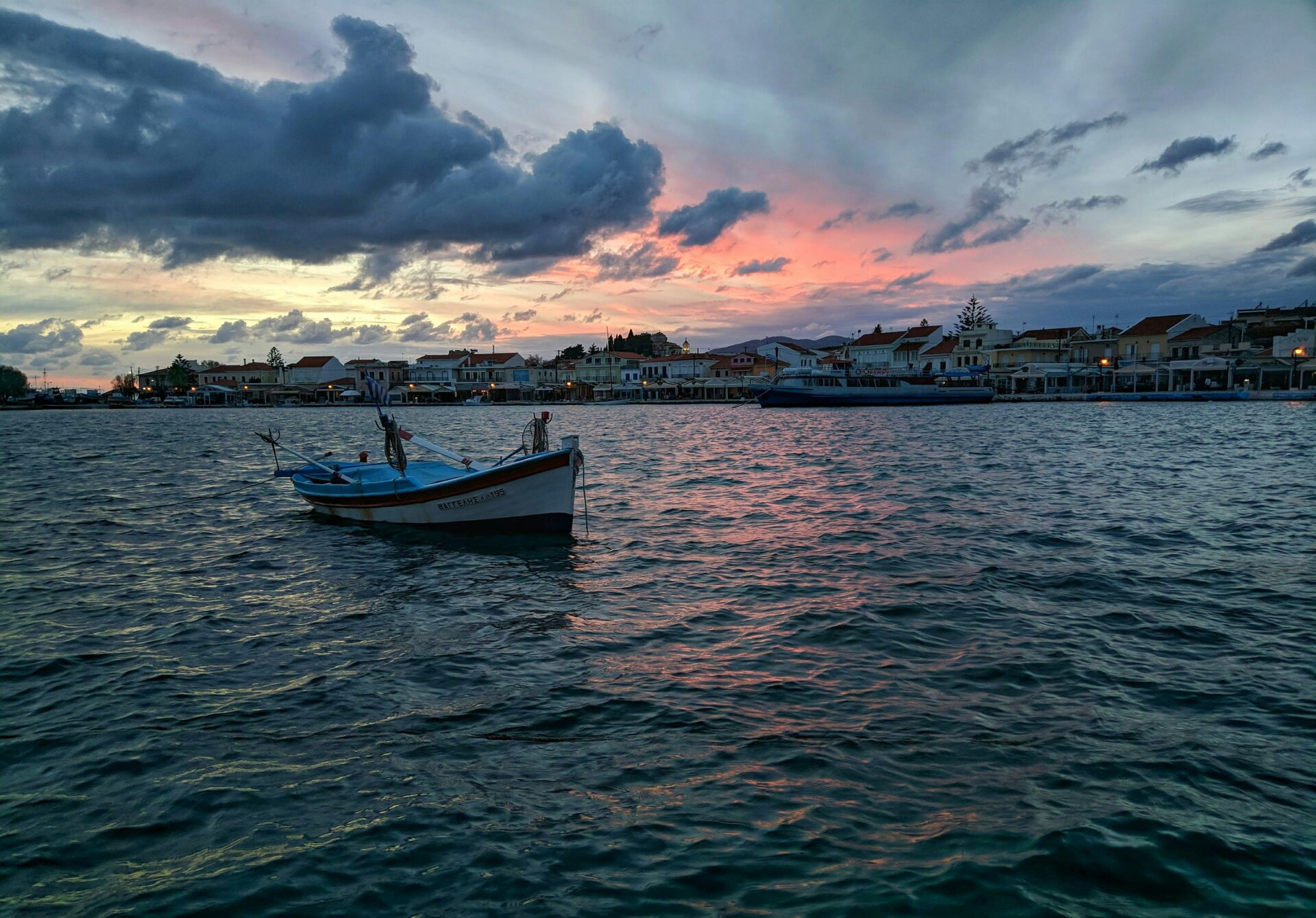
Top image: A stock photo shows a small boat in the waters off the island of Samos, Greece, in July 2019 (Fotis Fotopoulos/Unsplash)
Editor’s note, Aug. 12, 2026: This article has been amended to correct a typo in Delphine Rodrik’s surname.