











Early this year, Brent Peak was taking a short break from his work with Indivisible Northwest Valley, a grassroots group fighting authoritarianism in suburban Phoenix. He’d been leading protests against the Trump administration for several months, with many of them garnering thousands of attendees. But their Indivisible chapter, like all others, is fully staffed by volunteers, many of whom work full time.
“We were so burnt out,” says Peak, a therapist in Phoenix who often leads protests in the nearby city of Surprise, Arizona.
Then Renee Good was killed, followed shortly by Alex Pretti. The Department of Homeland Security had embedded itself in communities across the country — including Surprise, a city of about 170,000 people — and the deaths of two protestors was too much for Peak to bear.
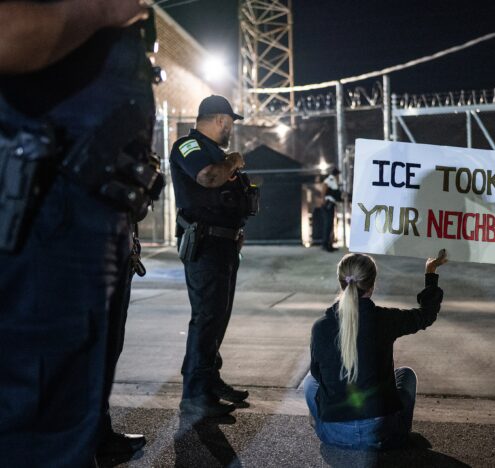
He and his local Indivisible chapter ramped up their protests of Immigration and Customs Enforcement (ICE); hundreds of people packed one of the city’s main thoroughfares on a weekly basis. Then, shortly after, news broke that ICE was planning to convert a Surprise warehouse into a detention facility. For $70 million, the agency purchased a 418,000-square foot building with plans to hold up to 1,500 people.
Peak and his fellow volunteers were incensed by what he called “an Amazon Prime for people,” (echoing the language acting director of ICE Todd Lyons used to describe his ambitions). Anger in Surprise only grew when the county, city and state refused to hear their concerns about the facility. They’d show up to biweekly council meetings, at one point bringing over 1,000 people and urging more than 100 to voice their dissent via public comment. It didn’t work, even though few in the city seemed in favor of the facility.
“Their apathy on this has just been confounding,” says Peak, referring to the council. “I don’t understand it. They had the political cover. We gave them the political cover, and they just wouldn’t respond.” (The mayor and city council members did not respond to requests for comment.)
Peak knew his group needed to take a different tack.
Over the next several weeks, he and a small network of local activists began digging into the industrial park surrounding the proposed detention center. What they uncovered transformed their fight. Across the street from the warehouse sat a major chemical-storage facility containing hazardous materials. They shared their research with the office of Arizona Attorney General Kris Mayes. Weeks later, Mayes filed a lawsuit seeking to block the project.
“We had a couple of meetings with the AG’s staff over the last couple of weeks, and they had really good poker faces,” Peak says. “All they would say was, ‘We are very grateful that you have brought this to our attention.’ Then we found out how grateful.”
Across the country, communities are increasingly turning local resistance to ICE into organized campaigns. In New Mexico, for instance, a coalition of attorneys, organizers, and immigrant-rights groups have spent years building support for the Immigrant Safety Act, which the governor signed into law earlier this year. Among other things, the new policy prohibits local law enforcement from working with or acting as federal immigration agents.
Many organizers say the movement has become more coordinated and more urgent during the second Trump administration.
“When we have power in numbers, when community shows up together, we can be a powerful opponent to these institutions,” says Carla Law of the ACLU of New Mexico.
Across states like Minnesota, Arizona, New Mexico, and Michigan, people with no prior activism experience — including retirees, students, and suburban parents — are gathering records, organizing protests, and helping communities navigate fear and detention threats. In many cases, these localized fights focus on government surveillance.
Elsewhere, community members have raised serious objections about the playbook ICE tried to use in Surprise: buy a local warehouse and convert it into what they call a “temporary detainee dormitory.” But in many cases, the facilities are not temporary.
Law is particularly angered by the case of 23-year-old Kesley Vial, a Brazilian asylum seeker who died by suicide in 2022 at an ICE facility in Estancia, New Mexico. Vial had been held at the facility for four months by the time of his death, and the ACLU alleges the facility — run by the for-profit prison company CoreCivic — held Vial in “inhumane” conditions while his deportation was repeatedly postponed.
“The Feds have gone too far,” Peak says, “and the average person is standing up and doing the work, whether other people will do it or not.”
One of those “average people” is Lynne Gehling. A retired Minnesota transplant living in Surprise, she started attending protests organized by Indivisible after growing alarmed by ICE raids and detention stories shared by friends back home. “I kept reading Facebook posts from friends in Minnesota that just absolutely horrified me,” she says. “It made me cry, and I kept thinking, ‘I can’t handle this.’”
When she learned about ICE’s plans for the local warehouse, her activism became more technical.
Gehling was driving by the site, simply to see it for herself, when she noticed the large neighboring facility operated by Rinchem, a chemical-storage company that handles industrial materials used in semiconductor manufacturing. Troubled by the idea of housing up to 1,500 detainees across the street from a hazardous-materials site, she began filing public records requests and researching federal environmental laws. One of her requests yielded details about the hazardous chemicals stored in the building; another led to a hazardous-material report from the state’s environmental regulators.
“It made me cry, and I kept thinking, ‘I can’t handle this.’” – Lynne Gehling
She learned, for instance, that the quantity of chemicals stored by Rinchem was big enough to require a federal Risk Management Plan (RMP), which mandates worst-case disaster modeling and emergency-response planning. To review the restricted RMP documents, Gehling traveled to a secure EPA reading room, where she was supervised by a US Marshal and allowed only to take handwritten notes.
She later shared her findings with the Arizona Attorney General’s office, which incorporated the chemical-risk concerns into its lawsuit seeking to block the detention center. The attorney general’s suit shows that it was trying for months, with no response, to receive info about the facility from DHS.
They’d ask questions about how the agency planned to deal with traffic, noise and waste disposal, and the office of Kristi Noem, then the head of DHS, failed to respond. But the attorney general’s office wasn’t yet asking questions about the nearby chemicals, indicating Gehling’s work gave the attorney general critical new information.
“Our office did have conversations with the Northwest Valley Indivisible chapter as part of our research for the case, and they did mention the proximity of the chemical storage facility,” an attorney general’s office spokesperson said in a statement. “Given the ongoing litigation, I will have [to] decline to comment further.”
All told, Gehling estimates she spent over 100 hours compiling data on her chemical research. As Peak tells it, her work is a clear example of the creative, volunteer-led activism that’s crucial when local officials won’t respond to their constituents’ concerns.
“In this story, I would say that if we’re David, then so far city council has been the Goliath,” Peak says. “Obviously the federal government and DHS is the bigger Goliath, but city council has been where our fight has been. It’s like their position has been, ‘You can come into town and do what you want as long as you don’t do it to our people. And what we’re finding is that residents in Surprise care about other people a little bit more than that. They don’t want it to happen to anybody.”
While Attorney General Mayes’s lawsuit has asked a federal judge to block the facility, ICE claims the suit “isn’t about the environment. It’s about trying to stop President Trump from making America safe.”
“As with any transition, we are reviewing agency policies and proposals,” the agency added. “As Secretary Mullin said in his confirmation hearing: ‘I will work with the community leaders and make sure that we are delivering for the American people what the President set out. … We want to work with community leaders. We want to be good partners.’”
Meanwhile, groups like Indivisible may have more Goliaths to beat. ICE has snatched up local warehouses in at least 15 states, and companies like GardaWorld, which operated the infamous “Alligator Alcatraz,” are raking in hundreds of millions of dollars in contracts to operate these detention centers even as that Florida facility is accused of torturing its detainees.
In some cases, local officials are seeking ways to prevent ICE from purchasing buildings in their area. But Peak, Law, and others intent on taking a stand aren’t counting on any help from local officials.
“It doesn’t have to be federal policy; it doesn’t have to be state policy,” Law says. “It can be smaller, community-led changes that really hammer down protections on a grand scale.”
Correction: This article has been amended since publication to correct Brent Peak’s city of residence.