






Between December 2023 and May 2025, US airstrikes on Yemen killed at least 213 civilians and injured 363 more, according to a new report. Researched and authored by the Mwatana for Human Rights watchdog in Yemen, the report was published through Brown University’s Costs of War project. It documents 46 separate incidents that include strikes on homes, hospitals, water infrastructure, a steel factory, an oil port, and a migrant detention center.
Victims and their families, according to the report, have received almost no compensation and no acknowledgement from Washington.
From December 2023 until January 2025, then President Joe Biden’s administration led a multinational military effort it called Operation Prosperity Guardian in response to Houthi attacks on shipping in the Red Sea. After returning to the White House, President Donald Trump’s administration conducted Operation Rough Rider from March 15 until May 6, 2025.
Mwatana’s field team, working under Houthi security restrictions that blocked access to some sites, has documented seven incidents under Biden and 39 under Trump. Researchers conducted 59 interviews with survivors, relatives, eyewitnesses, and first responders. They also collected death certificates, medical records, and identification documents to verify the civilian status of individuals, excluding anyone whose status couldn’t be confirmed.
The seven Biden-era incidents led to 27 casualties, while the seven-week Operation Rough Rider caused 549, including 50 children and 25 women.
The deadliest single strike came at around 4:30 in the morning on April 28, 2025, when three US airstrikes hit the pretrial detention center in Saada. Roughly 120 African migrants were asleep in a hangar. One strike hit the hangar directly. When it was over, 68 migrants were dead and 47 wounded, along with several prison guards. A 25-year-old Ethiopian survivor told researchers that “30 of my fellow detainees died; their bodies were charred.”
The delay in rescue, which he attributed to the Houthi authorities running the prison, pushed the death toll higher.
In Hajjah governorate, three direct strikes on April 1, 2025, destroyed the only health center serving the village of Abu Haqqa, where residents already lacked electricity and running water and women carried water from the valley on their heads.
No authority announced plans to rebuild it. In Saada, US jets hit the nearly complete Great Prophet Hospital for Oncology, a $7 million Omani-funded facility meant to spare cancer patients from three governorates the journey to Sana’a, with three missiles on March 16 and five more on March 24, leaving it almost entirely destroyed. West of Al-Hudaydah, a strike on a Water and Sanitation Corporation building wiped out its computer systems and disrupted supply.
The economic damage has compounded over the months since. The strike on the Ras Issa oil port killed 80 people and injured 171, most of them loading and unloading laborers paid by the day. Surviving workers cut their shifts out of fear. “I work in terror, not knowing when US aircraft might strike again,” one survivor said.
Families of the roughly 50 contractors killed there petitioned the Yemen Petroleum Company to register the dead as formal employees so their salaries would continue, but the company refused. One widow received about $95. The destruction of the Al-Akhawain steel factory in Al-Hudaydah cost around 200 workers their jobs. A strike on the government complex in Raymah destroyed the local radio station and put 20 more out of work.
Survivors compared the US campaigns unfavorably to the Saudi and Emirati coalition bombing of 2015 to 2022, which drew years of international condemnation, saying the American strikes produced heavier civilian tolls on many of the same sites. Compensation was minimal and, according to some families, distributed selectively by Houthi authorities: food baskets and about $20 for the families of schoolchildren wounded in a 2024 strike in Taiz, roughly $380 for a house guard in Sana’a.
Mothers described children who could not sleep and ran trembling at the sound of thunder. Interviewees still carried shrapnel in their hands, thighs, and feet with no access to surgery.
The report classifies the strikes under nine categories of international humanitarian law violations, including indiscriminate attacks, strikes on essential civilian infrastructure, and attacks on medical teams during rescue operations. It notes that the US has a long record in Yemen of failing to disclose civilian casualties from its counterterrorism strikes, and that the Pentagon’s own annual reports claimed zero civilian deaths in the country in 2018 and 2019, years in which Mwatana documented at least 17.
The two operations together, according to economist Linda Bilmes’s estimate, cost the US between $9.65 billion and $12.07 billion.
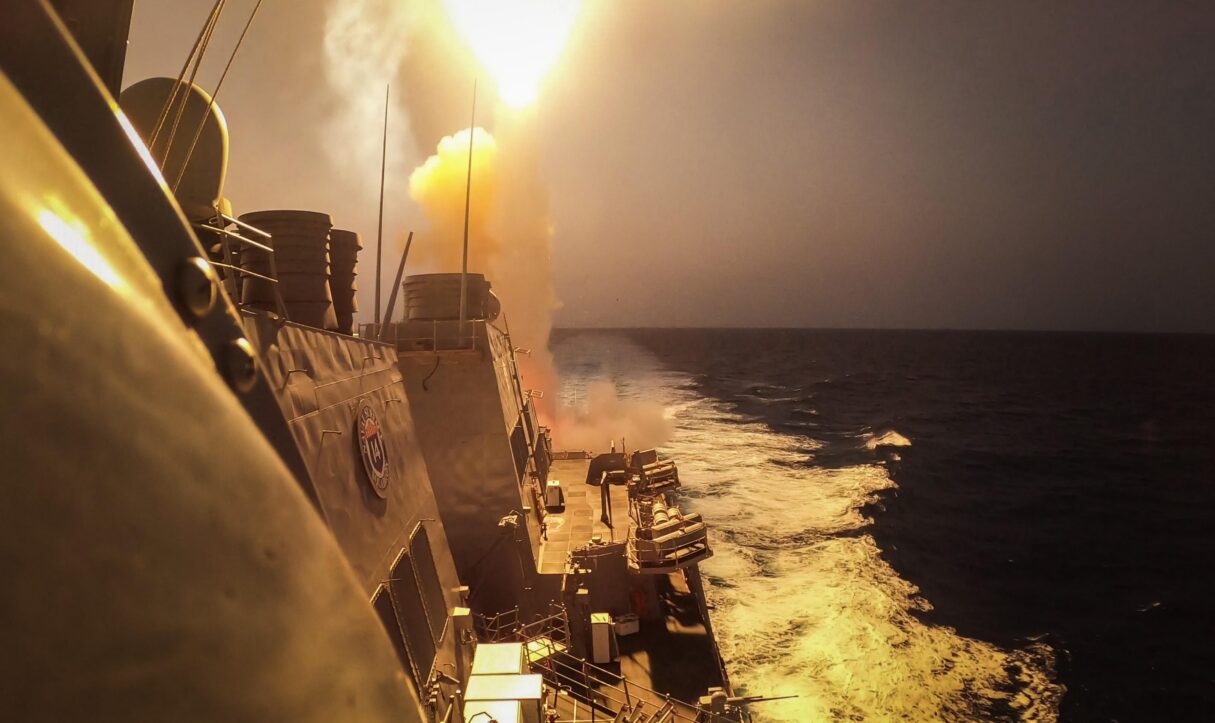
Top photo: In October 2023, the USS Carney deflects Houthi missiles and drones in the Red Sea (Aaron Lau/US Navy/Wikimedia Commons)