




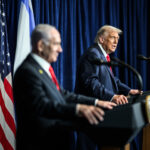





When Xi Jinping visits the White House on Sept. 24, it’s uncertain whether he and Trump will discuss nuclear weapons. In either case, it’s an issue arguably as urgent as artificial intelligence and more consequential than trade and tariffs, but one which gets far too little attention.
China is on a massive building bonanza. Not only is it outpacing the world in manufacturing electric vehicles, solar panels, and other forms of clean energy, its construction of skyscrapers and airports, nuclear power plants, and just about everything else is staggering. China will comprise 45% of global industrial production by 2030, according to the United Nations. Xi Jinping announced China’s intention to become a science and technology superpower by 2035. Beyond manufactured consumer goods and heavy industrial materials, China is also building battleships, bombers, rockets, and missile launch pads, and rapidly expanding its arsenal of nuclear weapons.
For more than seven decades, Moscow’s and Washington’s nuclear arsenals have widely outpaced the rest of the planet, and they still hold nearly 90% of the world’s nuclear weapons. China developed its own nuclear bomb in 1964 and now has the third largest arsenal. Until around 2020, China’s arsenal was estimated at about 300 warheads, providing what China considered the minimum deterrence necessary for national security.
Like the other eight nuclear armed nations, China is modernizing its arsenal. What’s different is that China is also significantly increasing its number of warheads. In 2021, the public disclosure of three new intercontinental ballistic missile (ICBM) silo fields represented China’s largest known increase to an arsenal that has grown to an estimated 620 nuclear warheads.
US Senator Deb Fischer, a Republican from Nebraska, described China’s weapons development as happening “at a breathtaking speed.” Still, it has a fraction of the total stockpiles maintained by Russia and the US, currently more than 4,400 and 3,700, respectively.
China is also developing advanced delivery systems, though questions remain about specific missile numbers. Like the US, China continues to develop its nuclear triad — the ability to deliver nuclear warheads by air, land, and sea. This raises the question: Why is China investing huge sums of money — by one estimate $59 billion over the last five years — if it could maintain its national security without doing so?
Speaking before a Senate Armed Services Committee hearing on the 2026 National Defense Strategy in March, Mississippi Republican and US Senator Roger Wicker said, “China’s massive military buildup casts a pall across the Indo-Pacific.” Beijing, Wicker said, “looks to dominate Asia and supplant US leadership around the world.” He added, “we are supercharging our defense industrial base to meet the production demands for this type of competition,” saying, “we must continue incorporating new weapons and new companies with advanced manufacturing capabilities.”
A 2025 Hudson Institute report posits that “based on current trends, China will become a quantitative and qualitative nuclear peer of the United States by the early to mid-2030s with a diversified, accurate, and survivable force that will rival America’s.”
Others interviewed for this story are not so sure. Xiaodon Liang, a senior policy analyst for nuclear weapons policy and disarmament at the Arms Control Association (ACA), said it is possible, but “I would not say that it is necessarily likely and I’m not sure anybody can exactly make a firm prediction here.” Liang points out the many factors to consider when determining what weapons are being counted (deployed vs. reserve warheads vs. various delivery systems) as well as whether or not China has enough fissile material to achieve parity with the US.
Eliana Johns, a research advisor for the Federation of American Scientists Nuclear Information Project, notes that terms like “peer” and “near peer” can evoke certain images but she says that based on her team’s analysis, China is nowhere near that point. She adds that the US Department of Defense, which previously indicated China could build up to 1,500 warheads by 2035, now estimates China will have 1,000 nuclear warheads by 2030. Will China go that high? “We just don’t know,” says Johns, but given Beijing’s opacity and the lack of verifiable information, it’s easy to assume the worst.
When discussing China’s nuclear buildup, Johns said the word “more” can evoke strong reactions but it’s important to consider the complexity of terminology and the uncertainty about what China actually does or does not have in the broader context.
Tong Zhao, a senior fellow with the Nuclear Policy Program and Carnegie China, is less confident about predicting the size of China’s nuclear arsenal beyond 2030. Based on his understanding of Chinese strategic military development and Beijing’s constant reevaluation of its security needs, he says, “I would be surprised if they have already decided to reach quantitative parity with the United States. That’s a very tall bar for China to reach.”
Zhao points to evidence that top Chinese civilian and military leaders remain influenced by China’s traditional belief in asymmetric strategic deterrence — the idea that China doesn’t need an equally sizable nuclear force to achieve deterrence.
One important factor behind China’s build up, Zhao says, is Xi Jinping’s belief that the time has come for China to demonstrate it is a strategic power through the psychological impact of nuclear weapons. He says that as China perceives a decline in US conventional military superiority, some in the US may consider the threat of the first use of tactical nuclear weapons in a scenario in which the US is losing a conventional war against China. Tactical (also called non-strategic) nuclear weapons are generally considered to have a shorter range and lower explosive yield, although definitions vary.
US efforts to enhance its own tactical nuclear capabilities, Zhao said, reinforce Chinese fears which could fuel Beijing’s desire to further develop so-called “theater range” nuclear systems which may be more precise and deliver a lower yield warhead. Zhao said that since the Obama administration, the US has been trying to enhance its tactical nuclear capabilities — primarily in response to a perceived Russian “escalate to de-escalate” posture in which one party in a conflict takes a deliberate measure to compel an adversary to back down.
During the first Trump administration, the US initiated a submarine-launched ballistic missile low-yield warhead and a nuclear-armed submarine launched cruise missile. The US has also completed “life extension” improvements to the older B61-12 gravity bomb which has a yield that can be adjusted between 0.3 and 50 kilotons. The bomb that destroyed Hiroshima was around 15 kilotons.
For its part, Zhao says China is developing intermediate-range land-based missiles that can reach US military bases in the Pacific. China has a host of theater range missile systems and other longer-range systems that could potentially strike targets in Hawaii, Alaska, or the western Pacific.
Because of the lack of transparency in China’s nuclear program, it’s difficult to know to what extent China is developing low-yield warheads, although Zhao notes that US government officials and reports indicate they are doing so. One DOD report describes Chinese high-precision systems suitable for delivering low-yield (below 10 kiloton) warheads, but what “low-yield” means to China is unclear.
Speaking at a US Strategic Command Deterrence Symposium in August, US Under Secretary of War for Policy Elbridge Colby said that crossing the nuclear threshold would be “a titanic historic catastrophe,” adding “but if it did happen, in order to have it be …credible and rational and effective on a potential opponent, he’s got to believe there’s some sense in which we would use it.”
Colby’s greatest concern was not a bolt from the blue nuclear attack, but a regional conventional war which, he said, “might have local employment, God forbid, of nuclear weapons that could escalate from there as it expanded outward…” Colby described a scenario in which the US could take action the adversary might misinterpret as a “total [nuclear] attack” and could respond with a reaction “far greater than we anticipate, and that would lead very rapidly to an incredibly pressurized situation that would be almost by definition not in our interests.” In other words, rapid escalation to an all-out nuclear war.
ACA’s Liang points to the US Senate’s support to build two new tactical nuclear weapons, a position favored by Colby and others in the Trump administration who argue that these weapons could be used to win back the initiative in a Taiwan war scenario. Liang describes this as an unpredictable, dangerous development. “This is, I think, a very, very dangerous path to be going down because what it will signal to the Chinese is that they also need to have similar weapons to be able to go tit for tat … and there is no guarantee that will end well.”
“Once you start using a tactical nuclear weapon, it has strategic implications. … You’ve broken the taboo,” says Liang. “You don’t have any reliable model for how it’s going to escalate from there.”
There’s also the issue of testing delivery systems (missiles) and alleged underground explosive tests. Earlier this year, US State Department officials made very specific accusations that China had conducted low-yield explosive nuclear tests in 2020 — which China firmly denied. Such tests, if they happened, would violate the intent of the Comprehensive Test Ban Treaty (CTBT). The CTBT organization which monitors seismic activities stated that it was not able to “assess the cause of these events with confidence.”
China does test its nuclear weapons delivery systems, usually over its western territory, but in 2024 China tested an ICBM over the Pacific Ocean. FAS’s Johns wrote that such a test “likely reflects China’s ambition to solidify its international status as a major nuclear power.”
In July, China tested a submarine-launched nuclear capable ICBM also in the Pacific. Although the test was widely denounced by Pacific nation leaders, several pointed out that the US also regularly tests its own ICBMs from Vandenberg Space Force Base to the Marshall Islands.
These developments come as arms control and diplomacy are under enormous stress. Although unofficial, non-governmental Track II talks between the US and China have taken place in the last year, there are currently no formal high-level negotiations underway. In the words of John Erath, senior policy director for the Center for Arms Control and Non-Proliferation, the arms control bureaucracy at the US State Department “has fallen on hard times,” with many job vacancies and those remaining under great pressure. “The bench is very thin right now,” Erath says.
Under these conditions, and in the absence of higher-level diplomacy, Erath believes the relationship between presidents Trump and Xi is very important because, “that’s all there is.”
But with the US-China focus on trade and the economy, nuclear issues, as urgent as they are, are taking a back seat. Erath hopes the two leaders will initiate or at least suggest the importance of arms control talks. “I would not be surprised if it came up,” Erath said. “I would be a little bit surprised if very much came of it. I don’t think it’s a high priority for either right now.”
Citing multiple instances when Trump said he would like to see a reduction in nuclear weapons, Erath believes Trump lacks the patience required for arms control. “It’s a painstaking process,” Erath said. “It’s not a game for people who want it to be over fast.”
China’s nuclear buildup comes alongside the elevated global tensions and instability of more than a dozen years of Russian warfare against Ukraine, a global post-pandemic commodity and resource disruptions, a worsening climate crisis, strained alliances, grinding wars, and the normalization of nuclear threats. Erath said that as the world becomes less predictable and more dangerous, “there are people who suggest arming, particularly [with] nuclear weapons.”
The introduction of new weapons by Russia and the US, uncertainty about the future of the Treaty on the Non-Proliferation of Nuclear Weapons and CTBT, the rise of artificial intelligence, drone warfare, and other disruptive technologies all contribute to a growing sense of instability.
“It feels almost like we’re in this no man’s land,” says Johns. “There are norms that have started to erode, there are power dynamics that are shifting. There are priorities where the United States is being drawn in different directions [and] everyone’s dealing with their own domestic situations. There’s so much going on,” she says, calling it a “perfect symphony of chaos.”
As China expands its own nuclear options, targeting for the US grows more complicated, leaving policymakers feeling the pressure to develop more options. But Johns says that unlike Cold War-era US-Soviet/Russian relations, the US and China don’t have the predictability that comes from decades of arms control engagement. And because China’s approach is very different from Russia’s, this is a particularly confusing time for the US.
“There’s a level of predictability that we just don’t have any more and as time goes on, as we get further and further away from the last data exchange, the last verification inspections … we will have more assumptions [and] less clarity,” says Johns. She notes the importance of understanding China’s policy priorities which can help open doors to further conversations, provide clarity, and close information gaps.
But if, as reported recently by Politico, China is reluctant or unwilling to speak with key figures on the US side, those conversations are less likely to happen. Without face-to-face talks, it’s difficult to develop shared goals. In this new era, Johns sees a need to try new approaches to problem solving. “This moment is ripe for new policy.”
Does China’s nuclear buildup mean that the US needs more nuclear weapons? “If the United States deployed more nuclear weapons, it would not necessarily prevent China from doing something we don’t want them to do. The number and types of nuclear weapons alone is not what deters another country from taking an action or from continuing to build up its own arsenal,” says Johns. “While it’s tempting to rely on nuclear weapons for a sense of security and stability during times of uncertainty, I don’t think that building or deploying more will allow the United States to achieve what it wants or guarantee the stability it seeks.”
Liang says it’s important to appreciate that every country has its own insecurities and foreign policy goals and to understand that from China’s perspective, US nuclear forces are very threatening. To counter this, he says the US should try to separate nuclear weapons issues from broader US-China competition. He also thinks the US should consider how to reduce its own reliance on nuclear weapons that, in turn, will hopefully encourage China to do the same. Fearing China, he adds, is not the right approach. Instead, he said, “the United States should be cautious, wary, and thinking about how to solve the problem” and what it can do to stabilize the arms race with China.
When Xi Jinping visits the White House on Sept. 24, it’s uncertain whether he and Trump will discuss nuclear weapons. With China’s nuclear buildup and ability to demonstrate greater comprehensive national power, Zhao says the second Trump administration has adopted a softer approach towards China regarding Taiwan.
If one of the aims of China’s comprehensive military modernization, including its nuclear buildup, is to blunt strategic containment and gain acceptance by the US as an equal, Zhao says China could argue that its goals are being achieved. And if that’s the case, will Beijing determine there’s no need to build more nuclear weapons? Or, he asks, will they say, “Well, it is working, so why should we stop?” Zhao thinks the latter is the more likely outcome, at least until US-Chinese relations are stabilized in an irreversible way.
But lest China’s leaders forget, this arsenal, which is being expanded so rapidly, consists of weapons whose use would almost certainly lead to the destruction of everything it worked so hard to build.