




Samar Yazbek’s Your Presence is A Danger to Your Life: Voices from Gaza is riveting in some of the most tragic senses imaginable. A Syrian fiction writer and journalist born in 1970, Yazbek has produced a body of work — seven novels and four nonfiction books translated into over 20 languages — that has earned accolades including a 2010 PEN Pinter Prize and a 2012 International Writer of Courage Award. In her introduction, she asks: “Why have I come back to writing about war?” The answer to that question is in the 27 Gazan voices, out of the hundreds interviewed between March and June 2024, that Yazbek has given a platform to speak the unspeakable.
War, of course, upends any semblance of conventional human life. But following the Hamas-led attack on Oct. 7, 2023, Israel’s genocide of the Palestinians in the Gaza Strip has emphasized the fact Carolyn Forché articulated in the closing line of her 1979 poem “The Visitor”: that “there is nothing one man will not do to another.”
The 20th century gave us two world wars, the Nazi concentration camps, and the gas chambers. The 21st century, with Gaza as the laboratory, has become an advanced weapons frontier for the “unfathomable barbarity” that Yazbek documents in the testimonies of civilians from ages 13 to 65. As much a factual accounting of the violent atrocities visited upon these lives and bodies, these recollections attempt to salvage language’s ability to articulate meaning when that too is being eviscerated by the mainstream media’s collusion with the project of erasure.
“And so,” writes Yazbek “we find ourselves adrift in the face of the transformations that genocidal wars impose on meaning and language, after the destruction of people.” What within the hell of such “transformations” happens to those whose bodies are literally scattered, whose torn limbs are missing, blown or cut off, whose bodies are decimated or buried in the rubble of buildings and the catastrophe of vapor bombs? Narrated by the survivors themselves — Yazbek questions the word survivors even as she uses it — the stories speak of, and to, the dignity and humanity of what does indeed survive despite the brutality and subjugation and murder.
An opening question posed in the interviews is what life was like on that Saturday three years ago. The answers, varied as they are, reveal qualities of living, building, and dreaming that are part of any human dailiness wherever one might be on Earth. It is what becomes so shocking in the narration of the “before” and “after”; the contrasts stark, unrelenting and unforgiving as the reader learns and learns again of “those few seconds” when, in the words of a 31-year-old named Nasma al-Farra, “our life changed forever.”
Thirty-year-old Khaled Abu Samra was finishing up his night shift at the Al-Shifa hospital early on the morning of Oct. 7. “Exactly 20 minutes before that, at precisely 20 minutes to seven in the morning,” he recounts, “the baying of savage rockets joined the waves of the sea.”
For Nasma, the first interviewee in the book, it was a moment when her 11-year-old son Yahya asked for a sandwich and Nasma got up to go to the kitchen. “All of a sudden, I found myself covered in black dust and smoke — I didn’t even hear the bomb,” she recounts. “I screamed and shouted my children’s names.”
What follows is a nightmare that recalls mythic depictions of evil and pain captured in such iconic works as Picasso’s “Guernica” or Dante’s purgatory. “I could hear my voice,” Nasma continues, “but it was as though it wasn’t me shouting, like it was someone else looking for their children. … I screamed Leen’s name. I found her next to me and picked her up and tried to get out, but fire scorched my face. I went back to the kitchen, the missile was still burning there, a terrible fire.”
Of the five children — Leen, Yahya, Sama, Sara, and Lama — Sara’s face was completely burned as were her hands. “Sara! Sara! Come here! Where is your sister? Where is Sama? Come over here!” The mother in distress exclaims, calling out to her child. Sara, suffering major burns, was crawling over the rubble and “refusing any help.” As Nasma continues to scream, “Sama! Yahya!” Sama’s corpse is being carried by her father. Yahya eventually dies of internal bleeding, and Lama’s head was split open “to the middle of her forehead.”
Nasma continues: “They buried Sama, they buried her at six o’clock in the morning, they buried Yahya. They made me watch the video. I couldn’t move from the hospital. My son Yahya was buried after my daughter Sama. Two of my children were buried and I wasn’t there. Nine martyrs from my husband’s family, they couldn’t take their bodies out whole. They were torn to pieces — they buried them in plastic bags.”
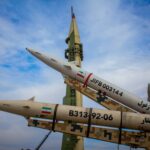
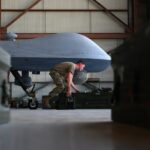
The threnodic interweaves with the apocalyptic, as we witness the capacities of such advanced weaponry as “reconnaissance drones” and “precision-guided missiles” that demonstrate the bone-chilling effects of AI-driven technology, or in Yazbek’s words, “the unleashing of algorithms of murder.”
If the Nazi concentration camps introduced the gas chamber as a threshold in the machinery of genocide, the Israeli American military-industrial complex has provided yet another threshold. Shaimaa Naji, a 21-year-old from Jabalia, describes how a drone, what Palestinians in Gaza call zannana for its bee-like buzzing, appeared outside her building. “It was watching us… it had in fact been taking pictures of us… We realized later it was scoping the place out. My father was a target.”
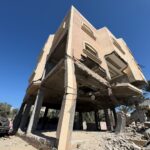
That night Shaimaa wakes “to a sea of fire and the sound of explosions. We were on the third floor of a five-story building. There we were, and all five floors were collapsing. Eleven people died immediately, including my father.” The scene, and the telling of it, reads like a Hollywood action movie, and perhaps this is what the military-industrial complex has in mind as a blueprint for our collective amnesia regarding the facts of such violence. (Spokespeople such as Kamala Harris have emphasized an American commitment to producing the “most lethal fighting force.”)
Meanwhile, Shaimaa remembers “waves of flame” that “rose and fell,” and describes her brain’s inability to “interpret” what her eyes saw. “I noticed a hand trying to get hold of me — as soon as I touched it, the rubble sent me sliding,” she remembers. “I went rolling with the rocks while the floor above came down and turned into wreckage and debris. The hand belonged to my aunt, who was martyred at that moment.”
The question these contrasts beg is one the spectacle of violence is meant to placate. That might makes right, that it will impose that right, however wrong it might be. Thucydides records the maxim in his History of the Peloponnesian War (416 BCE) in the section of the Melian Dialogue when the Athenian envoys to Milos had declared that “the strong do what they can and the weak suffer what they must.” Thucydides uses dialogue to recreate scenes in an otherwise historical narrative channeling, not unlike Yazek, a parallel retelling of a historical tragedy.
A contemporary iteration would be Greece’s recent $3 billion defense agreement with Israel named “Achilles Shield.” One remembers too that Achilles’s death is attributed to an arrow shot at his ankle (not heel), hence the adage of an “Achilles’ heel.” It begs the question of what parts of our bodies remain humanly vulnerable despite our elaborate shields. I have always been struck by the ways the weaponized bodies of Israeli soldiers, clothed in bullet-proof vests, fatigues, helmets, calf-high boots, phones extending from helmets, waists thick with holstered guns, transform them into creaturely beings in lethal proximity to the plain-clothed bodies of Palestinians, as if no amount of power, or shields, are enough to destroy the specter projected onto Palestinians.
The documentary film NAZA, directed by Rachel Szor and Yuval Abraham, is made up of the testimonies of 24 Israeli “insider” military men involved in operations targeting Gaza homes. Released at the Venice Film Festival on Sept. 10, 2026, it won the Special Jury Prize and received a near 25-minute standing ovation.
Those interviewed in the film speak of “the industrial business of murder,” a system described by Xan Brooks in The Guardian interview with the directors, as “fiendishly efficient.” As Brooks puts it, it “appears designed to distance the perpetrators from the crime. … AI selects the target and a drone drops the bomb. Even the language feels purposely euphemistic and obfuscatory. NAZA translates as collateral damage, which in turn translates to human beings.”
It would not be lost on anyone that NAZA is one letter away from another particularly resonant four-letter word. And like those interviewed and interrogated after Nazi Germany was defeated, these 24 men speak of themselves as simply following orders. One interviewee insists his role was merely “technical,” while another calls himself “a small cog.” At the same time, they admit they played a part in a process of AI mapping that traced cell phone signals to apartment buildings full of families. Michelle Goldberg, in a New York Times column about the film, sums up the soldiers’ testimonies as descriptions of “factory-scale targeting … in which little effort was made to avoid enormous numbers of civilian casualties.”
Catastrophes, let alone genocides, raze the singular nature of each individual death and each individual life. In Nazi Germany, the Nuremberg Laws stripped Jews of their citizenship. In camps, numbers branded on their skin replaced their names. The Israeli military gives detained Palestinians a number after using facial-recognition systems to log their identities. Those numbers are sometimes marked on their foreheads.
In compiling these testimonies, Samar Yazbek does the work of resisting the anatomization that seeks to dismember identity. As the physical bodies of Palestinians are being murdered, it is their stories that push back on the distancing of what these weapons do; the testimonies speak to what survives, what will not be sanitized in that distancing. Jihan Bakry, a 30-year-old from Khan Younis, tells of the massacre of her family, and the destruction of the bodies she witnesses, including her own.
“I saw maggots wriggling out of my wounds,” she recalls. “I saw my body rotting while I was still alive… The massacre of the al-Bakry family, that’s what they call it. They were tiny children, little birds — they all died.” She goes on to list a long line of atrocities and lost loved ones, maimings and deaths. “It was a wonder we died and a wonder we lived.”
What does it mean, what does it look like when a life, like a body, loses qualities that defined its value? Muhammad Yasir, an18-year-old from al- Bureij Camp is horrified that his legs need to be amputated. “The doctors decided to amputate them both, because they were just bones with no flesh. … I insisted many times, over and over, that I preferred death over having my legs amputated.”
And yet it is the amputations — literal, metaphorical, and metaphysical — that we witness through Yazbek’s selection of testimonies. She has given presence to a crucial humanity: The everyday continues even as it is being systematically erased, even as language suffers its ruptures. Yazbek provides space for reclaiming the heroisms and sacrifices by those living a nightmare as they gift us their illuminations, tasked as they are with living with what is left to them.
Samar Yazbek’s Your Presence is A Danger to Your Life: Voices from Gaza was published in North America by Other Press in August 2026 and is now available for purchase.