







The United States expelled 536 people between January 2025 and August 2026 to African countries that were not their own, denied them a meaningful chance to contest the transfers, and in several cases delivered them into prisons or onward deportations to the very countries US judges had barred them from being returned to, according to a recent report from Human Rights Watch (HRW).
The 125-page report, entitled “To Scare People: US Expulsions of Third-Country Nationals to Countries in Africa,” draws on interviews with 24 deportees across Cameroon, the Central African Republic, the Democratic Republic of Congo, Equatorial Guinea, Eswatini, and South Sudan, along with court records and ICE data obtained through litigation. Human Rights Watch wrote to eight African governments and filed 26 FOIA requests with US agencies; none produced substantive answers.
“The point is to scare people,” an unnamed US official told the Senate Foreign Relations Committee. The official explained that the value of countries like Palau or Eswatini lies in the threat of dropping people somewhere remote, the official said.
The African transfers formed a small slice of a program that moved nearly 28,000 people to more than 50 third countries in the same period, under arrangements with at least 36 governments, 14 of them in Africa.
A March 2025 memo from then Homeland Security Secretary Kristi Noem allowed removal without further procedures wherever Washington held diplomatic assurances against persecution or torture, and a July memo from ICE set a 24-hour notice window that could shrink to six hours.
A federal district court vacated both memos in February 2026, an appeals court upheld that ruling in September, and the administration asked the Supreme Court for a stay. Meanwhile, immigration judges pretermitted 31,835 cases, closing asylum claims on the assumption they would be heard abroad.
Most of the people interviewed had already won withholding of removal, a finding by a US immigration judge that they would likely face persecution or torture at home, but were shut out of asylum on technical grounds such as crossing the border irregularly or missing a one-year filing deadline.
That status made them targets. ICE arrested them at routine check-ins, shuffled them between detention centers so lawyers could not locate them, and in several cases, put them on planes within days of a pending habeas petition. Officers told some they were headed to Chad when the destination was Cameroon, or to Ghana when it was the Democratic Republic of Congo.
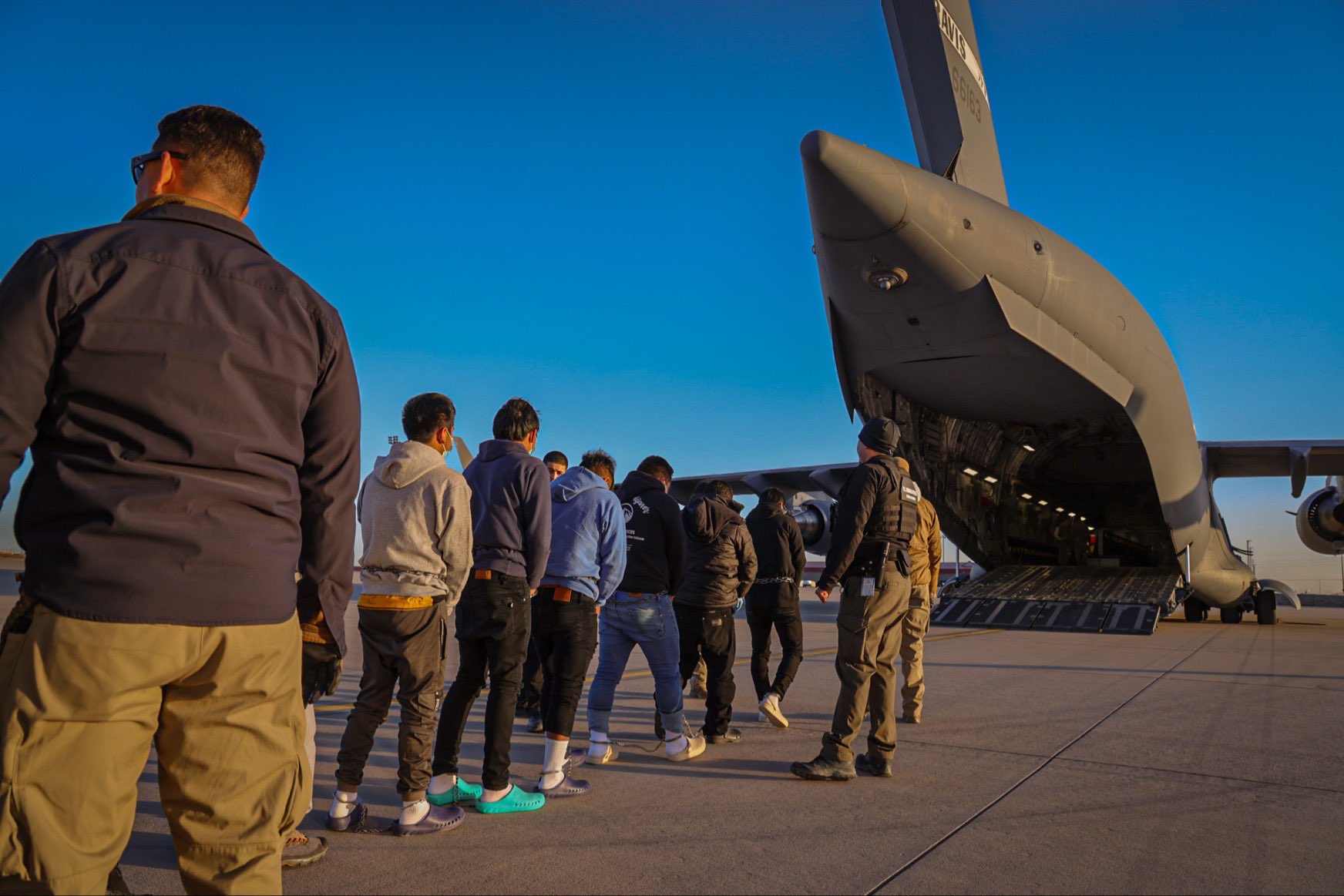
Every interviewee described being shackled at the wrists, waist, and ankles for the entire flight, sometimes 18 hours or more, and one man was strapped into a full-body restraint after refusing to board. At least a dozen LGBT people, several of whom had been protected from returning home because of their sexual orientation, landed in countries that criminalize same-sex relations.
What awaited them varied by country but rarely included an asylum system. Eswatini locked 32 arrivals in the Matsapha maximum-security prison under a $5.1 million deal to take up to 160 people; a Senate minority report put the cost at $413,333 per deportee. Equatorial Guinea received $7.5 million, more than all US aid to the country over the previous eight years and confined roughly 65 people in a shuttered hotel ringed by armed police before returning about 30 to their home countries, among them a man who had escaped hereditary slavery in Mauritania.
Cameroon held 46 deportees in a Yaoundé facility where malaria spread and chronic conditions went untreated, after Washington withheld a $30 million UNHCR disbursement until the government signed. The Central African Republic accepted 92 people on three flights while the State Department still told Americans not to travel there, and police soon detained two of them in an extortion attempt. Of 15 South Americans flown to Kinshasa in April, none remained by late September; 11 went home despite US orders barring their return.
HRW has called on the United States to suspend all third-country removals and on African governments to refuse new agreements and terminate existing ones, in line with an African Commission on Human and Peoples’ Rights resolution adopted in October 2025 that warned states against migration partnerships carrying a real risk of serious abuses.
The watchdog contrasts the current arrangements with the 2002 US-Canada safe third country agreement, which was public, reciprocal, binding and enforceable in court, and concluded that none of the African deals plainly met the US legal standard requiring access to a full and fair asylum procedure. Washington, the report noted, paused visa services for countries that refused and withheld UN funding from one that hesitated.