











A few weeks ago, Jenny Golden, a 48-year-old nurse and single mother, was in her car in the suburbs of Chicago, surrounded by 10 to 12 ICE agents. “They had abducted eight people within an hour and a half, and it was all hands on needed,” she says.
She and several others had followed a vehicle driven by the agents, and after several turns through the neighborhoods surrounding the city, Golden ended up directly behind their car.
A masked officer asked her to step out, and Golden said no. He asked her to hand over her license, and she did so reluctantly, rolling down her window “about an eighth of an inch” to drop it to the ground. When the agent asked her to stop using her phone, she refused. Her hands were trembling as she texted her emergency contact, telling them, ‘“This is probably not going to end well.”
She worried they would pull her out of the car and “break my arms,” she says, explaining that she feared the agents might even kill her.
Eventually, after several threats to get out of the car or be pulled out by force, the ICE officers circled to the back of her vehicle and took photos of Golden’s license plate.
“I know everything about you,” an agent told Golden moments later, in her telling. “And if you and all your friends don’t stop following us, next time I see you, I’m going to arrest you.”
Then the agents drove off.
This is just one of many recent incidents where protestors and activists have come face to face with government agents, sometimes with violent results. Around the same time agents surrounded Golden’s car, 38-year-old Silverio Villegas González was shot and killed in Franklin Park. The Department of Homeland Security (DHS), which oversees ICE, said Villegas González “drove his car at law enforcement officers,” resulting in one officer being “seriously injured.” Yet body camera footage from local police officers shows the agent saying his injuries were “nothing major.”
Then, on Oct. 4, a 30-year-old Chicagoan named Marimar Martinez was shot by a Border Patrol agent. DHS claims Martinez intentionally rammed her car into a Border Patrol vehicle, but her lawyer says the footage shows the opposite. Now Martinez has been charged with impeding a federal officer with a deadly weapon.
Each of these incidents occur as the Trump administration uses the military, DHS, and Border Patrol to wage a war against a newly defined form of terrorism.
Historically, terrorism has been defined as the use of violence to further an ideological goal. Under Trump, everyone from protestors and activists like Golden to progressive donors, politicians and drug smugglers have been cast as enablers or perpetrators of terrorism, even when there’s no evidence to back their direct involvement in violent acts.
In a late September national security memo, President Donald Trump highlighted “anti-capitalism,” “anti-Christianity” and “extremism on migration, race, and gender” as examples of the “common threads” he has directed his agencies to investigate. Then, on the same day Martinez was shot, Stephen Miller, the president’s deputy chief of staff for policy, claimed “there is a large and growing movement of leftwing terrorism in this country.” Miller wrote, “The only remedy is to use legitimate state power to dismantle terrorism and terror networks.”
As the president threatens a broader crackdown — even suggesting that the military could use US cities as “training grounds” — experts warn the administration’s use of ICE and the armed forces bears the hallmarks of encroaching fascism.
“Branding your political enemies as terrorists is a classic fascist move,” says David Noll, a legal scholar and author of the book Vigilante Nation. “If you look at prototypical fascist states, what they do is attempt to stamp out dissent by branding people as terrorists.”
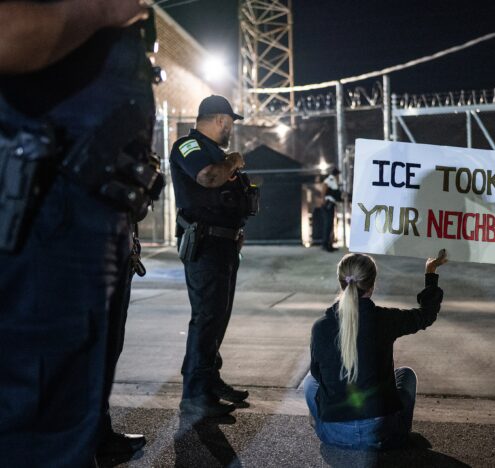
Elsewhere in Chicago, protestors have been arrested and held in custody for days at a time. For instance, 31-year-old Ray Collins, a Chicago resident, was held in custody for two days after he tried to defend his fiance, 30-year-old Jocelyne Robledo, from ICE agents. Collins and Robledo were both protesting the agency at their Broadview facility.
“His wife was thrown up against the wall by ICE agents and he essentially ran and said, ‘What the hell are you doing to my wife?’” says Collins’ attorney, Richard Kling.
Collins was initially facing federal assault charges (the government argued he injured an officer’s thumb) but a grand jury declined to indict him. To Kling, the grand jury’s decision shows there was never enough evidence to charge Collins with any crime, let alone assault. Yet he’s not surprised. He represented a Chicago woman who he says was arrested for merely yelling at ICE agents. (In that case, the government declined to press charges, and the woman was released after a day in custody.)
“The first Trump administration never happened like this,” Kling says. “I’m aware of the fact that Obama rounded up people as well. Biden rounded up people as well. Trump did in his first administration, but not to the extent of having what I would call ICE Gestapo, in their uniforms with masks and covering their nameplates. It was not like that until this administration in the last few months.”
Kling attributes what he calls the “maliciousness” of his clients’ prosecutions to the Trump administration’s posture on protests. The longtime defense attorney is especially troubled by the rhetoric of Attorney General Pam Bondi and Homeland Security Secretary Kristi Noem.
Bondi followed Trump’s late September memo with a missive of her own, which tried to draw a throughline connecting political assassinations and ICE protests in Chicago and Portland. However, there is no evidence of the broader, coordinated efforts suggested by her and the president. (That same month, Bondi’s department removed a 2024 study from the National Institute of Justice website that concluded far-right extremists have committed significantly more politically motivated homicides than other domestic extremist groups since 1990.)
For her part, Homeland Security secretary Noem has compared Antifa to groups like the Islamic State and Hezbollah armed groups, echoing how Trump has labeled Antifa (shorthand for antifascism) a domestic terrorist organization. Even though there is currently no statute by which a US-based organization can be legally classified as a terrorist organization, multiple experts interviewed for this story point out that the move is a signal for how Trump’s adherents within and beyond his administration should treat people with anti-fascist leanings.
To terrorism experts like Jazon Blazakis of the Middlebury Institute, the label makes little sense. After all, Antifa is “more of a movement” with diffuse chapters that are themselves not organized in the typical hierarchical manner one might recognize in most organizations.
Blazakis points out that, “we’ve never seen even the KKK designated as a domestic terrorist group, which to me also just calls into question all the things that are wrong with the Trump executive order.”
And like Kling, Blazakis says there are stark differences between the current Trump administration and the president’s previous term.
“You have individuals who are just ‘yes people,’” he says — people who are eager to turn X posts and executive orders into action. He is particularly concerned about the ways in which Trump plans to pursue anti-fascist organizations, including, as the president’s September memo says, “necessary investigatory and prosecutorial actions against those who fund such operations.”
To Blazakis, this vagary could open the door to a host of tactics, including using the FBI and the US Department of Treasury’s financial intelligence unit, known as FinCEN, to investigate people’s finances in a way that could violate privacy laws.
“Does it mean that the administration is going to pursue law enforcement action against people who may think differently from the administration and disagree with its policies?” he asks. “And I think that’s the implication of the executive order, and thus will have even a more chilling effect on a person’s willingness to speak up against things that the administration is trying to pursue.”
In fact, The Wall Street Journal recently revealed that a senior official at the Internal Revenue Service (IRS) has already “drawn up a list of potential targets,” including some donors to the Democratic Party, as part of some changes at the IRS. These changes “would allow the agency to pursue criminal inquiries of left-leaning groups more easily.”
Natalie Lerner, a 29-year-old lawyer and board member at the Portland Immigrants Rights Coalition (PIRC), is deeply familiar with that “chilling effect.” PIRC operates a rapid response hotline for immigrants in the area who have questions and concerns or need connection to an attorney, and in 2024, Lerner says the hotline received an average of 10 to 15 calls per week. Now, they’re getting around one thousand calls per month.
What’s more, Lerner describes ICE’s tactics as unpredictable and often secretive, with agents donning masks, driving unmarked cars, and wearing plain clothes. Meanwhile, advocates and volunteers — including Lerner and her colleagues — have been labelled “Antifa terrorists.”
“The power of fear just can’t be overstated right now,” she says.
Recently, while several PIRC team members were manning an information table at the ICE building in Portland, Lerner says a man with a gun hurled transphobic insults at one of the coalition’s volunteers. “Unfortunately, what we’ve seen in the last few weeks is there’s been this pivoting of attention to Portland,” she says. “There’s this huge influx of far-right streamers who are all going to the building and trying to get their clips to sell some story that there’s something wild happening in Portland.”
That includes Nick Sortor, a far-right social media influencer who was arrested in Portland following a skirmish with protestors. He was ultimately not charged with a crime, and shortly after his arrest, he was at the White House, meeting with the president as part of a roundtable discussion about Antifa. Pam Bondi and Kristi Noem were in attendance at the meeting, as well, and Bondi claimed she is “opening a pattern-or-practice investigation into how Portland police let this happen,” referring to Sortor’s arrest.
It was the latest chapter in the administration’s ongoing villanization of Portland and Chicago. According to Noll, the author and legal scholar, the success of authoritarianism depends on whether states — in this case, Oregon and Illinois — push back against the aspiring autocrat.
“The story of the second Trump administration so far is institutions that should know better are caving,” he says, specifically referring to universities and law firms. “States need to lead the resistance to the institutionalization of vigilante power.”
In Chicago, Mayor Brandon Johnson is trying to resist. Recently, he issued an executive order to implement “ICE-free zones” in his city, prohibiting the agency from using parks, libraries, and other city-owned property for their staging and processing. The move drew sharp rebukes from Trump (who has threatened Johnson and Illinois Governor JB Pritzker with jail) and his fellow Republicans, many of whom have praised ICE’s work in recent months. Shortly after Mayor Johnson’s announcement, Jim Jordan, a Congressman from Ohio and the chairman of the House Judiciary Committee, said ICE is “doing the Lord’s work.”
Portland does not currently have “ICE-free zones,” but as part of a city council resolution, Portland police are not supposed to assist ICE. This sanctuary city approach has also drawn the ire of Republicans, as did the “No Kings” protests, which drew millions of protestors across the US. Republicans like House Speaker Mike Johnson and House Majority Whip Tom Emmer cast the protests as a form of hate and radicalism, as did Transportation Secretary Sean Duffy.
Emmer, for instance, called the demonstrations a “Hate America rally” held by “the terrorist wing” of the Democratic Party.
Despite the climate of fear her home is currently experiencing, Lerner wants people to know that Portland is a vibrant, supportive community. There is ample support for immigrants, she says, and she wants the focus to remain on them as much as possible.
“I think people really care about their neighbors here, which is something that gives me a lot of hope and makes me really love living here,” she says. “It’s this place that I think is on a trajectory to being a better and more just place. And I think that’s part of what the Trump administration doesn’t like. I think they’re doing cool stuff here, and that makes them mad.”
Golden, the nurse and single mother from Chicago, said something similar about her own city.
“I want people to know that we are out here helping,” she says. “We are not violent, we are not harming people, we are not obstructing. We are using our rights and we are being punished for doing something that we are allowed to do, and that is to protect our neighbors.”