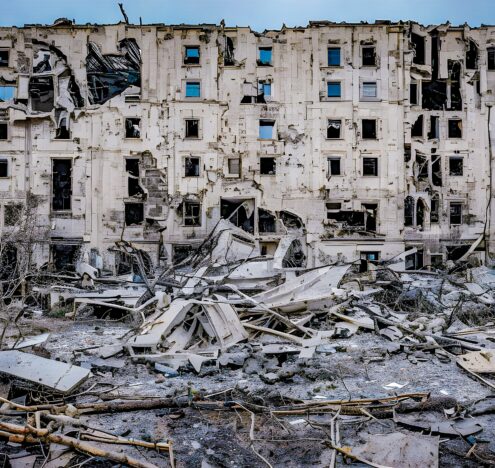





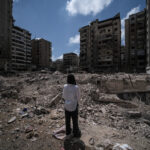

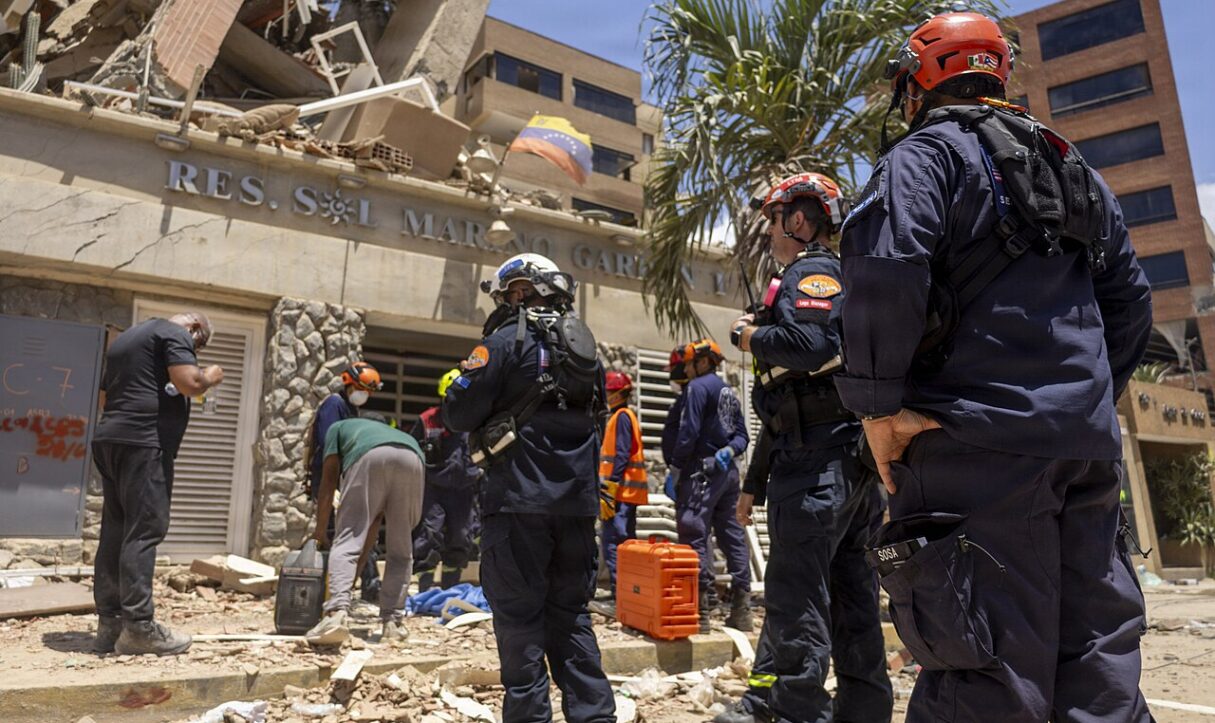
When two earthquakes hit near Venezuela’s capital city of Caracas on June 24, they brought with them unthinkable devastation. Within three weeks, authorities have confirmed that the disaster has killed 4,500 people — and with 60,000 individuals reported missing, the number of casualties will continue to grow. In turn, United States President Donald Trump’s administration responded quickly, pledging $300 million to relief efforts, and sending hundreds of aid workers to support the local and international response. While there is no doubt US aid is vital, so long as Washington continues to deny Venezuelans self-determination in their own country, aid is far from enough.
US policy toward Venezuela, both under the current administration and throughout recent decades, left Venezuela distinctly vulnerable to a disaster like this one. Devastating US sanctions, followed by the Trump administration’s direct takeover of the Venezuelan government, destroyed any chance of an effective response to a natural disaster in Venezuela. It is well-evidenced that both a lack of democratic representation and sanctions undermine effective disaster response. Long before the earthquake, American neocolonialism already spelled catastrophe for the Venezuelan people — and we must undo it.
In Trump’s first term, he enacted a sweeping series of sanctions on Venezuela in an attempt to force regime change, but then-president Nicolás Maduro remained in power. Venezuelan civil society weakened under the oppressive weight of economic collapse, caused by the widespread corruption of the Maduro government and directly inflamed by US sanctions.
Trump 2.0 has only brought further calamity for Venezuela. In the first days of 2026, the second Trump administration invaded the country and forcibly removed Maduro from office, replacing him with his vice president, Delcy Rodriguez. Maduro had long denied Venezuelans of the economic stability and safety net they deserved. Yet despite Rodriguez’s promises of sweeping reforms, the only thing that has changed is to whom the Venezuelan government is accountable and who is profiting: Donald Trump. When Rodriguez came into office, she worked with the Trump administration and American oil executives to overhaul Venezuela’s oil and gas regulations to favor the US. Now, the US Treasury has direct control over Venezuela’s export revenues. In just four months, the United States took control of over $8 billion of Venezuelan oil exports, with no meaningful oversight or reporting on where the funds were flowing.
Meanwhile, the Venezuelan bolívar continued to depreciate, the corrupt Chavista electoral system remained in place, and oppressive government surveillance continued unabated. When Rodriguez’s 90-day interim term ended in April, conversations about elections were consistently avoided and pushed into an uncertain future. Rodriguez’s approval rating fell to 25% a month later — lower than even that of Maduro’s during the last year of his rule. The meaningful difference between Maduro and Rodriguez is not corruption or competence — it is the willingness to do Trump’s economic bidding.
Worse yet, Trump has elevated longtime hawk Secretary of State Marco Rubio to de facto leader of Venezuela. According to a New York Times report, Rubio issues direct marching orders to Rodriguez, decides who can do business in Venezuela, and determines precisely how the Venezuelan government can spend money from its state coffers. Amid such an imperial makeover, is it any surprise that many have taken to dubbing Rubio the “viceroy” of Venezuela?
Even the mainstream Venezuelan opposition to Rodriguez is a supplicant for Trump. María Corina Machado, the longstanding right-wing opposition leader to Maduro, defined herself by championing the privatization of the Venezuelan oil market and supporting US sanctions. In Trump’s second term, Machado has been a vigorous ally, openly supporting his extrajudicial killings in the Caribbean and deportation of Venezuelan immigrants to El Salvador’s infamous CECOT prison.
In a performative gesture, Machado gifted her Nobel Peace Prize to Trump to gain his favor, likely in hopes of being elevated to power after Maduro’s ousting. Despite this, Trump denied her a position of power in Venezuela — instead choosing the route of least resistance to the most immediate profit. Machado was a leading figure in the drive to document Maduro’s stolen election in 2024, and she often centers her advocacy around democracy promotion in Venezuela. Like Rodriguez, though, if she can only rise to political power on account of Donald Trump, there is no promise that the people of Venezuela will retain the ability to grant or deny her power in the future.
Trump often uses false claims of liberation to justify his extractive foreign policy. In Iran, he started a devastating war that, on its opening day, killed 120 children at a girls’ school in the city of Minab. Just hours after this horrendous strike, Trump attempted to justify the war by claiming, “All I want is freedom for the [Iranian] people.” Unsurprisingly, his rhetoric towards the Venezuelan people has been similarly hypocritical. In January, Trump justified his ousting of Maduro through the legitimate relief many Venezuelans felt after years of Maduro’s corruption. In the days following the earthquake, Trump proclaimed, “it was a big earthquake, knocked down buildings, but outside [of the earthquake] it’s a happy country again, people are dancing in the streets.”
To Trump, who campaigned in large part on promising to end wars and keep the US out of foreign entanglements, the people of Iran and Venezuela are nothing more than pawns for his political gain.
Just how a country should respond to natural disasters is a challenge for any leader. Democratic processes give citizens a chance to choose a leader who is competent, prudent, and will put their needs first when disaster strikes. For Rodriguez, none of these characteristics were criteria for her rise to power — concessions to Trump were. Venezuelans were denied self-determination under Maduro, and continue to be denied self-determination under the US-controlled Rodriguez government.
The earthquake response is a brush with reality on all that has stayed the same for Venezuelans since Trump installed Rodriguez. Predictably, people in Venezuela are already pointing out Rodriguez’s underwhelming and politicized earthquake response, the result of years of corruption that continued under her watch. Reports are already emerging of Venezuelans with the means or connections being given priority to aid and rescue equipment. In La Guaira, one community blocked the exit of an excavator looking to leave while hundreds of their neighbors were still waiting for rescue. In the continued absence of an organized government response, anger toward the Rodriguez government is growing, and will likely continue to do so.
Where their government has failed, the Venezuelan people have shown heroism, digging through rubble with their bare hands to rescue their neighbors and loved ones. A mother protected herself and her three children under the rubble for 11 days before their rescue. In the final hours of her own life, an 11-year old girl guided emergency rescuers to her brother’s location, saving him.
As the response continues to unfold, the Venezuelan people will continue to bear the consequences of the corruption and chaos — and they deserve justice and accountability. To ensure they have any material chance, the US government must immediately sustain and increase humanitarian aid and permanently lift all sanctions. Even more vitally, though, the Trump administration should stop blocking self-determination for Venezuelans, and ensure there is a path to a safe, free, and fair election so they can decide their own future.