









Skip to content
Ohio National Guard’s 52nd Civil Support Team prepares to enter an incident area to assess and monitor public facilities for any potential remaining hazards in East Palestine, Ohio, Feb. 7, 2023

Safe Enough? East Palestine, Emergency Spending, and Who Gets Protected

After the East Palestine derailment, residents were told the air was safe. But as Congress rushes billions toward war, some communities are left asking: safe enough for whom?

Words: Laicie Heeley
Pictures: US Air National Guard
Date:
album-art

Sorry, no results.
Please try another keyword
  • After a Norfolk Southern train carrying toxic chemicals derailed in East Palestine, Ohio, residents were told the air was safe and the situation was under control. But for many people living there, the emergency never really ended. In this episode, East Palestine resident and Rail Watch founder Jess Conard takes us inside the chaos and[...]
00:00

After a Norfolk Southern train carrying toxic chemicals derailed in East Palestine, Ohio, in 2023, residents were told the air was safe and the situation was under control. But for many people living there, the emergency never really ended.

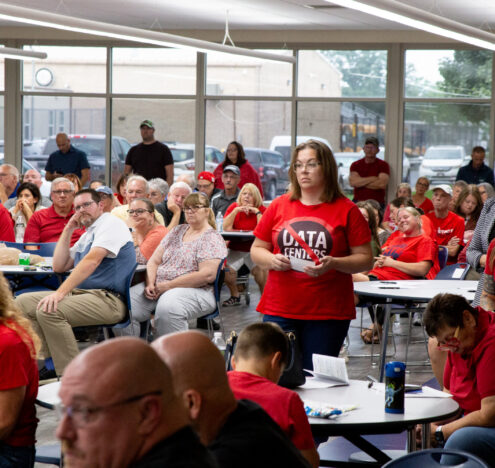
In this episode of Things That Go Boom, East Palestine resident and Rail Watch founder Jess Conard takes us inside the chaos and confusion of the derailment’s aftermath: shifting evacuation zones, lingering chemical smells, chronic health problems, and the exhausting burden of trying to prove harm after disaster strikes.

But this story isn’t just about one train derailment. It’s about what actually counts as an emergency in the eyes of the federal government — and what kind of response that label unlocks.

As Congress routinely moves billions of dollars quickly and flexibly for war and national security priorities, communities impacted by industrial disaster often struggle to access long-term healthcare, environmental testing, or meaningful support. Through conversations with budget experts Steve Ellis and Julia Gledhill, this episode examines how emergency spending works, how “urgent” becomes a political category, and what those choices reveal about whose suffering matters.

Because emergencies don’t just expose broken systems. They expose what those systems were built to protect.

Guests:

Jess Conard, founder and executive director of Rail Watch
Steve Ellis, president of Taxpayers for Common Sense
Julia Gledhill, research analyst at the Stimson Center

Additional Resources: 

Rail Watch

The Ghost Budget: US War Spending & Fiscal Transparency, Linda J. Bilmes, MIT Press Direct

The United States Is Self-Destructing Amid Empire Collapse,” Julia Gledhill, The Nation

Defense Divided: Overcoming the Challenges of Overseas Contingency Operations, Laicie Heeley and Anna Wheeler, Stimson Center

Photo: Members of the Ohio National Guard’s 52nd Civil Support Team prepare to enter an incident area to assess remaining hazards in East Palestine, Ohio, Feb. 7, 2023. (US Air National Guard photos by Capt. Jordyn Craft, Ohio National Guard Public Affairs)

Laicie Heeley

Editor in Chief

Laicie Heeley is the founding CEO of Inkstick Media, where she serves as Editor in Chief of the foreign policy magazine Inkstick and Executive Producer and Host of the PRX- and Inkstick-produced podcast, Things That Go Boom. Heeley’s reporting has appeared on public radio stations across America and the BBC, where she’s explored global security issues including domestic terrorism, disinformation, nuclear weapons, and climate change. Prior to launching Inkstick, Heeley was a Fellow with the Stimson Center’s Budgeting for Foreign Affairs and Defense program and Policy Director at the Center for Arms Control and Non-Proliferation. Her publications include work on sanctions, diplomacy, and nuclear arms control and nonproliferation, along with the first full accounting of US counterterrorism spending after 9/11.

LEARN MORE

Hey there!

You made it to the bottom of the page! That means you must like what we do. In that case, can we ask for your help? Inkstick is changing the face of foreign policy, but we can’t do it without you. If our content is something that you’ve come to rely on, please make a tax-deductible donation today. Even $5 or $10 a month makes a huge difference. Together, we can tell the stories that need to be told.

SIGN UP FOR OUR NEWSLETTERS