






Camila Lourdes Galarza Zavala is no stranger to US intervention in Latin America. She comes from a family of political prisoners and former guerrilla fighters from Ecuador, some of whom, she says, were trained by Che Guevara and granted asylum in the 1950’s by the Castro administration after the Cuban revolution. Her great-grandfather was part of a general strike that overthrew the dictator Carlos Arroyo del Rio in 1944.
As a labor organizer and investigative journalist in Quito, she has witnessed contemporary resistance to militarism, dictatorships, and foreign intervention throughout Latin America, including the US-backed military coup in Bolivia in 2019. She says that the current US-backed administration of Daniel Noboa in Ecuador, which she characterized as a dictatorship, is more repressive than anything she and even many of her friends and family have seen.
“There is a real orchestrating of instability and organized crime fueled by the Noboa administration and his closest allies, intentionally, to justify the arrival of US boots on the ground and the complete revoking of any civil liberties,” Galarza Zavala told Inkstick.
She described life under the Noboa administration as one where opposition parties are being banned, Indigenous and environmental activists have been attacked and killed, press freedom has been suppressed, and violent crime has spiked. In March, the United States and Ecuador launched a military partnership to conduct operations against actors that the Trump administration deems “narco-terrorists.”
Ecuador is just one part of a larger picture. As the Trump administration’s 2025 National Security Strategy (NSS) shows, the administration is reassessing which regions of the world to prioritize for securing US interests. The Western Hemisphere, and Latin America in particular, tops the list. The NSS directly references a “Trump Corollary to the Monroe Doctrine,” invoking the foreign policy concept in which the United States has historically used its power to intervene throughout Latin America.
Articulated by President James Monroe in 1823, the Monroe Doctrine argued that European powers should respect the Western Hemisphere as the United States’ sphere of interest. Now US foreign policy strategists point to China’s growing political and economic weight in Latin America, arguing that this warrants greater US focus on the region.
On Jan. 3, 2026, two months after the NSS was released, Trump launched a military attack on Venezuela in which US forces captured President Nicolás Maduro and his wife Cilia Flores from a safe house. This has paved the way for a rapidly expanding US intervention in Venezuela, including US Marines and aircraft carrying out military exercises in Caracas in May.
Shortly after the January attack on Venezuela, the Trump administration established a blockade to cut off Cuba’s supply of oil, fueling a humanitarian crisis that is devastating the island nation.
In March, the Trump administration established the Shield of the Americas alliance, consisting of 13 governments in the Western Hemisphere, with the stated mission of intervening against drug trafficking and immigration.
The US military has expanded operations in Panama, including a jungle operations training course and the arrival of a US aircraft carrier in Panama’s waters for the first time in over 50 years. On May 29, the New York Times reported that Guatemala agreed to joint military strikes with the United States, though President Bernardo Arévalo denied the report.
Galarza Zavala said that the regime in Ecuador offers a warning for other Latin American countries of what they face if the US-backed right is able to entrench its power. “This playbook that we’ve been living for the past five years is being now copied in Bolivia, in Guatemala, in Argentina,” she said. “We know how this ends up in the long-term.”
Beyond direct US military operations in the region, many right-wing governments that have come to power in Latin America in recent years are carrying out policies that align with Trump’s regional ambitions. Along with Noboa, some of Trump’s staunchest regional allies are Nayib Bukele in El Salvador, Javier Milei in Argentina, José Antonio Kast in Chile, and Rodrigo Paz in Bolivia.
Historian Josefina L. Martínez, an editor at the leftist La Izquierda Diario international news network, which was founded in Latin America and where I’m also an editor, argues that there is a war on the region’s working class. “Right-wing governments led by figures like Milei, Kast, and Paz have launched a class war against workers and working-class sectors,” Martínez said. “They seek a radical restructuring of the economy — one designed to further benefit major domestic and foreign business interests.”
Milei in Argentina has been a test case for the neoliberal policies that several South American governments are carrying out. He was elected president in 2023, promising a wide range of economic reforms that target the country’s public sector, while leaving the private sector untouched. This “shock therapy” economic model has fueled poverty in the country. It has, however, benefited US influence in Argentina, with Milei effectively outsourcing monetary policy to the US Federal Reserve. This, in part, explains the Trump administration’s staunch support for Milei, going as far as to intervene in Argentina’s legislative elections, with Trump conditioning a $40 billion economic bailout for Argentina on the success of Milei’s La Libertad Avanza party.
Despite the impact of Milei’s policies, neighboring Chile and Bolivia elected right-wing leaders in 2025. Both Kast in Chile and Paz in Bolivia have quickly begun carrying out shock therapy policies similar to Milei’s.
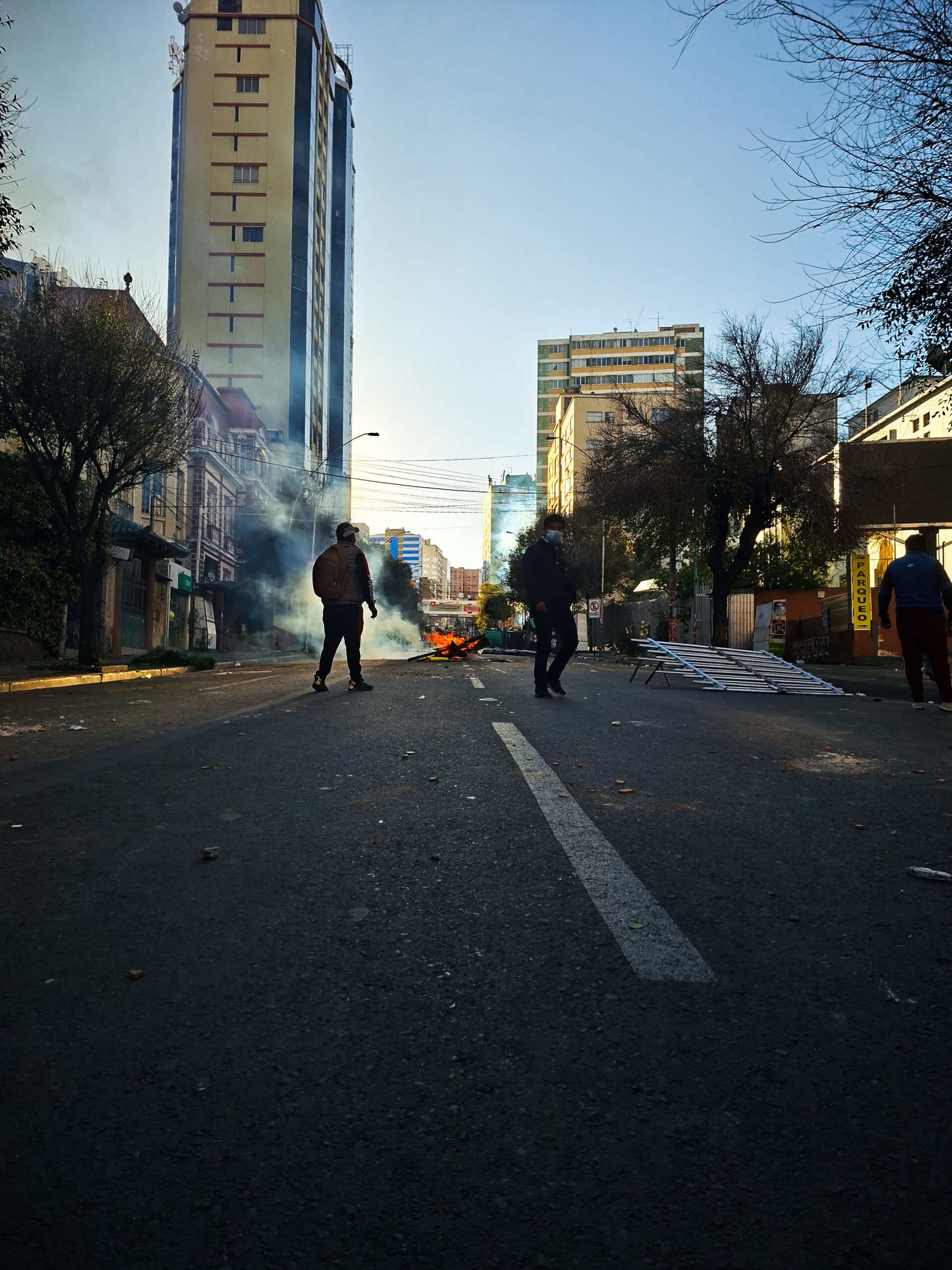
The economic agenda of the region’s right-wing governments has not gone unchallenged. Bolivia especially saw a powerful uprising in which workers, peasants, and indigenous peoples revolted, demanding Paz’s resignation. For weeks, road blockades, labor strikes, and massive protests ground the country to a halt.
Joseph Bouchard, a visiting fellow at Universidad Mayor de San Andrés in Bolivia, told Inkstick that the protests have significantly weakened Paz’s government. “There is a sentiment that this government may not last its full mandate. The protests were able to rip apart much of the coalition that Paz had brought together,” Bouchard said.
Milei and Kast have also seen massive protests in recent months, in particular against their attacks on public education. On May 12, hundreds of thousands marched in Argentina demanding that the government fund public education. On May 14, Chilean students engaged in a nationwide strike, enduring violence from militarized police. This was followed by another massive, student-led march on June 3, which faced similar repression.
Darlyn Marchant helped organize the May 14 march through Asamblea Coordinadora de Estudiantes Secundarixs (ACES), a coalition of high school students which plays an important role in Chile’s student movement. “Under Kast’s mandate, the [student] movement is far more visible and active, as many high school students are discontented over budget cuts to various ministries,” Marchant told Inkstick. “We take to the streets because they prioritize their own positions of privilege at the expense of working-class families.”
In just a matter of months, Kast has seen his approval rating plummet. Milei, who had spent several years in power without experiencing much opposition, has also begun seeing his approval decline. In fact, one of Milei’s most outspoken critics, Trotskyist congressional deputy Myriam Bregman, has been polling as the most popular political figure in the country and the only politician with a net positive approval rating.
Martínez said that this all points to a weakening of Trump’s plans for the region. “Trump’s aura of invincibility is fading,” she told Inkstick. “His key pawns in Latin America — such as Kast, Milei, and Paz — are in deep crisis. At the same time, this offensive by Trump is galvanizing new generations of workers and young people toward the anti-imperialist struggle.”
Bouchard, similarly, is anticipating more opposition to right-wing governments throughout the region. “This model of authoritarianism on security and democratic rights, combined with neoliberal shock therapy and destruction of the social state, is now the dominant model for the right in Latin America,” Bouchard said. “With this new right-wing autocratic wave in Latin America, where immense levels of wealth inequality, poverty, violence, and a lack of basic human rights and public services are being exacerbated, there should certainly be a public backlash.”
Correction 7/8: an earlier version of this piece indicated that Camila Lourdes Galarza Zavala’s relatives participated in the Cuban Revolution. They were granted asylum by the Castro regime.