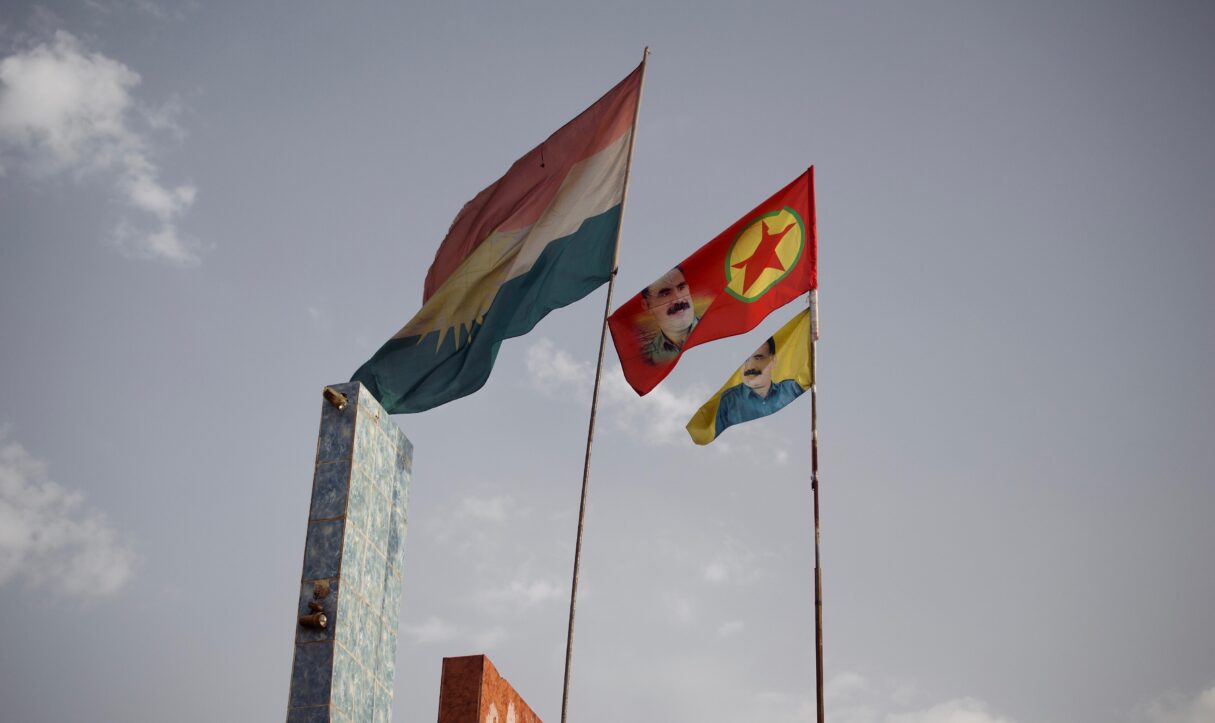
The current approach combines a PKK pledge to disband with offers by the Turkish state of limited amnesty for some former fighters. It is a robust step forward but falls short of most Kurdish demands.
If momentum stalls, though, it could lead to the kind of situation that Zagros, a commander in the PKK’s military wing, described to Marcus regarding the end of the first ceasefire in 2004: “Our view in the PKK was that there was no political development, so why weren’t we at war?”
Moreover, Marcus brings up a specific political puzzle that Turkey’s Kurds have had to confront throughout Recep Tayyip Erdoğan’s 23-year period of power: What are his “true intentions?” Does he actually intend to release Kurdish activists like former presidential candidate Selahattin Demirtaş, much less give Öcalan a path to freedom? Will he make progress on deeply meaningful cultural and language rights for Kurds? Or is this merely a useful pause that will allow him to run for a third presidential term?
One of the strengths of Marcus’s approach — and an outgrowth of her remarkable access to former PKK members and others associated with the movement — is that she is able to move beyond the maps, battles, and politics that are typical of such books and describe the PKK’s unique culture and social life in great detail.
In the aftermath of Öcalan’s arrest and the first ceasefire, from 1999 to 2004, the PKK actively struggled within itself over how it organized the lives of its fighters. If one of Öcalan’s notable contributions to political discourse in the Middle East has been to prioritize gender equality in very real ways, the PKK also tightly controlled the sexual and emotional lives of its members by forbidding relationships between cadres.
With the possibility of a more peaceful future beckoning, this discipline began to waver and couples who had fallen in love during the struggle declared their intention to marry. The controversy over whether to allow this shift resulted in factionalism within the group, which its leadership feared above all else. Eventually, most of those who favored the change — and others who had challenged Öcalan’s leadership around the same time — were purged from the party.
We might discount or be unable to adequately perceive the internal politics of movements like the PKK in the moment, but they have a direct impact on its functionality — and its ability to deliver on whatever promises it makes at the negotiating table. This is a real strength of Marcus’s account.
The second half of Resurgence and Revolution shifts its geographic focus to northeastern Syria and the Kurdish experience with self-governance in Rojava. Marcus deftly untangles the complex political dynamics among Syrian Kurds before the civil war began in 2011, no small task due to the alphabet soup of competing groups, and then explain the multilayered political, ideological, and administrative frameworks that the PKK helped set up and support in order to govern northeastern Syria.
Marcus also traces the US involvement in Rojava as a major military partner with the Kurdish-dominated Syrian Democratic Forces (SDF) in order to fight Islamic State (ISIS), which inevitably led to Turkish anger. This pragmatic decision across several US administrations to work with what Marcus describes as an organization that the PKK in effect established, guided, and sustained created an absurd situation. Washington both refused to acknowledge what was evident — “the Americans don’t want to hear about linkages,” she was told — and also looked too hard for cleavages between the SDF and the PKK, which led to misinterpretations. If “by, with, and through” is to remain a part of US doctrine, this experience is worth understanding.
Perhaps one criticism of Resurgence and Revolution is that it does not engage in detail with Rojava as a multi-ethnic, multi-religious region where Kurds are but one component. Much was made after the collapse of Rojava earlier this year about whether Öcalan’s concept of a “brotherhood of peoples” had failed amid attacks on the SDF by Arab tribal fighters from areas that had lived in SDF-controlled territory for years. While Marcus compressively addresses US attempts to show the SDF as a multiethnic force as an argument against Turkish objections, the reader wonders how PKK cadres in Syria approached the issue of integrating Arabs and other groups into their administrative, military, and political structures.
The pairing of Turkish and Syrian Kurdish developments in Resurgence and Revolution is not only logical from a historical and narrative point of view — it also addresses two important considerations for any Kurdish nationalist organization: the need to address its home base in the specific context of the state where that group develops and then how to expand its influence to other parts of Kurdistan, a territory spread across the current borders of Turkey, Syria, Iraq, and Iran
This dynamic comes to the fore following the collapse of the Assad regime in 2024 and the subsequent decision by the PKK to lay down its arms and dissolve. Öcalan’s thinking at the time, Marcus argues, was that “a cessation of hostilities between Turkey and the PKK could protect Kurdish gains in Rojava.” While arguably this failed insofar as it did not stop the new government in Damascus from retaking much of northeastern Syria and ignoring Kurdish calls for a form of federal system that would allow for a measure of Kurdish autonomy, it shows the degree to which the PKK’s approach to events in Turkey, Iraq, and Syria.
As Marcus ultimately concludes: “there can be no solution to the Kurdish ‘problem’ in Turkey, and no stability in the region, without taking the [PKK’s] history and supporters into account.” In publishing Resurgence and Revolution, she is both asking and enabling us to do so, which is a significant contribution at a critical time for Kurds in Turkey, Syria, and the broader Middle East.
Aliza Marcus’s Resurgence and Revolution: The PKK and the Kurdish Fight in Turkey and Syria was published by NYU Press in May 2026 and is available for order.