




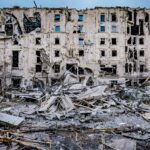





A falling stone woke Noor Sameh at 1:30 in the morning. It was Sept. 16, and the 17-year-old was staying with her mother and three younger siblings in al-Saada building in Gaza City. She remembers the sharp sound. Afterwards, she could not get back to sleep.
About half an hour later, part of the building collapsed on their heads.
“The wall fell on me, leaving only my face and one hand visible, while my back and legs were trapped under the rubble,” she says.
Sameh directed her mother to rescue her siblings. She waited for civil defense crews to reach her. Her father was in an Israeli prison; she was the eldest of the children and says she felt responsible for the family in his absence. “I was left alone under the rubble for more than four hours. I was the last to be rescued.” As she described what had happened, she touched her neck.
The family had lived there for more than a month, in the partly bombed home of relatives. Before moving in, they had spent months in displacement camps, dealing with mosquitoes and rodents. Sameh says nobody in the family had felt safe in the building.
“I was afraid of the building from the first day, but we had nowhere else to go.”
Eman Abdullah, 28, had also moved there with her family after living in a tent. When her mother entered, Eman remembers her beginning to cry. “This building will kill us,” her mother said, according to Abdullah.
Abdullah survived the collapse with an injured leg. Her parents and three sisters were killed.
Gaza’s Civil Defense and Health Ministry put the death toll at 21, with dozens injured. Around 100 people had been sheltering in the building. More than 4,000 unsafe buildings across Gaza require full or partial demolition, according to the United Nations Office for the Coordination of Humanitarian Affairs. More than 2,300 of these buildings remain inhabited, sheltering nearly 44,000 people.
Across Gaza, people have been forced to choose between two options: renting at exorbitant prices, even in damaged buildings, or living in hellish tents that do not save them from the heat of summer or the cold of winter. Temporary shelters are deteriorating. Families report infestations of mosquitoes and rodents, inadequate sanitation and exposure to heat, rain and flooding.
Even after the ceasefire, materials needed for more durable shelter and repairs have continued to enter far below what humanitarian groups say is required. Rainwater can enter cracked concrete and damaged roofs, while wind and storms add strain to buildings already weakened by explosions. Humanitarian agencies are simultaneously preparing for flooding in displacement camps; OCHA identified hundreds of sites at risk as the rainy season approaches.
In Deir al-Balah, Amira al-Aklouk has been trying to reassure six children about the building where they sleep.
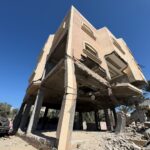
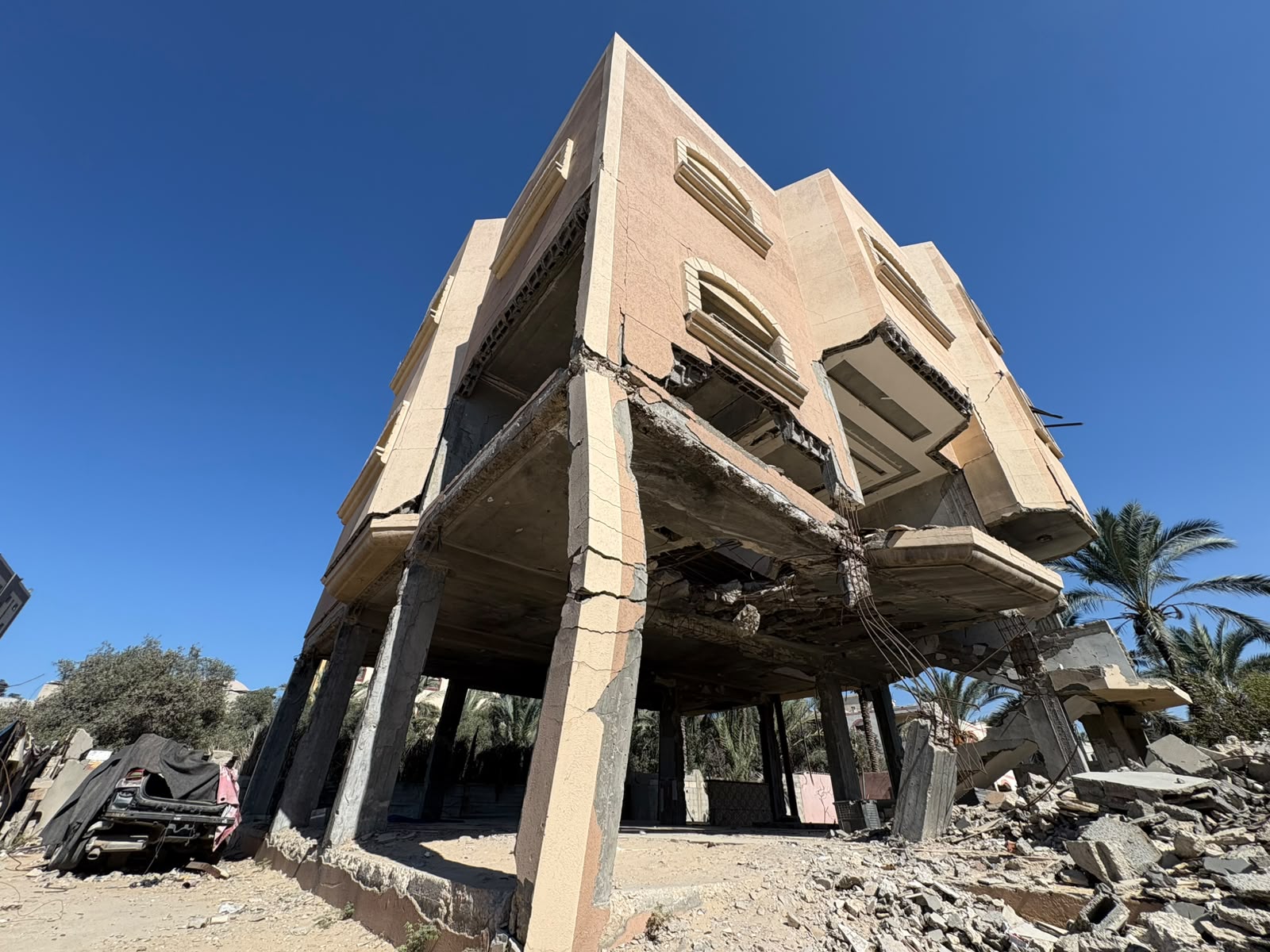
The 35-year-old lives with her husband, Bashar, and their children in a small third-floor flat. The walls are cracked. The lower floor of the building is partly destroyed. She remembers seeing the crumbling columns supporting the upper floors for the first time after Bashar told her he had found somewhere they could rent at a reasonable price. “When I first saw the house, I was stunned and shocked by the columns,” she says. “All its columns are leaning.”
Her young daughter could not sleep on their first night there. Amira recalls what she told her afterwards: “I didn’t sleep all night, Mum, because I was afraid the house would collapse on us.”
For her son, 9-year-old Ahmed, sleeping beside his mother follows another attack. Amira says her parents’ home was directly hit, killing her mother and sisters and injuring the boy. Since then, he has slept in her arms every night.
“If we die, I will die with you, Mum,” he tells her, according to al-Aklouk.
Her memories of life before the war make her pain even worse, she says. Renting prices were reasonable, as they had rented a large house for 400 shekels (about $130) a month. al-Aklouk remembers having comfort and privacy there. After the war started, the landlord forced them to leave because he wanted to rent it out for more money during the war. Prices of renting in Gaza, even for empty lands where people place their tents, rose sharply during the war; many landlords profited from people’s suffering.
Bashar works for the Palestinian Authority. The family searched for another rental and moved between relatives’ homes while they looked. al-Aklouk describes months of searching without finding a house they could rent.
“We were exhausted from moving from one place to the other,” she says.
Then Bashar found a flat paying 1,000 shekels (about $326) a month. What he described as a reasonable rent brought her to the tenuous beams she recalls from that first visit.
Amira says they have so far escaped injury in the building. She tries to calm the children and make them feel secure. But since the collapse in Gaza City, she has been unable to settle her own fears.
“I haven’t slept at night, thinking about myself and my children,” she says.
Leaving would mean finding another place to live or moving into a tent, hardships she says she and the children cannot manage.
“There is nowhere else for us to go. Life in a tent is very difficult. My children and I cannot cope with its hardships, so I prefer to stay here.”
Fakher al-Kurd, an engineer who directs the projects department at Deir al-Balah municipality, explains the inspection efforts for buildings that are heavily damaged.
“We visit houses to check whether they are fit to live in,” the 47-year-old says. “The first thing we examine is the columns: whether they are completely damaged, or whether they can be repaired and reinforced.”
The columns are the building’s principal supports, he explains. Direct bombardment, or a strike on a neighboring house, can weaken them. He identifies this damage as a main cause of the sudden collapses threatening residents of bomb-damaged homes.
In some buildings, he says, people are living on middle floors even though the ground and top floors have been destroyed.
The municipality visits buildings, assesses their condition and issues warnings to residents. Al-Kurd says people remain despite being urged to leave, as they have nowhere else to go. Amira’s search had already taken her family between relatives’ homes before Bashar found the flat. She says now there is nowhere else for them to go.
More than 4,000 unsafe buildings across Gaza require full or partial demolition, according to the United Nations Office for the Coordination of Humanitarian Affairs. More than 2,300 of these buildings remain inhabited, sheltering nearly 44,000 people.
Al-Kurd says the municipality’s work with the Ministry of Public Works to establish an accurate count of buildings at risk is still under way. The findings are intended for international organizations, including OCHA, and the United Nations Development Programme.
He identifies Gaza City, Khan Younis, eastern Deir al-Balah and al-Maghazi as particularly affected by dangerous buildings. But an inspection and a warning do not come with a guaranteed place for a family to move into.
“The most we can do as a municipality is warn and notify people and try to support them by providing other places to shelter,” he says.
Israel’s military campaign has left 201,290 structures, an estimated 82% of structures in the Gaza Strip, damaged as of June 2026, according to the United Nations Satellite Centre. Of those, more than 134,000 were classified as destroyed and nearly 14,000 as severely damaged. UNOSAT estimated that 328,627 housing units had been affected. This catastrophe affects 1.98 million people, 94% of Gaza’s population, who require shelter or basic household assistance. By late September, 65% of households were still living in tents or makeshift shelters. A final assessment by the World Bank, the European Union and the United Nations estimated Gaza’s recovery and reconstruction needs at $71.4 billion, including $26.3 billion needed during the first 18 months. Housing was among the sectors sustaining the heaviest damage.
The municipality lacks the resources to provide the help residents need, al-Kurd adds. It passes their appeals on to international organizations. Its survey is still being assembled while people are already living in the buildings it is trying to assess.
“We are preparing for winter, and we are afraid of the risks the season brings and its consequences for residents,” al-Kurd says.
Sameh had known the building was dangerous before she slept there. Abdullah’s mother had said so on entering it. Nevertheless, the families had come from tents and stayed.
For Abdullah, surviving the collapse has brought another search for somewhere she can live. She has been staying in hospital corridors because she has nowhere to go.
“I am staying in the hospital at the moment because I haven’t found anywhere else,” she says.
Her leg is broken, and moving around is difficult. A tent would leave her without the proper bathroom facilities she says she needs. She spends her nights in the hospital while trying to work out where she can go after losing her parents and three sisters.
As she spoke about her parents, Abdullah cried and touched her injured leg.
“I am worried about how I will live without my parents,” she says. “I keep thinking: who will support me after them?”
**Thanks to journalist Besan Shomer in Gaza for collaborating on the interviews.