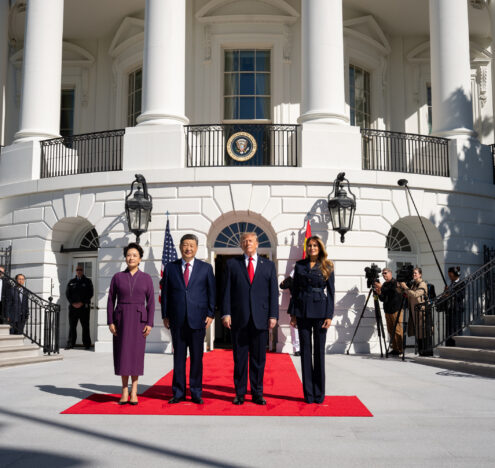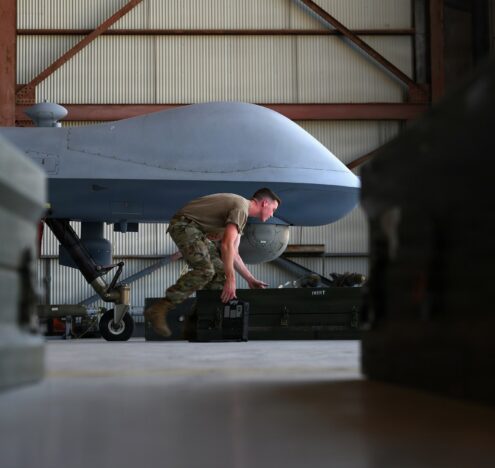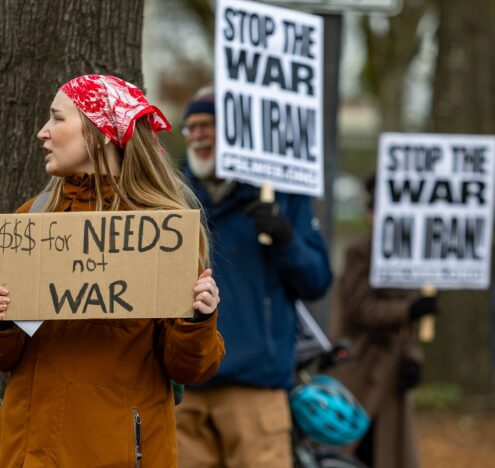













On Feb. 28, 2026, the United States and Israel launched joint strikes on Iran, turning a decades-long shadow conflict into an open regional war. In the days that followed, Israeli Prime Minister Benjamin Netanyahu described the campaign as something he had “longed to do for 40 years.” A new research note in Politics & Policy takes that timeline literally and asks whether the 2003 invasion of Iraq and the 2026 war on Iran were two phases of a single strategy, engineered by a junior ally that has spent a quarter century learning how to move a superpower.
The study, by Bülent Aras, sidesteps the usual debate about lobbying and back channels, which he called an unobservable “black box.” It looks instead at what Netanyahu said in public. Aras assembled a corpus of 3,139 timestamped events across two windows: the Iraq buildup from September 2001 to April 2003, and the Iran confrontation from October 2023 to March 2026. Against 3,106 public statements by Netanyahu about the target state, he set 33 verifiable US escalations: congressional authorizations, military deployments confirmed by the Pentagon, and sanctions confirmed by the Treasury.
The first finding concerns language. Using text-similarity analysis, Aras measures how closely the US president’s official justifications for escalation tracked Netanyahu’s earlier framing. During the Iraq buildup the overlap scored 0.72; during the Iran conflict, 0.65. Anything above 0.50 between two sovereign governments, he writes, indicates a “highly significant structural adoption of thematic framing.” In plain terms, Washington adopted Netanyahu’s vocabulary and threat metrics before it acted on them.
The second finding concerns timing, and it is the paper’s most striking. Netanyahu’s escalatory rhetoric preceded US action by an average of 73.2 days before Iraq and 73.7 days in the Iran case, a near-identical 10-week conditioning window that held across four administrations of both parties. For Iraq, a Granger causality test showed his rhetoric improved forecasts of US action at every lag from six to 16 weeks. The Iran series was longer and more diffuse, so the temporal evidence there rests on lag and cross-correlation analysis rather than the Granger test, a limit Aras states openly.
Process tracing, an investigative technique that works like a detective’s investigation, fills in the mechanism. On Sept. 12, 2002, with the Bush administration internally divided and Congress hesitant, Netanyahu testified before the House Committee on Government Reform. He told lawmakers there was “no question whatsoever that Saddam is seeking and is working and is advancing toward the development of nuclear weapons,” then followed up with a Wall Street Journal op-ed titled “The Case for Toppling Saddam.” Twenty-nine days after his testimony, Congress passed the Iraq war authorization.
The third finding is the one with the sharpest policy implication. Aras compares Netanyahu’s rhetoric in the 60 days before and after each US escalation. When the US removed Saddam Hussein outright, Netanyahu’s public statements about Iraq fell from 1.66 per day to 0.61, a statistically significant drop Aras calls the “Off-Ramp.” Maximalist force resolved the ally’s security dilemma, and the campaign switched off. Proportional force did the opposite. After limited US strikes on Iranian proxies and even after the June 2025 strikes on Iranian nuclear sites, Netanyahu’s statement rate nearly doubled, from 0.80 to 1.49 per day, according to the report. Restraint, Aras argues, does not insulate a hegemon from entrapment; it institutionalizes an “Escalation Loop,” because a strike that leaves the adversary’s regime intact reads to a vulnerable ally as proof that half-measures have failed. Netanyahu’s July 2024 address to Congress, his fourth, made the demand explicit: “Our enemies are your enemies. Our fight is your fight.”
Aras also examines the one campaign that failed. In March 2015, Netanyahu deployed the same repertoire against the Iran nuclear deal, and the Obama administration signed it four months later. The difference, Aras concludes, was that Obama was publicly committed to a countervailing course; rhetorical entrapment converts executive ambivalence into commitment but cannot overturn settled policy. That negative case also weakens the rival explanation that both governments simply react to shared intelligence, since the intelligence relationship was the same in 2015.
The polling data complicates the picture in a way Aras chooses to report, not hide. Support for the 2003 invasion ran between 52% and 64% during the conditioning window. Support for war with Iran never reached a stable majority: 27% in an Economist/YouGov poll days before the strikes, 33% to 37% in Reuters/Ipsos readings during the war itself. The US entered a major war against sustained public opposition, which suggests the mechanism works on Congress, partisan media, and the executive’s sense of permission rather than on mass opinion.
Aras is careful about what the evidence does and does not show. Predictive precedence is necessary but not sufficient for causation, there is no counterfactual, and classified intelligence remains an unobservable confounder.
The findings are “consistent with rhetorical entrapment and difficult to reconcile with a pure common-cause account,” not proof. He also flags that Netanyahu’s unique longevity and congressional access may make the lags specific to him. But the pattern he documents, of a 10-week rhetorical wave breaking ahead of each US escalation, twice, is hard to unsee.