











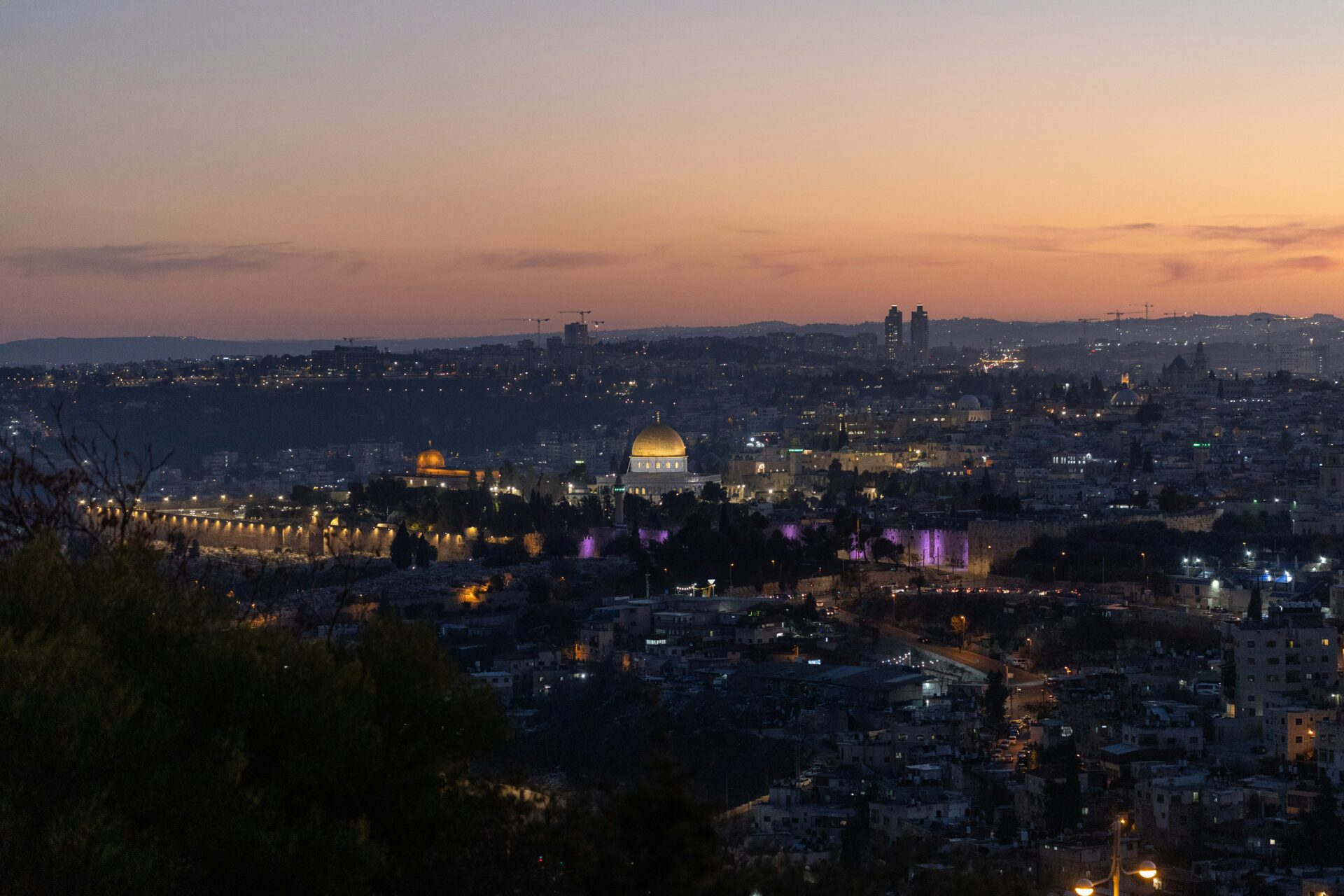
Silwan is built upon a hilly landscape just east of Jerusalem’s iconic Old City. The Dome of the Rock rises over the skyline, and every day, as it has for centuries, the Al-Aqsa Mosque fills the streets with its call to prayer.
For Fakhri Abu Diab, 62, Silwan has always been home — and a trove of memories. He fondly remembers his childhood days spent swimming at Ein Silwan, a local fresh water spring. He would later bring his children, then grandchildren, to the same place.
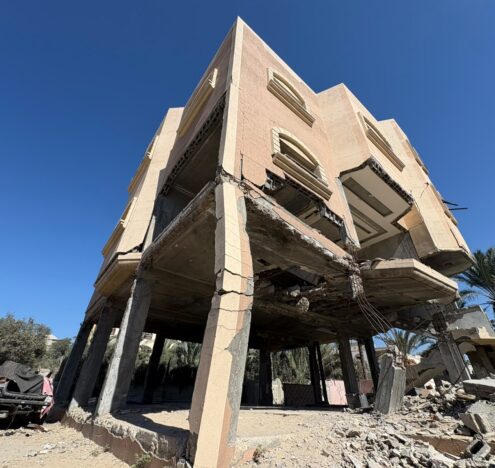
But his days in Silwan are numbered. Two years ago, Jerusalem’s municipal authorities demolished his house, which they say was built without the requisite building permit. The family members he lived with have scattered to other cities, but Abu Diab and his wife insist on staying. They set up a one-bedroom metal caravan on a nearby plot of land, but that too was hit with a demolition order. “Maybe by next month, after they demolish [the caravan], I don’t know where I will go,” said Abu Diab. “There is no other place.”
Abu Diab’s looming eviction is part of a broader campaign to increase Jewish settlement in this historically Palestinian suburb. The effort is anchored in the belief that traces of the biblical city established by King David, which holds central importance in Jewish history, lay beneath Silwan. There is a political end-game too. Asserting the Jewish character of East Jerusalem justifies its unification with the Western section of the city. The former sits across the internationally recognized Green Line which demarcates Israel from its occupied territories. Such a plan would preclude the possibility of any part of Jerusalem acceding to a future Palestinian state. These efforts have accelerated since the Gaza war began on Oct. 7, 2023, according to the Israeli anti-settlement advocacy group Ir Amim.
A variety of legal pathways in Jerusalem’s municipality and courts lay the groundwork to vacate Palestinian residents. The cleared ground makes way to dig for historical artifacts, establish archaeological sites, and expand Jewish settlement.
Where Abu Diab’s house once stood in Silwan’s Al-Bustan neighborhood, plans are underway to construct The King’s Garden national park. The greenspace models the royal garden of King David, which is mentioned in the Bible and is believed to map over approximately today’s Silwan.
Jerusalem is one of the richest archaeological grounds on Earth, with imprints left behind by a succession of empires ranging from the ancient Kingdom of Israel to the Persians to the Romans to the Ottomans. Talya Ezrahi, an advocate with the anti-settlement advocacy group Emek Shaveh, says that archeological missions’ selective highlighting of Jewish history paints an incomplete picture of Jerusalem that ultimately privileges its Jewish residents at the expense of its Palestinian ones.
Whose history the ruins underground tell speaks to who gets to remain above them today.
Forty-eight homes have been demolished to clear space for the development of the King’s Garden park between October 2023 and April 2026, according to Ir Amim’s 2026 report on human rights situation in the Occupied Palestinian Territories. The report tracks that the construction of this park puts 1,450 individuals, including 900 children at risk of expulsion.
This park will connect to the City of David archaeological complex, which sits in the Wadi Hilweh neighborhood uphill of Al Bustan. Managed by the settler group Elad, the City of David offers a comprehensive experience for tourists: a movie screening at the entrance, a hiking trail through sites and tunnels evoking the First Temple era when King David ruled over Jerusalem, and venues for fine dining and family celebrations.
“The Biblical narrative is being concretized in a way that gives tourists an experience that they’re walking in the footsteps of King David. It is part of a wider effort to replace the multicultural, multi-faith history of Jerusalem with a single-story narrative,” says Ezrahi.
Ezrahi leads what she calls “counter-tours” through the City of David, highlighting the presence of Palestinian communities that have long made Silwan their home and how archaeology has become an “instrument of settlement and discriminatory development.” Even if King David’s body was found underground, “the people who are actually living there today, should they not have a say in how the place is developed,” she says.
Decisions made inside Jerusalem’s municipality and courtrooms offer the legal basis to make way for the development of archaeological sites.
The Jerusalem municipality has demolished homes in Al Bustan on the grounds that they lack the requisite building permits. But permits are next to impossible for Palestinians to obtain in Jerusalem. According to Ir Amim, 8,898 housing permits were approved for Jews compared to 641 for Palestinians in 2025. That makes for 7% of approved housing units serving Palestinians even as they account for 40% of the Jerusalem population.
Residents argue that the permit system is a means of edging them out of the city. “We asked the municipality for a designated site where building is allowed, a place with schools, parks, open space, streets, but the municipality says everything is forbidden,” said Abu Diab.
In a statement to the AFP, the Jerusalem municipality said that Al-Bustan was zoned “for a public park” and “never designated for residential use.” To this, Abu Diab says that his home has been standing prior to 1967, when East Jerusalem was under Jordanian control, before it fell under Israeli occupation after the Six-Day war.
In other cases, settler groups utilize legal tools to claim ownership over private lands.
Such is the case of Abed Shaludi’s family. They had been renting their home in Wadi Hilweh since 1964. In February 2026, though, Himanuta, the real-estate arm of the Jewish National Fund (KKL-JNF), handed them an eviction notice. The notice demanded that the family vacate the home by June and pay up 283,290 NIS, accounting for legal fees and fines due for their use of the house since 2004, when the Jerusalem court first ruled in favor of the eviction.
The case has its roots in a 1991 land swap deal between the JNF and the Israeli Development Authority. The former acquired 15 properties in East Jerusalem in exchange for land in northern Israel, according to the exchange deal document. The Shaludi family home was swept up in the exchange after the JNF approached the state-body with evidence that Musa Sumarin, the Shaludi family’s landlord, resided outside of Israel. Under the Absentee Property Law, that nullifies Sumarin’s property rights. The law was first instituted to grant Israel ownership over properties of Palestinian owners who fled to neighboring countries like Jordan after the war in 1948. The law later expanded to East Jerusalem after it fell under Israeli occupation following the 1967 Middle East war.
Yet, in the 1995 court ruling on the JNF’s push to evict the Shaludi family, the judge pointed out that Sumarin had lived and died in Jerusalem. That meant the house was not an absentee property vested in state ownership and that the landswap lacked solid legal ground. The judge chastised the JNF for presenting false evidence to advance their political motivations of acquiring land in East Jerusalem and the state for accepting the JNF’s evidence without independent verification.
“The JNF together with the settlers initiated the declaration of absentee properties and then got them from the government… but although it was determined that this process was corrupt, the government did not cancel [the landswap]” said Hagit Ofran, who works on the Settlement Watch project at PeaceNow, an Israeli advocacy group. She says that according to PeaceNow’s findings, the JNF is handing over properties it acquired through the landswap to Elad, which runs the City of David park.
While the initial court rulings declared that Sumarin retained property rights and that the Shaludi family had protected status as tenants, the JNF appealed the decision and by 2004, the court reversed the rulings. The Shaludi family was stripped of tenancy protections since the patriarch lived in a separate home and Musa Sumarin’s children were deemed absentees even if Musa himself was not.
The JNF did not enforce the eviction ruling until this February, when they sent the family a final notice to vacate the property. “We have hit a dead end in the case, the Shaludi family will have to leave their house this year,” said a lawyer working on the case. He asked to remain anonymous for safety reasons.
“I grew up here. Then someone comes, and says he was here 3,000 years ago. That’s what this sad little story comes down to,” said Abed Shaludi, in a statement published by PeaceNow.
Silwan today is only a trace of the town Abu Diab grew up in. The spring he used to swim in has been fenced off, with access controlled by settlers. Longtime neighbors no longer live next door. Even a stroll outside at night stokes worries of confrontations with soldiers or settlers. Yet, he savors every day he has left in Silwan. “I wanted to stay next to my land because losing a home means losing a history and losing memories,” he said.