











Nearly one in five women alive today spends her days within reach of a war she did not start, according to a new report from the Peace Research Institute Oslo.
The report, entitled “Women Exposed to Armed Conflict, 1990-2025,” has found that 756 million women worldwide lived within 50 kilometers (31 miles) of a deadly conflict event in 2025, a population larger than the United States, Brazil, and Mexico combined. The number has nearly tripled since 1990, tracking a broader surge in global conflict that has pushed violence to its highest level in decades.
Sub-Saharan Africa has become the epicenter of that shift. A third of all women living near conflict now reside there, and the regional total has grown fivefold since 2010 alone. Unlike shorter, more visible wars elsewhere, many of these conflicts have settled into decade-long stalemates: Nearly 9% of women in the region have now spent more than 10 years living in areas touched by armed violence, a duration that reshapes entire childhoods and careers rather than interrupting them briefly.
PRIO’s data suggests that the gap between visibility and scale is only widening as Africa’s conflicts deepen and the international mechanisms meant to respond to them continue to erode.
Siri Aas Rustad, PRIO’s research director and the report’s author, said conflict is now reaching more women than at any point since the end of the Cold War. “These figures are more than a measure of violence — they reflect millions of lives shaped by insecurity, disrupted healthcare, lost education, and fewer opportunities,” Rustad said.
The data is a combination of the Uppsala Conflict Data Program’s Georeferenced Events Dataset, population figures from Columbia University’s Center for International Earth Science Information Network and the UN’s 2025 World Population Prospects. The report sets out to measure not just where wars are fought but who lives inside their blast radius. Their proximity to conflict increasingly means women navigating collapsing health systems, interrupted schooling, and eroding personal security rather than combat itself.
The report links that exposure directly to measurable declines in women’s welfare. Countries with the heaviest concentrations of conflict-affected women also score substantially worse on the global Women, Peace and Security Index, a composite measure of women’s inclusion, justice, and security spanning more than 170 countries.
But the question of where the world’s attention goes and where its wars actually are runs through the report. Ukraine and Gaza have absorbed the overwhelming share of international media coverage and diplomatic energy in recent years, but PRIO’s data shows conflict spreading fastest across parts of Africa that rarely make international headlines.
Compounding the problem, PRIO’s researchers found, is a shrinking international response at precisely the moment when need is rising. New United Nations peacekeeping missions have become rarer even as conflicts multiply, and development assistance to fragile states has fallen sharply in recent years.
Meanwhile, arms transfers into some of the same conflict-affected regions have increased, a combination the report warns risks deepening instability rather than resolving it.
Rustad frames these findings as a warning rather than a fixed outcome. Reversing the trend, she argues, would require renewed international commitment to conflict prevention, peacekeeping, and multilateral cooperation.
Without that commitment, she warns, the number of women living in the shadow of war is likely to keep climbing.
The report offers no single policy fix, but argues that treating women’s exposure to conflict as a footnote to broader security statistics obscures a crisis now measured not in the thousands but in the hundreds of millions.
For now, the 756 million figure sits largely outside the frame of major diplomatic summits, overshadowed by conflicts that generate more coverage but touch fewer lives in aggregate.
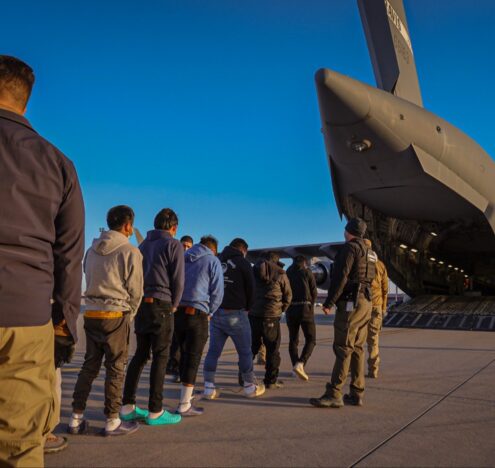
Top photo: US citizens and others being evacuated from Sudan in April 2023 as armed conflict grips the country (AFRICOM/Wikimedia Commons)