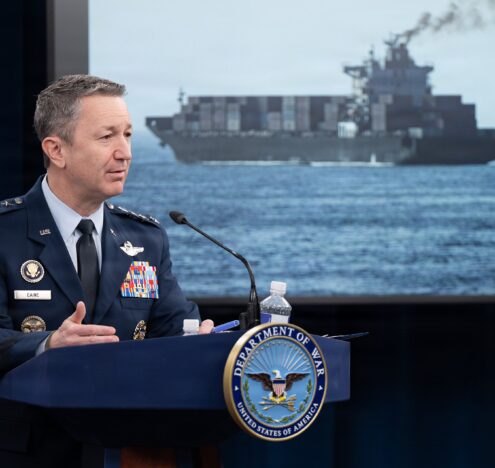






When US President Donald Trump and Secretary of Defense Pete Hegseth addressed military leaders who had been called home from around the world on Tuesday, their remarks displayed a dangerous misunderstanding of the role of the armed forces in a democracy. In the New York Times, Adam B. Kushner summarized Hegseth’s message, which boiled down to the claim that our military brass needed to “get serious about killing people.”
For his part, President Trump revealed that he had told Hegseth to use domestic deployments — which are being carried out without a plausible legal justification — that should serve as “training grounds” for US troops. The president went on to make it abundantly clear that his motive in doing so is firmly rooted in partisanship.
“It seems that the ones that are run by the radical left Democrats, what they’ve done to San Francisco, Chicago, New York, Los Angeles, they’re very unsafe places,” Trump insisted. “And we’re going to straighten them out one by one, and this is going to be a major part for some of the people in this room.”
There is no evidence to suggest that the cities targeted by Trump are any less safe than other metropolitan areas, once their size is taken into account. The deployment of troops for domestic law enforcement is supposed to be extremely rare, limited to times when they are being used to put down an “insurrection.”
In Los Angeles, the Trump administration justified its troop deployment as an effort to supposedly protect federal property in the city amid protests against raids by Immigration and Customs Enforcement (ICE) agents. Homeland Security Secretary Kristi Noem claimed the administration sought to “liberate the city from the socialists.” In Washington, DC, Trump insisted the National Guard deployment would help crack down on crime.
Yet, demonstrations against harsh immigration crackdowns, or a crime rate in Washington, DC, that is on track to be lower this year than last, hardly constitute “insurrections.” Rather, they are tools of intimidation by an administration that is increasingly contemptuous of the rule of law.
The deployment of troops to major cities will not stop with Los Angeles and Washington. Illinois Governor JB Pritzker has reported that the Trump administration wants to send at least 100 troops to Chicago, and the Oregon National Guard has said it is scrambling to comply with an order to deploy 200 personnel to Portland. Louisiana Governor Jeff Landry has requested 1,000 federal troops to deal with “high crime rates” in New Orleans and other cities in his state, and Trump’s numerous mentions of Baltimore as another target city have drawn strong protests from Maryland Governor Wes Moore.
Trump’s rhetoric aligns with what we know about the Pentagon’s new national defense strategy, the draft of which “places domestic and regional missions above countering adversaries such as Beijing and Moscow,” according to officials briefed on the document who spoke to reporters from Politico.
All of this comes in the wake of the president and his allies falsely blaming their critics on the left — and his critics, no matter where they are on the political spectrum — for politically motivated violence in recent years. The danger in this rhetoric is that, rather than tamping down violence, it could give it license, at least in the minds of some Americans who may already be prone in that direction.
“The deployment of troops for domestic law enforcement is supposed to be extremely rare, limited to times when they are being used to put down an ‘insurrection.'”
In response to the administration’s use of the military to address alleged internal “threats,” 11 retired generals have filed an amicus brief in support of a lawsuit brought by California Governor Gavin Newsom. The brief argues that the practice would undermine the “cohesion and reputation” of the US military. “Deployment of the military within our country’s borders to be used against its population is not only contrary to core American values,” it states, “but can also be harmful to the reputation, integrity, and morale of the military itself.”
There is also considerable public opposition to actions like the deployment of troops to Los Angeles. A recent NPR/Ipsos poll found that 49% of Americans opposed the move, versus 38% in favor, with the rest undecided.
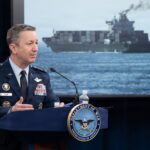
The second major theme of the day was Hegseth’s attack on what he described as the US military’s “stupid rules of engagement.” He also said the military would “untie the hands of our warfighters to intimidate, demoralize, hunt, and kill the enemies of our country,” adding: “No more politically correct and overbearing rules of engagement, just common sense, maximum lethality, and authority for warfighters.”
It wasn’t that long ago, in May 2019, when Hegseth defended soldiers accused of war crimes during his time as a cohost on Fox & Friends. “These are men who went into the most dangerous places on earth with a job to defend us and made tough calls on a moment’s notice,” he said at the time. “They’re not war criminals, they’re warriors.”
It looked like the point of the event was to assemble military leaders as a backdrop for promoting the administration’s questionable views. Yet, totally absent from the addresses was any deeper discussion of the military’s appropriate role, which should be as reluctant warriors, ready to defend the country against legitimate threats when ordered to do so, and loyal first and foremost to the US Constitution, not the partisan whims of any one political leader.
The administration’s perspective on the role of the military is not just misguided. It is unacceptable if the United States is to retain a democracy worthy of the name. It is also a direct threat to fundamental rights, many of which were only made possible after decades of struggle and advocacy. It is time to put the same level of energy, courage, and commitment into preserving these freedoms that were exercised when a mobilized public won them in the first place.