











In a beige-brick community center behind tennis and basketball courts hosting lively matches, nearly 100 people gathered in the South Carolina town of North Augusta earlier this month for the sort of event that’s rarely occurred in the eight decades since the United States acquired nuclear weapons. The National Nuclear Security Administration (NNSA), its hand forced by a successful lawsuit filed by a coalition of scrappy watchdog groups, was holding the first of five court-ordered public hearings. The purpose was to ask locals whether new nuclear warhead production in and around their towns made them feel safe in their daily lives.
The lawsuit had introduced a rare speedbump into the United States’ new nuclear arms race, which was playing out nearby in a 310 square-mile plant called the Savannah River Site (SRS), whose existence dates back to the early days of the Cold War. When that conflict wound down, the site’s reactors were shut down and its mission largely transitioned to cleanup. The tens of millions of gallons of radioactive waste held in aging and cracking tanks that SRS staff call “tank farms” led the weapons plant to be declared a Superfund site. The state of South Carolina has called the tank farms “single largest environmental threat in South Carolina.”
But while the SRS inched ahead in its task to clean up the Cold War-era waste, the government proposed a plowshares-into-swords reversal for the site. The DOE decided that a mothballed nuclear energy facility there would be torn apart and repurposed as a warhead plant to make hundreds of plutonium pits, the hollow cores of nuclear weapons, over the next half century.
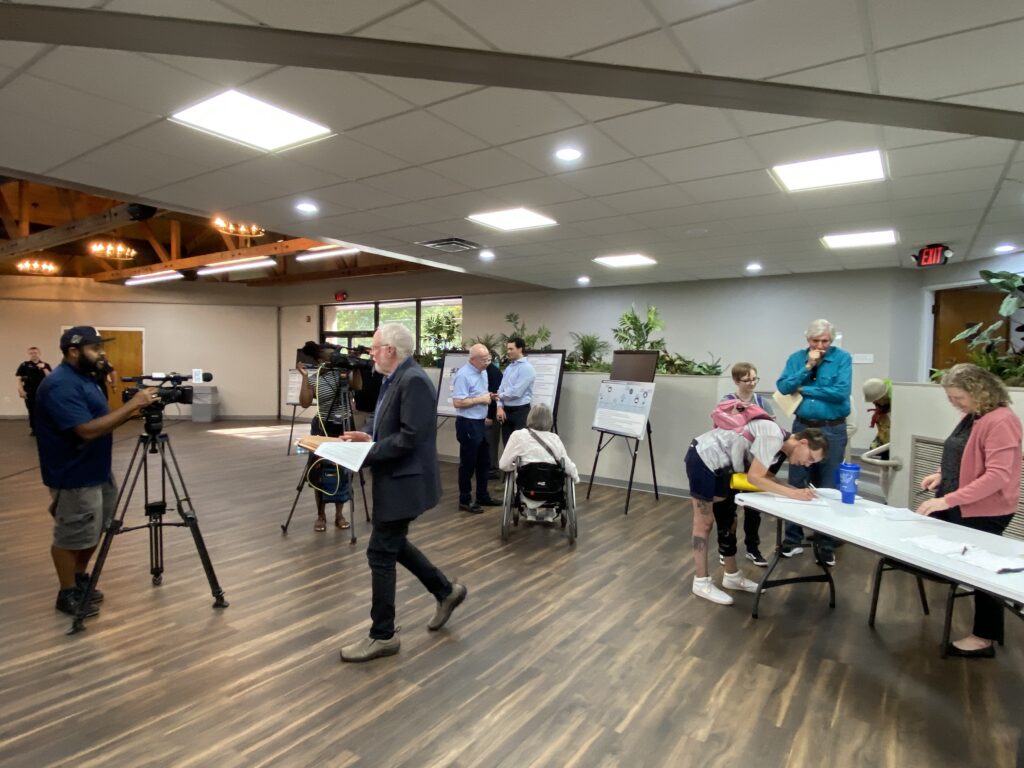
The prompt for the hearing in North Augusta was the government’s drafting of a Programmatic Environmental Impact Statement (PEIS), hundreds of pages that outlined their expectations for how pit production would contribute to air pollution, hazardous waste production, groundwater contamination, and other problems in surrounding communities. And for a topic often veiled by jargon and secrecy, the discussion at the event was frequently blunt.
“We know going into this that there are a lot of strong opinions about this plan — and about nuclear weapons in general,” David Ableson, the event’s moderator, told the crowd.
Local opponents included a horse farm owner, a young couple, and a grandmother who brought her guitar to the podium and sang a sardonic ode to war profiteering. They greatly outnumbered the project’s boosters, with several dozen people speaking against the new warheads and about five in favor, the latter largely speaking about the jobs and business activity created by the large federal project. Critics’ concerns ranged from local and personal to national and global ones. Many said they mistrusted the government’s claim that it needs additional pits when thousands are already sitting in storage and feared that possessing new weapons would lead to their eventual usage. Others were exasperated to see the government producing a new generation of weapons when contamination, cancers, and cleanup were still ongoing from the last century’s nuclear arms race.
“I come from a nuclear family,” Barbie Poston Church told the gathering.
Church said she was born in the town that anchors the SRS, Aiken, and that after her father’s death her family received compensation from the government due to his exposure to plutonium after a career at the SRS and weapons plants in Oak Ridge, Tennessee, and the Hanford Site in Washington state. Her brother also worked at the SRS, she said, and was exposed to hazardous substances in a glovebox that led doctors to shave a whole layer of skin off of his body.
“I’ve never seen a whiter human in my life,” Church said of her brother after the shaving. He was required to urinate and defecate in containers for three months after the workplace accident. “They call it being crapped up. That’s what they call it at the plant. It’s not being polluted. It’s not being contaminated. They call it being crapped up because that’s exactly what it does to your life.”
Another critic who was newer to the area said the warhead plant gave her pause about starting a family there.
“Where I live is within a 30-mile radius from Savannah River Site, and I, like many others who have spoken so eloquently before me, have many concerns about the environmental risks and the health risks involved in new plutonium pit production,” Mary Moussa Rogers, a psychologist, told the NNSA.
Rogers said she didn’t believe the draft PEIS sufficiently accounted for how accidents in handling plutonium could cause radiation drift and pollute the local air. “I … am particularly concerned that the PEIS is missing some key components for thorough risk analysis, putting my family — the family I want to raise, hopefully, some day — and the citizens of this area at unnecessary risk,” she added.
In 2010, then-President Barack Obama made a deal with Congressional Republicans. In exchange for their votes in favor of the modest weapons reductions of the New START arms control agreement with Moscow, he would back their bid to “modernize” the US nuclear arsenal, committing the federal government to purchasing a whole new generation of weapons in a spending spree projected to cost about $2 trillion. New START is gone — President Donald Trump let it expire earlier this year, and there’s currently no treaties limiting the size of US-Russian arsenals. But modernization continues full speed ahead, sending billions of dollars to contractors and reshaping entire economies across Cold War-era towns like Aiken that are rebuilding their weapons industries.
The North Augusta hearing comes at a moment of crossroads for the SRS. The Trump budget request for next year nearly doubles the amount that the administration seeks to spend on pits at the SRS, located in a deeply Republican and rural swath of the state. However, the Trump ally and lawmaker who has championed the project, US Senator Lindsey Graham, is facing a competitive reelection campaign this year. Graham’s political career over four terms in office has tracked closely with the tremendous volume of spending in what is known as “F Area” of the Savannah River Site.
Long before the federal government proposed a warhead plant on the site, F area was home to a would-be disarmament project that sought to convert weapons-grade plutonium into fuel for nuclear power plants. Known as MOX, or Mixed Oxide, the plant represented a promising new chapter for the SRS but for a major problem that lurked behind the proposal: US power companies didn’t want that type of fuel.
Congress sunk about $5.4 billion into the MOX plant construction, without it ever producing fuel, before cutting it off in 2018. Some 1,800 local workers were laid off. Constituents directed their ire at Graham, the senator so closely associated with the venture that he was locally nicknamed “Mr. MOX.” But on the same day MOX closed in 2018, the Department of Energy (DOE) announced that the partially constructed facility would now produce cores for a new generation of nuclear warheads. The following year, Graham co-authored an amendment to the annual military bill calling for a surge in pit production.
“Does the knowledge and expertise exist at SRS to build a facility which will be safe for workers?” – Pete LeBerge
The MOX-turned pit plant’s price tag has skyrocketed to a projected total of more than $35 billion, including the more than $5 billion spent on the failed MOX plant that has since largely been gutted.
The handful of boosters who spoke at the event, including two from the local chamber of commerce, did not address the downfall of MOX but spoke eagerly about job creation spurred by the pit contract.
“In 2024 alone, Savannah River Site supported local business throughout the Georgia-South Carolina area to the tune of over $438 million,” Robbie Bennett, the president and CEO of the SRS Community Reuse Organization, said. “That’s livelihood for a lot of people in this region.”
The nonprofit he leads dates back to the post-Cold War period, when the federal government sought to establish economic development organizations that could diversify towns reliant on weapons contracts and find new uses for their facilities and workforces. But the SRS Community Reuse Organization has championed an expansion of nuclear weapons production in recent years.
In a nod to the priorities of Bennett and other pit proponents, the PEIS lists the “Socioeconomic Impacts” of warhead production in its evaluations. The report projects that, once the $35 billion building is completed, between 1,705 to 2,840 people would be employed to staff plant operations, the number depending on whether the government ordered 50 warhead cores per year or as many as 125.
Detractors also said they were concerned about workers.
Pete LaBerge, a horse farm owner who lives three miles from the northern border of the SRS, recalled the thousands of SRS employees whom the government has paid benefits to under the Energy Employees Occupational Compensation Program, legislation from 2000 that has awarded more than $25 billion to 141,000 workers and their surviving families nationwide.
“Does the knowledge and expertise exist at SRS to build a facility which will be safe for workers?” LaBerge asked. “History suggests that the answer is no.”
Don Moniak, a resident in Aiken County, said that building a new plutonium pit plant from scratch ignored the experience of Rocky Flats, a Denver-area plant that was the last US facility to mass produce pits. In 1989, Rocky Flats was raided by agents from the Federal Bureau of Investigation and the Environmental Protection Agency for environmental crimes that exposed workers and the surrounding community to radiation.
Moniak said that the draft PEIS didn’t address the well-documented travails of Rocky Flats, which was shuttered after the raid and declared a Superfund site.
“DOE fails to specifically address the unique hazards inherent in plutonium foundry work and machining — hazards that would be new to SRS,“ he said. “There’s no discussion of difficulties faced during the three decades of pit production in Rocky Flats.”
A bureaucratic yet crucial issue soon coming to fore loomed over the May hearing — one that could be a chokepoint in the government’s plans to produce any pits at all in South Carolina. An official overseeing the pit project for the NNSA gingerly addressed the issue that night.
In opening comments, Jade Fortiner, an NNSA official overseeing the environmental impact draft, alluded to an ongoing dispute between the states of South Carolina and New Mexico. That disagreement boils down to a section of a 1976 law known as the Resource Conservation and Recovery Act (RCRA). The provision is colloquially known as the “cradle-to-grave” measure and requires that generators of hazardous waste be responsible for the final “disposition of such wastes”.
Only one place in the country is allowed to accept the most toxic form of waste produced in pit production, called transuranic, or TRU, waste. That location is a 2,150-foot-deep salt mine called the Waste Isolation Pilot Project (WIPP) in southern New Mexico.
Last October, representatives from the contractor seeking to produce the pits told members of the public at an info session that TRU waste from future pit production would be deposited at WIPP. But the state that hosts that “grave” is increasingly objecting to taking in that future waste, and it doesn’t have to do it. When asked by Inkstick about the interstate dispute, a spokeswoman for the contractor said: “We would not speculate on what WIPP and the state of New Mexico may decide to accept.”
In April, New Mexican authorities continued to signal their resistance to taking on a new generation of TRU waste, issuing a draft permit modification that would majoritarily prioritize the limited space at WIPP for Manhattan Project and Cold War-era waste from a site located in their own state, the Los Alamos National Laboratory. Don Hancock, the director of the Nuclear Waste Safety program at Southwest Research and Information Center in Albuquerque, noted that WIPP is also slated to cease disposal in 2033, long before the end of the 50-year period that the federal government seeks to produce pits at the SRS.
The draft modification in April, in addition to that closure date, is “another indication that NNSA should not be proceeding [with pit production] without considering now in the PEIS the alternative of not being able to use WIPP for some or all of the pit waste,” Hancock told Inkstick.
At the North Augusta hearing, Fortiner, the NNSA official, suggested that the government would address bottlenecks in waste disposal later.
“NNSA would take proactive measures to stay within the existing limits established at WIPP,” she said. “If, in the future, DOE determined that further regulatory actions for TRU waste disposal would be required, additional NEPA [National Environmental Policy Act] review would be performed.”
But without detailing the “grave” for its future waste production, South Carolina authorities may decline to issue RCRA permits needed for the pit plant to set up TRU waste storage facilities whose purpose would, officially, be to hold waste on site only temporarily before being shipped to that final “disposition.”
Laura Renwick, a spokeswoman for the South Carolina Department of Environmental Services, told Inkstick that it had received the permit application for the waste storage facilities from the pit plant’s contractor and that “there isn’t a timeframe for when the draft permit will be written and ready for public comment.”
In the meantime, pit production also can’t get underway because of the watchdogs’ lawsuit, which prevents the government from introducing nuclear materials into the plant and constructing classified facilities.
While those permitting and legal battles play out over the coming months and years, Pamela Greenlaw, a South Carolinian who spoke at the evening hearing, took a longer view. She told the North Augusta hearing that the scope of the environmental report was inadequate because it didn’t look far enough into the future.
“Because the half life of plutonium is 24,000 years,” she said, “the PEIS probably should have a 24,000-year plan.”
Top photo: A liquid waste evaporator at the SRS’s Canyon facilities is photographed in June 2021 (Michael Shaffer/Wikimedia Commons)


.jpg)