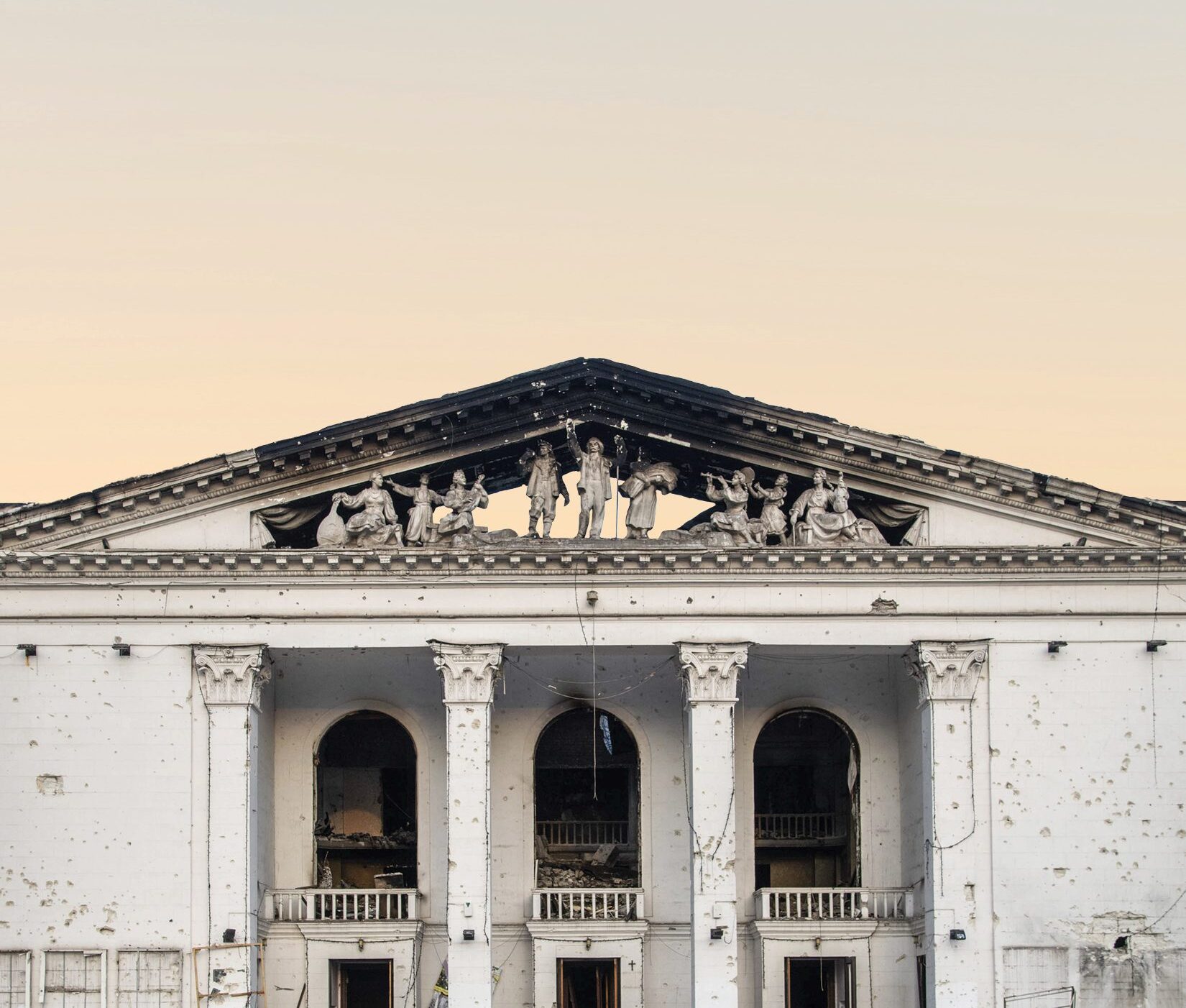
As the siege continued, citizens streamed into the theater with their children, grandparents, and family pets, hoping to escape the cold and violence outside. They found whatever dressing room, alcove, closet, or unoccupied corner they could claim as their own and waited to join an evacuation, which ultimately never came. Inside the theater, conditions worsened as the population swelled to around 1,500, with nearly twice as many visiting daily in search of food.
Once a place of entertainment and culture, the theater staged a new kind of drama as residents organized themselves, scavenged materials, gathered food and prepared meals, and tried to manage sanitation, record keeping, healthcare, and the endless task of repairing bombed-out windows.
In an attempt to lift their spirits, residents improvised theatrical performances, played music, and, when rockets rained down outside, they defiantly sang folk songs and rock anthems to drown out the sound of destruction. They did their best to stay safe and sane under impossible conditions until death came upon them from the sky as a blinding blast of light and fire, followed by suffocating dust and concrete rubble heaped upon piles of shattered bodies.
As of February 2026, the The Office of the High Commissioner for Human Rights reported more than 15,000 civilian deaths, over 41,000 injured, and millions displaced in four years of war. Aerial bombardments across Ukraine continue, competing for the world’s attention as missiles, drones, and bombers kill civilians in wars across Asia, Africa, and the Middle East.
On April 6, James Verini spoke with Jon Letman for Inkstick Media. Their conversation has been edited for length and clarity.
Jon Letman: With so much violence against civilians in this war, why is the theater bombing in Mariupol “the defining atrocity of the Ukraine war”?
James Verini: To date, that we know of, it is the most egregious and grievous and lethal civilian attack of the war. It’s defining in that sense. Also, it is defining because…on that day when the theater was bombed, everyone in Ukraine realized this isn’t about territory. This is about a much deeper grievance and a much more profound existential sense of sadism and revanchism and Putin’s desire to correct, in the most vivid and lethal terms possible, what he views as a misturn of history which was the creation of the Republic of Ukraine.
The theater bombing, more than any other single incident, pointed out the historical significance of this war and the ideological significance for Russia. It showed Ukrainians… that this really was a war about trying to kill Ukraine as a culture. Kill Ukraine as a state and kill the notion of an independent Ukraine.
Around the same time as the theater bombing, there was an infamous massacre in Bucha on the outskirts of Kyiv which received much more attention. Why is that?
There are a few reasons for that. One is that journalists could cover the massacre in Bucha because it was just outside Kyiv and the Russians were quickly pushed out so reporters could get there and document it almost in real time. But in Mariupol, no reporters could get into there. There was that very brave AP crew who was still there, and that was it. The city was surrounded… It was also so much more personal. The theater was a bombing. Bucha was people being shot execution style in front of their homes. With the theater, Russia still maintains that it was bombed by Ukrainian saboteurs.
Have you seen anything that would support that claim in any way?
The idea that Ukrainian saboteurs came in and did this, no. First of all, the nature of the explosions. These were not explosions that were created within the theater. You can tell that from the debris fields and the nature of destruction. You can tell that from the size of the destruction. These are large bombs. The idea that somehow saboteurs made it into the theater with these immense explosives when the theater had security and everyone saw everything that was going on, there was no privacy at any time, you know — completely ridiculous, like so much of the propaganda.
I get the sense oftentimes with Kremlin propaganda that it’s winking or even smirking. They know this is implausible, but they say it anyway in order to get under our skin.
Was there ever a definitive determination of who bombed the theater?
There was no way for investigators to go on the ground to do a forensic investigation and if the Russians ever did one, it’s not been published that I know of. Amnesty did a report entirely based on photography just after the bombing. They analyzed the destruction to the structure and the debris fields. One of the things about this incident is that we will probably never know all the exact details.
In late December, Russian authorities announced the completion of the reconstruction of the theater. Mariupol officials described the theater opening as “singing and dancing on bones.” What does this mean for documenting this atrocity and what does it mean for the people of Mariupol?
Of course, this means that it won’t ever really be documented. We have the Amnesty International report, the Human Rights Watch report, and my book and there are online testimonies from survivors… What it means for Ukrainians of Russophilic tendencies, perhaps the rebuilding of the theater feels like some sort of redemption. For people who are not of that mind, for all of the survivors and all of the Mariupoltsi who fled the city and are now living elsewhere in Ukraine or in Europe, I can’t begin to imagine how forlorn and disappointed they are.
I describe in the book a mother and son [survivors] whom I interviewed in a city a few hours west of Mariupol where they’d been living for a year or more and they still had all of their bags packed because they believed it was only a matter of time before Mariupol was liberated and they’d be moving back. Can you imagine what seeing this Russian propaganda about the rebuilding of the theater must do to them?
Your book has been described as being in the tradition of John Hersey’s Hiroshima. Was this something in your mind? Were you thinking to write something in a similar vein?
It was explicitly in my mind… I knew that was the sort of approach I wanted to take. I wanted to tell the moment-by-moment stories of a handful of characters in this place and I wanted the timeline to be as tight as possible and I wanted to toggle between the characters. I had Hiroshima very much in mind when writing it.
You’ve covered wars in Africa, the Middle East, and Asia. Is there something about the war in Ukraine that strikes you as different to other conflicts?
In terms of the wars I have covered, it was different because of the familiarity of the landscape… If you’re from a highly urbanized, highly organized country and used to seeing European and North American cities, that’s how Ukraine looks. It looks very Russian, but in many places it could be Berlin, it could be Amsterdam. It could be Brooklyn in certain places. Other parts look like Los Angeles… And so the spectacle of a place like Mariupol or Kyiv getting bombed, it brought to mind images of World War II in a way that no conflict really has. There was Sarajevo of course, and the Bosnian civil war. Those images evoked World War II for many people, but by contrast, not this scale of war. This [is] a huge war with hundreds of thousands of invaders and defenders.
Also, the nature of artillery was frightening in a way I’d never experienced. I was around a lot of airstrikes but in Mosul as long as I stayed on the Iraqi army side and didn’t wander onto the ISIS side of the city, I knew that the artillery wasn’t directed at me. In Kharkiv and in Kherson and in Donbas and everywhere else, the artillery was massive and constant and coming from both the air and the ground. The Russians have these Grad systems that are just wicked to behold. When a Grad system goes off and it launches a few dozen missiles in nanosecond succession and they’re coming upon you, yeah, I’ve never felt anything quite like that.
What struck you about the way in which Mariupol’s people organized themselves in response to this assault that maybe different from other conflicts?
After the invasion began, during the siege of Kharkiv, I spent a lot of time in basements. And in Mariupol, they had basements. One interesting aspect is that not everyone in the world has basements. In Iraq there are not a lot of basements for whatever reason and in Africa, precious few that I’ve ever seen. The most striking thing that I found in Ukraine during the first year of the invasion was how people basically moved underground into their basements, into the metro stations. You know, found a way to get underground…I remember a wonderful scene in Kharkiv in the metro station where hundreds of people were living. Someone had set up a little lending library on a cot. They had all these volumes that people could come and read. And there was a teacher leading a drawing class for the kids. People find a way.