










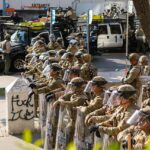


The atmosphere was tense as I exited the elevator on the 12th floor of Manhattan’s Federal building at 26 Federal Plaza. It was early March and a brutal New York winter was finally beginning to break. The spring-like weather outside clashed with the sterile and drab fluorescent lighting inside the building. The doors opened and I walked out into the elevator bay, turning the corner and peering down the nondescript hallway lined with the doors of the many waiting rooms of the building’s federal immigration courts. As I looked down the windowless corridor, a group of people waited in the hall. A dozen or so armed Immigration and Customs Enforcement (ICE) agents stood against the walls of the hallway. Many had masks on, revealing only their eyes. Some had official identification, often in the form of badges, but others wore plain clothes, seemingly designed to blend in with the array of people in the multitude of different rooms where immigration hearings were taking place.
I had spent the morning in the neighboring building at 290 Broadway, which, along with the building at 26 Federal Plaza, houses the bulk of New York City’s immigration courtrooms. Generally thought of by activists and volunteers as more relaxed, my morning at 290 had consisted of entering the waiting rooms of the courts and talking to the people waiting for their hearings. Along with other volunteers who had signed up for “Court Accompaniment” that morning, I was working with an organization called New Sanctuary Coalition (NSC). As I was about to leave, I received a message from one of the coordinators from NSC. The group at 26 Federal Plaza had spotted ICE agents arriving outside one of the waiting rooms and asked for help in the case of a detention. This wasn’t uncommon. Instead of going home, I went into the building at 26 Federal Plaza, made my way through the airport style security area, and went up to the 12th floor.
When I arrived, I had one of the quick impromptu meetings that are common within the hallways of the building. Two attorneys I recognized stood in one of the empty waiting rooms accessing the situation. “Where’s Suzanne?” I asked, trying to figure out where the coordinator who had messaged me was. When I found her, she gestured towards the crowd of masked agents and press that had amassed waiting for the impending detention.
“Hey,” she said, gesturing toward the group of people down the hall. “I need you in there.”
I nodded and began the walk through the array of masked agents. I made eye contact with some, others seemingly averting their gaze as I passed. There is a surreal nature to these hallways, a normalcy that can at times be crazy making. ICE agents continued with casual conversations, ones someone would have with coworkers on a slow day at the office. The casual nature of their affect, the way they approached a detention that would inadvertently change the course of someone’s life, was jarring. At the same time, though, I was already used to it. This is the reality of working within the immigration court system.
Since Donald Trump’s return to the Oval Office in January 2025, his administration has squarely positioned immigrants in its crosshairs. Trump had campaigned on mass deportations, and once in office, he immediately began a “shock-and-awe blitz” of executive orders cracking down on immigrants. In 2025 alone, the Department of Homeland Security dubiously claimed, more than 2.5 million people departed the country “thanks to President Trump.” Rights groups and watchdogs have disputed those numbers, and DHS itself has said elsewhere that it deported a little more than 600,000 people last year. Meanwhile, Congress approved drastically increased funding for immigration enforcement: The budget for new immigrant detention centers rose to $45 billion, and ICE’s budget for enforcement and deportations has swelled to $29.9 billion.
By the time I entered the waiting room that day, several activists were already preparing to respond to the detention. They spoke to respondents in hushed tones, trying to get their information without alerting the court clerks who come in and out of the courtroom looking to check in those who had just arrived. I recognized many of the faces. Others I knew only in the way that is common in the halls of 26, a kind of unspoken relationship that develops after weeks of working within the courts. Relationships formed in the high intensity situations that can occur when faced with the life-altering situations that are the reality of these court cases.
In the waiting room, a dance of sorts begins. Everyone in the room knows what’s coming. They all know why each one is here and what role they will come to play in the tragedy that is about to occur. The agents, masks still on, come into the waiting room, looking at the paper docket on the wall to see if their target is supposed to be in the court. They stare at the volunteers, their contempt clear. To the agents, these volunteers are nothing but troublemakers. Occasionally, they approach respondents, demanding to see court paperwork with no explanation given. As the docket for the day concluded, the remaining respondents slowly filed out of the court into the small, already congested waiting room. Volunteers shot to their feet, trying to intercept them before they emerged into the hallway where ICE agents prepared to apprehend their targets. As one woman emerged, a fellow volunteer approached me.
“Listen, I don’t speak Spanish,” she whispered. “So, I need you to come with me to accompany our friend here.”
I stood up and explained to the startled woman that I was a volunteer with NSC and that I would be walking her out. I told her ICE was out in the hallway, that she should do everything she could not to interact and to make her way to the elevators as soon as possible. The woman and my fellow volunteer walked out of the waiting room arm in arm. As we emerged, the ICE agents sprung into action. They moved in unison, each one taking their respective role. They swarmed the group of people coming out of the waiting room, pushing me up against the wall of the hallway. As my fellow volunteer and the respondent were sucked into the group of agents, the woman gripped the court accompanier in terror, refusing to let go of her arm. ICE agents yelled at the two women, telling them to stop resisting and demanding the volunteer let go of the woman they intended to apprehend.
In the chaos, the volunteer’s arm was pushed and pulled in a violent, unnatural way, crushed between the crowd and the wall. The respondent, who was becoming emotional, screamed out for help in Spanish. She was thrown to the ground, the crowd of journalists and volunteers pushing up against the agents as they dragged her down to the detention area. Her screams could be heard from the door of the waiting room. Then, just as suddenly as the chaos had begun, it ended. A sinister calm took hold of the hallway from which the woman had been taken. It was like that in 26. Utter chaos, despair, and violence followed by a banal, eerie quiet.
Since the beginning of the second Trump administration, Manhattan’s federal buildings at 26 Federal Plaza and 290 Broadway have become focal points for volunteer-led solidarity activism intended to support the increasing numbers of migrants being apprehended by ICE. As immigration detentions in the New York City area rose 314% in 2025 alone, a network of community activists have emerged to support those facing deportation within the city.
One of the largest of these organizations is New Sanctuary Coalition, a faith-based pro-immigrant activist group run by the Brooklyn chapter of the Religious Society of Friends, also known as the Quakers. The organization began its immigration work in 2007 to “stop the inhumane system of detentions and deportations in this country.” In tune with its Quaker roots, the organization refers to the migrants it works with as “friends” and not clients, a reflection of both the group’s family-oriented philosophy and a push to humanize the people anti-immigrant politicians and pundits so often dehumanize.
While nominally organized by the Quaker church, the group conducts an impressive array of both interfaith and secular activism, welcoming volunteers from all backgrounds and walks of life. During my time with the group, the diversity of the volunteers who work with NSC impressed me. Some consisted of clergy from churches all across the city. They include students from universities who study an array of subjects and topics. They are retirees from a broad swath of professional backgrounds and simply everyday people who dedicate their mornings to this form of activism. “Something about NSC is that we have a largely older group of volunteers,” said Suzanne Boswell, a coordinator with the group.
It’s largely true. Something that struck me about the group when I first began volunteering with them was the prevalence of retired volunteers, many of whom were more than willing to go into situations where they’d be in direct confrontations with armed agents. In fact, many of the older volunteers stand out as some of the most dedicated members of the group, showing up every week. “A lot of these older people are some of the most hardcore, radical activists I’ve ever met,” said Bozwell, adding that “sometimes these older volunteers get away with murder, they get into rooms or situations that no one else would because they aren’t seen as a threat.”
NSC’s work is divided into two main points of operation. One is a pro se legal clinic, where volunteers help fill out paperwork and prepare friends for their immigration hearings. The other is their court accompaniment work, in which volunteers sign up to go into the courts to provide support to those facing deportation. The bulk of court accompaniment work revolves around getting the personal information of respondents who are there for their own trials. This includes information about their court case, an emergency contact, and perhaps most importantly, their Alien Registration Number, or A number, which is the number issued to respondents in immigration cases.
This information is crucial for responding to detentions. It allows volunteers to help file Habeas Corpus petitions in the aftermath of friends being detained by agents. These petitions, which contest the legality of such detentions, are filed through the congressional office of US Representative Dan Goldman, which operates a rapid response clinic allowing lawyers to begin the process of getting respondents out of ICE custody. Without this information, filing these petitions —and potentially getting people out of detention centers — is nearly impossible. For volunteers, the instances when someone is detained without getting their personal information are seen as failures. “The things that stick with me most are the situations where we couldn’t do anything. Where we couldn’t get a person’s information,” explained Boswell. “Of course there are victories, but the ones where we couldn’t get a habeas filed … That’s what really sticks with you.”
At the same time, as the increasingly harsh immigration crackdown of the second Trump administration has come into full effect, the work of the volunteers in the courts has become more difficult — with the increased presence of ICE agents presenting new risks. According to Alan Yaspan, a longtime volunteer and communications director with NSC, the tense atmosphere in the courts has increased considerably since the re-election of Donald Trump. Of his work with the group during the first Trump administration, Yaspan said that “there weren’t ICE agents in the courthouse halls. They were obviously a part of ICE check-ins … but ICE was not part of the courthouse situation. As far as masks, I don’t remember that being part of ICE at all.”
This approach to immigration enforcement has imposed considerable restrictions on the ability for volunteers to operate freely in the buildings. Due to pressure from the organization, court clerks and security guards have imposed new rules on the ability to stand in hallways, talk to respondents in waiting rooms, and to document the actions of ICE within the buildings. Although court employees have enforced these restrictions, many observers and critics have questioned their legality. After all, federal buildings are, at least nominally, public spaces.
“As long as it does not interrupt the proceedings of the court, the public should have the right under the First Amendment to engage in non-disruptive demonstrative behavior,” said Burt Neuborne, a professor of law at New York University and expert on civil liberties. And many activists working in the courts agree that the public should have a right to engage with the system in support of those who are facing deportation. In March 2026, activists associated with NSC filed a lawsuit against the Trump administration, claiming that ICE was unlawfully impeding the First Amendment rights of volunteers in the building.
For NSC leadership, these restrictions, and the increasing number of tense confrontations with ICE agents, presents a source of anxiety for the future of the group. Some organizers fear that as time goes on, volunteer numbers may begin to wane. The normalization of increased detentions, as well as the potential for harm to volunteers at the hands of ICE, presents an obstacle to continuing court accompaniment work. “I worry about keeping volunteers,” Boswell admitted. “I worry as the inflammatory coverage begins to wane, less and less people are going to show up.”
For those determined to keep NSC’s work alive, the dynamics of working with a purely volunteer-based organization represent an obstacle to maintaining a reliable volunteer base. “Because there’s not a paid organizational structure, people need to take the initiative,” said Johnathan, an organizer at NSC who asked not to use his surname. “We are always working on a crisis basis,” he explained, adding: “We mutate. We adapt. … But ICE is being paid, our volunteers are not. That means that burnout can happen very quickly, the confrontation, the tension, some people aren’t going to want to do that anymore.”
Still, while the numbers may fluctuate, what remains clear is the dedication of those who have decided to be part of this form of resistance to the Trump administration’s immigration policies.
A couple of weeks after the detention in the halls of 26, I received a message from one of the coordinators I had been working with that morning. It was short and to the point: “She’s out!” The relief was palatable.
During my work as an accompanier, the violence of that morning had stuck with me, coloring the coming weeks in the courts with an anxiety that I had not felt up until that point. After the detention, I had gone with fellow activists and the woman’s family to the office of Representative Goldman, beginning the somewhat painstaking process of filing a habeas corpus petition. Through tears, the woman’s girlfriend told us how they had struggled after arriving in New York, landing in a homeless shelter in The Bronx, a reality that clashed with their dreams of what arriving in the US would mean. My heart ached for them. Despite my best efforts — all of our best efforts — I feared there was nothing to be done. Another person, another life, had disappeared into the opaque bureaucracy and brutality that is the new face of immigration enforcement in this country.
But when that message reached me, I felt like we’d done something. We had struck a blow, however minor, to the seemingly unending system of detention, incarceration, and violence that had become commonplace in New York’s immigration court system. However short-lived, it is that fleeting sense of accomplishment, victory, and solidarity that keeps volunteers coming back to the halls of 26 Federal Plaza every week, determined to continue this work of resistance in any way they can.
Top photo: Former DHS Secretary Kristi Noem visits the US ICE processing center at 26 Federal Plaza in New York City in July 2025 (Tia Dufour/DHS/Wikimedia Commons)
.jpg)