












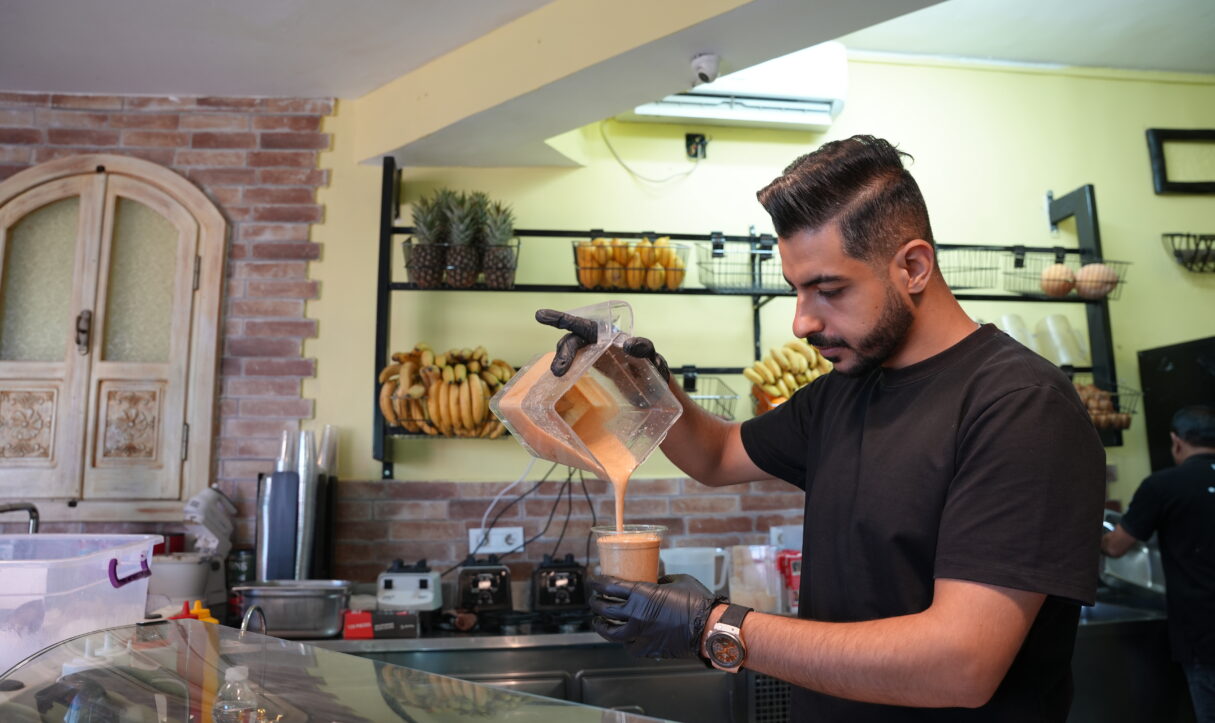
Eyad Ghannam was at work in Tripoli’s Havana café when news broke out of the fall of Syrian president Bashar al-Assad on Dec. 8, 2024. Incredulous, he wondered, “Is this really happening?” The news felt surreal. He could not imagine what a post-Assad Syria would look like. Yet, he was determined to return home.
Ghannam had arrived in Libya in September 2023 from Lebanon, after an arduous journey. In 2015, at 18 years old, Ghannam left Syria to avoid mandatory military conscription. “I was studying hard to pass my high-school exams, but I didn’t end up taking them,” Ghannam recalled. His brother was already in Turkey, having pursued a similar path of evading the brutal military service, and Ghannam followed.
At the time, it was rare to see military-aged men in the streets of Damascus in civilian clothing. Faced with forced conscription into the Assad government’s army, many fled the country, while others went into hiding, confining themselves to their homes to avoid arrest at checkpoints. This mass disappearance reflected a stark choice: fight in a war many did not support, or risk detention, forced recruitment, or disappearance.
Ghannam’s cousin was one of the over 160,000 Syrians disappeared under the Assad regime, a tally compiled by the Syrian Network for Human Rights. “For a couple of years, my family did everything in their power to figure out the whereabouts of my cousin, but to no avail,” Ghannam said. “Eventually, they were directed to a detention center where he was supposedly held. One of the guards came out and talked to them. ‘Your son is dead,’ he said, offering no further explanation.”
Ghannam wanted to avoid this fate, and so he took a long journey to join his brother in Turkey. First, he crossed legally into Lebanon, where he spent a full day in transit. He waited eight hours at a security checkpoint before driving north to Tripoli. From there, he traveled 12 hours by sea to the port city of Mersin, then continued another roughly 12 hours to Istanbul, where he reunited with his brother.
Ghannam spent four years in Turkey, working numerous jobs to stay afloat and support his family back in Syria. But he faced constant threats of deportation, and eventually he decided to return to Syria. His brother-in-law promised to help him dodge conscription.
When he got back in 2019, at 22 years old, Syria was still in dire straits. Ghannam wanted to complete his high school education and get his degree, but there were 74 attacks on schools from January to June of that year. Twenty-four schools were used as military centers, and two out of every five schools were reportedly damaged or destroyed. Since 2014, a year before Eyad left, there had been over 385 attacks on educational facilities. Even though ISIS lost nearly all its footholds in 2019, the risk of being drafted still loomed large.
And despite his brother-in-law’s reassurances, Ghannam found it difficult to avoid the draft as promised. He ended up scrambling to find work while trying to avoid the public eye. “I was so scared of taking one step outside of my home,” Ghannam said. “There was a pattern for security forces to enter a café and ask for the IDs of military-age males. I was mortified by that fact, which made it difficult for me to get a job in an environment like that.”
Luckily, he knew a friend who owned a coffee shop and could offer him a job. He worked with him briefly, but he found the position overly visible. So he shifted to manual labor, installing tiles while buying and selling used products on the side. “It was difficult to make ends meet, so I was fixated on leaving Syria once more,” Ghannam said.
Ghannam’s options were limited. He didn’t want to go back to Turkey, and Lebanon looked unstable. At the time, there was an uprising that triggered waves of protests across Lebanon. Then the currency collapsed, and the country faced near bankruptcy. The 2020 Beirut port blast that wiped out a big chunk of the capital’s infrastructure further paralyzed the state. Ghannam set his sights elsewhere: on Libya.
“I paid a total of $2,000 between having my passport renewed and obtaining a Libyan visa,” Ghannam recalled. Eventually, he left Syria on Aug. 17, 2023 — a month after he got engaged to his girlfriend.
With two rival governments vying for influence, post-Gaddafi Libya remains fragmented between East and West. As of 2026, approximately a million migrants are estimated to be in Libya. Many of these migrants cross the Mediterranean to reach Europe, while many others have been intercepted by Libya’s coast guard. Drones were used by numerous European Union countries to alert Libyan authorities of crossing migrants, making them potentially complicit in human rights violations. The same entities engaged in these human rights violations have been trained and funded by various EU countries to halt migrant flows into Europe. Ghannam hoped to not cross the Mediterranean, but he said many of the Syrians on the plane with him were.
To reach Libya, Ghannam was smuggled into Lebanon from Syria’s Homs. The legal route was not an option this time, because his passport had expired. Even if his document was still valid, he would have been blocked from leaving the country because of his draft-dodging. The journey was frightening and filled with uncertainty and sleepless nights. “At one point, we were instructed by our smuggler to walk in the middle of the night through rough mountainous terrain,” Ghannam said. “We were deathly quiet and forced to walk in a single file. Anyone who deviated from our smuggler’s instructions was facing a bullet to the head.”
Ghannam recalled a four-hour walk through the mountains.
Upon arriving in Lebanon, Ghannam had no food, no water, and little money. He was expecting money to be wired upon arriving in Beirut, which would be used to fund the remainder of his journey. He stayed in Lebanon for approximately a month until he managed to renew his passport.
Ghannam flew from Beirut to Cairo, then took another plane to Benghazi. At the time, Benghazi was under control of Khalifa Haftar, a leading figure since the crisis following the fall of Qaddafi in 2011, who holds vast power over the Eastern part of Libya. According to Wolfram Lacher, a researcher at the German Institute for International and Security Affairs, Haftar and the Assad regime shared a beneficial relationship. “Beyond economic activities that ranged from irregular to criminal,” Dr. Lacher said, “the Haftars and Assads also shared a common model of iron-fisted authoritarianism and common allies, who facilitated their cooperation: Russia and the UAE.”
When Ghannam reached Benghazi, he ended up in an abandoned warehouse with a number of other Syrians before being smuggled to a friend’s place in Zawiyah. What was meant to be a 12-hour drive to Zawiyah turned into 26 hours. “At first, eight of us were lumped into a Kia Rio,” Ghannam said. “Yet, we were constantly being picked up by different drivers who were familiar with certain terrains. It was scary.”
Ghannam eventually reunited with a friend and worked in Zawiyah there for two months before moving to Tripoli. A botched deal resulted in the cancellation of his agreement to rent the house where he intended to stay in the capital. “I briefly stayed in a hotel, but I was so desperate to the point that I would walk up to random strangers and ask if they had a place to rent,” Ghannam said.
Then, a year after Ghannam arrived in Libya, the Assad regime fell. European countries were some of the first to adopt serious measures to repatriate Syrians. Tens of thousands of asylum seeker applications were frozen, adding more pressure for Syrians to leave. According to Joshua Landis, a scholar of the Middle East and professor at the University of Oklahoma, the Syrian government has “no money” to help resettlement. “Forcing Syrians to return at this early date is unfair and harmful, ” explained Landis. “There are few jobs and well over 60% of Syrians live in poverty.”
By late 2025, it was estimated that more than three million Syrians had returned to their home country. Libya followed suit with a repatriation program that was launched in late 2025, which not only targeted Syrians but also other nationalities. Ghannam was fixated on leaving Libya, but he still had debts to pay.
In Syria, the reality on the ground remains challenging. After more than 13 years of a brutal civil war that damaged its infrastructure, the World Bank estimates that reconstruction will cost around $216 billion. And 50% of the country’s infrastructure has either malfunctioned or been obliterated, according to the UN. Ghannam, for his part, remains unfazed by these statistics. “For the past 10 years, I have been accustomed to starting from zero, and I am not scared to do that once more,” Ghannam said. “I can’t wait to go back to my family and tie the knot with my fiancé.”
Eyad hopes to return to Syria in May. He estimates that his wedding will cost approximately $1,700, but he is determined to save up for it. The wedding is set to take place in December.
Ghannam is one of many Syrians whose lives have been marked by constant unknowns. The toll that the journey has taken on him is difficult to comprehend, leaving him with deep, invisible wounds that require more than the passage of time to heal. Ghannam will soon be leaving Libya. Yet, like many Syrians, his road to repatriation remains treacherous and uncertain.