









When she tries to sleep, the woman known as “Doberman” still hears the sound of the flash bang grenade reverberating through her home. It was late June, shortly after the sentences were issued in the Prairieland case, and Doberman was asleep in her house in Midlothian, a small city about 30 minutes south of Dallas. That’s when agents with the FBI and the Department of Homeland Security barreled through her door in a “no-knock” raid aided by flash bangs, rifles and an armored vehicle outside.
Doberman — the name she uses on social media — is a transgender woman who often attends protests to work as a medic. She brings guns with her, something she believes caught the eye of the Trump administration.
“I’m somebody who saves lives,” she says. “Yes, I’m a more militant medic and I’m more combat-ready, but that’s not the purpose in my line of work. So the fact that they showed up with multiple rifles trained directly at me told me that they don’t care if you’re in a support role or if you’re somebody that has allegedly done something. They will treat you just the same.”
At first, the agents wanted to talk to her about a plot to kill government officials during the Ultimate Fighting Championship event at the White House earlier this summer. But while she sat handcuffed in her underwear in a police cruiser, the conversation shifted to Prairieland. It seemed the agents wanted to know everything they could about left-wing activity in North Texas.
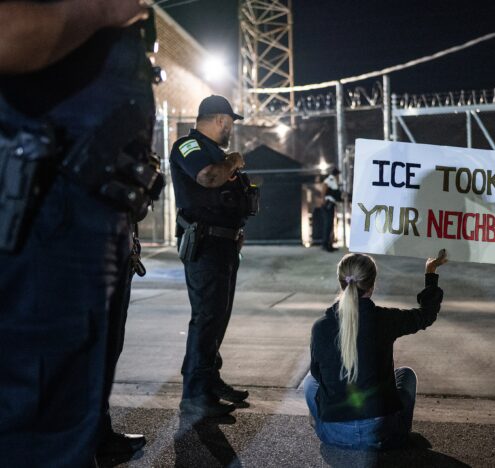
Nearly a year earlier, in July 2025, a noise demonstration turned into mayhem outside the Prairieland Detention Center in Alvarado, Texas. During a pursuit by law enforcement, a demonstrator shot and injured a police officer. Federal authorities subsequently arrested a slate of protesters at the site. In June, prosecutors secured convictions of eight people, and terrorism enhancements meant they received lengthy sentences that civil rights groups and watchdogs have criticized as politically motivated. The Trump administration has celebrated the convictions as a first step in its crackdown on “Antifa” — the shorthand for the loosely knit antifascist movement.
Doberman wasn’t arrested that June morning after the raid at her home, but agents seized her cell phone. Days later, when an FBI agent visited her to return the phone, she said they made her an offer: $200,000 for any information on “bad actors.”
Doberman told the FBI she’d think about it.
The raid at Doberman’s house arrived during the Trump administration’s growing campaign to clamp down on dissent. Around the same time agents broke through her door, Trump aide Stephen Miller and Secretary of State Marco Rubio spoke to a gathering of international leaders about the purported rise of “left-wing political terrorism.” Vice President JD Vance used similar language after an ICE agent killed Renee Good in Minneapolis in January. In the White House’s briefing room, Vance claimed that Good was practicing “classic terrorism” and was part of a “broader left-wing network.” Miller and other Trump administration officials have vowed to “dismantle” these networks, despite any evidence that they exist.
Shortly after the killing of right-wing provocateur Charlie Kirk, targeting anti-fascist organizers became government policy through a national security memorandum often abbreviated as NSPM-7. The memo was cited throughout the Prairieland case.
As the Trump administration’s efforts to target the political left intensify, Doberman’s story is an example of how this campaign can affect a person simply because they have ties, however loose, to organizations or activity the government deems a threat.
When interviewed for this story, she was hesitant to divulge too many personal details about herself. But she shared that she had post-traumatic stress disorder even before police raided her home. “I’ve been working on it since 18,” she adds, “trying to get better, trying to not be as jumpy, trying to not spiral as much.”
Federal agents visited Doberman’s home weeks before the late June raid, seeking information about an upcoming attack and wanting to know if she planned to visit Washington, DC. She told them she didn’t know anything and had no such plans. Then, on June 24, the local right-wing website Dallas Express, owned by wealthy Trump donor Monty Bennett and known for its incendiary headlines, published an opinion piece titled “Armed Left-Wing Extremism is Growing in North Texas.”
Doberman was mentioned in the article’s opening paragraphs, which identified her as a leader of a local community defense group called the Community Liberation Brigade (of which she is a member) and also mentioned anti-ICE protests, the Prairieland case, and Kirk’s assassination.
A few days later, a search and seizure warrant was issued for Doberman’s Midlothian home.
While she initially told the FBI she’d think about their offer to become a paid informant, she told The Intercept shortly afterward that she had no intention of accepting it.
Asked if she formally turned down the agency’s proposal, Doberman said, “Me refusing it is when they see that article, which I’m sure that they already have.”
The FBI declined to comment on this story.
Researchers, experts, and nonpartisan think tanks have pointed out there is not sufficient data to back up the claim that “left-wing political terrorism” exists in a structured form like the White House claims, or that political violence on the American left has come close to the scale and lethality of political violence on the right. What’s more, Doberman says she is undaunted by the experience of having her home raided.
“This has reignited the passion and has made me want to fight even harder for the liberation of all people,” she says. “Not just in my community, but in the United States in general.”
In this, she appears to not be alone.
In the absence of protection from their state or local government, communities across the US are stepping in to protect their neighbors. Community defense organizations — wide-ranging groups that provide education, share legal support and, in some cases, alert their neighbors to ICE activity — became more prominent during the first Trump administration, and more groups of that kind have stepped in to help people targeted during ICE raids of major cities like Los Angeles and Chicago.
“The only response for state violence is community defense,” Doberman says.
Some community defense groups carry guns at protests as a way of asserting their Second Amendment rights, defending themselves from the threats posed by the state or extremist groups, or showing visible defense for people who are all too often subject to state violence.
“It’s defending themselves, it’s defending their community,” Doberman says of the many reasons she and others bring firearms to demonstrations. She also added that she believes it’s a way to protect her First Amendment rights while exercising her Second Amendment rights. “That’s why community defense is a thing.”
Data show more people are becoming first-time gun owners who, like Doberman, may not fit the stereotype of the US gun owner — specifically, more people of color and more people who identify as liberals or members of the LGBTQ+ community.
Philip Smith, founder and President of the National African American Gun Association, says his organization has seen an increase in membership in recent years. “You’re seeing people on the left get more guns now, and people on the right have certainly had a lot of guns,” Smith says. “Both are scared about what’s happening to the country. Both feel that they’re losing control. Both feel we’re going in the wrong direction. Both feel that the other side is so wrong. There are really no areas of commonality.”
Other experts and observers say the January 2026 killing of Alex Pretti, a registered nurse and armed protestor in Minneapolis who never drew his weapon, seems to be playing a role in this trend.
“I think historically people have rallied behind police shootings of African American folks, but I think for a lot of middle-class suburban white liberals, there’s always been a bit of a disconnect,” says Jordan Levine, founder of the gun rights advocacy group Better Way 2A.
Levine adds that he believes people have been sincere in their outrage over the killing of Black Americans, but for many people — including white liberals — “there’s been a bit of a socioeconomic disconnect where these people have historically felt protected.”
The killing of Pretti, he says, “shattered a lot of the presumption of that safety that these people have historically had.”
The way he tells it, scott crow (who does not capitalize his name) used to sleep with a .45 under his pillow.
The veteran organizer and anarchist, now based in Austin, Texas, was one of the founders of Common Ground, an organization that set up health clinics and distributed water, food and other essentials after Hurricane Katrina decimated New Orleans. One of Common Ground’s other founders, Brandon Darby, eventually became an FBI informant, and crow was investigated by the FBI and labeled a terrorist and extremist.
“When I tried to buy my first gun, between 2000 and 2002, I was already under surveillance, but I didn’t know it yet,” he says. “But one thing that happened was that every time I went to a gun show to buy a gun or I went to a pawn shop to buy a gun, the FBI was there within about 15 to 30 minutes.”
crow also says he received death threats from people on both the left and the right, which worsened his anxiety, making him feel like an intruder could harm him or his family at any time (hence the .45). A brick thrown through his window didn’t help matters.
He tells Inkstick that, in addition to Darby, he heard about the FBI approaching people with informant offers “all the time.”
“The one that you know about with me and Brandon Darby, he was the sixth informant in my life,” he says. “Not because I was so important; it’s just that I know about the way it happened. But how many people flipped or gave information? Way more than that. People ideologically disagree. They do it for money. They do it because they were jilted. There’s all kinds of reasons why people flip. It’s not uncommon.”
Before he left behind his organizing work to protect his and his family’s safety, he saw firsthand how owning and carrying guns became gradually more acceptable on the American political left. Part of that trend can be attributed to the National Rifle Association (NRA), crow points out.
The NRA spent decades and tens of millions of dollars on lobbying and political campaigns, all in an effort to prop up a friendly Congress and get more guns in people’s hands. (The organization criticized the Trump administration and came to the defense of Alex Pretti, but didn’t do the same for Philando Castile, a Black man killed by police in 2016 shortly after he told them he was lawfully carrying a gun.)
The other factor in making guns acceptable on the left, crow argues, is that more progressive-minded community defense organizations popped up carrying firearms. The increasing presence of those groups created a ripple effect.
Doberman belongs to one such organization.
As traumatic as the raid was, she still plans to protest and participate in her community defense organization. In fact, Doberman says she considered herself somewhat “soft-spoken” before this incident. She says she won’t be as soft-spoken anymore.
“People need to understand that Prairieland was … the tester,” she says. “That was them testing the boundaries of our legal system. And then my raid is, again, them testing that presidential memorandum labeling quote unquote ‘Antifa’ as a terrorist organization. Anything that is said against this regime, people need to understand that regardless of who you are, they will come after you.”