










Last April, Elham Adimi decided to spend the day visiting the bombed-out southern suburbs of Beirut. It was months after Lebanon and Israel signed a ceasefire deal, in November 2024, that was meant to end a devastating air war in which Israeli bombs killed an estimated 4,000 people across Lebanon.
Elham had lived through it all. The journalist and anthropologist comes from Iran but has lived in Lebanon since 2024, after fleeing, alone, during Iran’s 2019 mass protest movement.
In Dahieh, the suburbs south of Beirut, she found piles of rubble. Yet among the dust and mangled concrete and broken furniture, she also found little pieces of home.
The debris was strewn with beautiful Persian carpets.
Some were ripped apart, others caked through with grey dirt and left to their fates. There were the blocky crimsons and indigoes of the tribal rugs, handwoven in the hardy villages of Iran’s mountains. There were the delicate kaleidoscopes of masterfully threaded carpets from Kashan. Some reached out from the rubble of family living rooms, others from beneath an Iranian-owned carpet shop destroyed by the bombs. In one dry cleaning business, Elham found rows of pockmarked rugs, rolled up and standing at attention, awaiting repairs for their war wounds. “They were telling their own stories, that they survived this war.”

She spent hours taking cell phone pictures of the surviving carpets before local men, spooked by her photo walk, began asking questions. She went back home for the day.
The carpets stayed buried.
Now, yet more killing looms over Elham. This time, it’s from painfully far.
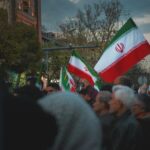
A now-massive protest movement began in late December in Iran, at first over inflation, and quickly spread to much of the country, soon demanding the fall of the Islamist government in place since 1979. Authorities quickly moved to repress the protests, massacring at least 5,000 people according to the United Nations’ latest count.
Weeks of internet cutoffs mean that other alleged crimes, such as torture and brutal street violence, are occuring largely in the dark. The US has meanwhile threatened — and reportedly come very close — to striking Iran, raising fears of a repeat (or worse) of this past summer’s air war between Iran and Israel, and talk of potential regime change.
In Lebanon, home to the largest Iranian-backed political-military organization, Hezbollah, it’s not clear yet what the protest movement might mean. Hezbollah leader Naim Qassem recently said his group “will not remain neutral” should the US go through with an attack, but remained vague on what possible action would entail.

“It would be difficult to see beyond this current phase until succession,” according to Mohanad Hage Ali, deputy research director at the Carnegie Middle East Center in Beirut. “I would say the margin for negotiations on [surrendering] Hezbollah’s weapons is quite tight now given the existential threat Tehran faces at the moment.” Part of the 2024 ceasefire deal in Lebanon included the disarmament of Hezbollah.
“On another level, the Iran events also witnessed a higher level of Iranian-Saudi coordination which will have implications on Lebanon,” Hage Ali added. “Saudi remains influential in Lebanon and could play a role in reaching a middle ground with Iran on issues like disarmament and Hezbollah’s role in a post-militant phase.”
Meanwhile, everyday Iranians in Lebanon and elsewhere outside of their country are stuck watching from afar, usually in the dark.
Haidar Alavi is the son of a Lebanese mother and a Kurdish-Iranian father from a region bordering Iraq. Just 24 years old, he “grew up” in his father Amir’s carpet shop in the Dahieh southern suburbs of Beirut, speaking Farsi and helping him sell fine Iranian rugs.
Over time the shop became a patouq, Haidar remembers, the Farsi word for a friendly hangout spot. Soon Amir retired, and Haidar was in charge. My own living room carpet came from Haidar’s patouq, a peachy pink and red tribal rug woven by women from a village in the mountains of Hamadan Province.
Israel bombed that shop in October 2024, leveling it to a pile of rubble. It was among the destroyed carpet businesses Elham photographed back in April, as she walked among the war debris of south Beirut.
There are anywhere from a few hundred to a few thousand Iranians living in Lebanon, depending on who you ask. Some are living here in political exile for their stances against the government, like Elham, while others simply arrived here for business, marriage, or a better life.

The closest semblance of a coalesced Iranian community is, perhaps, among the carpet merchants themselves, most of whom were either born in Iran or have strong family ties there and visit often. Lebanon’s best-known family of Iranian origin are the Maktabis, whose name adorns many of the luxury Persian carpet galleries across the country. They came here from Isfahan in the 1920s, according to Elham, who is studying the family’s history as part of her master’s thesis.
Other carpet merchant families came only in the past few decades, and still speak Farsi as their mother tongue. One afternoon last year with Haidar, we hopped from carpet shop to carpet shop in Beirut, as he switched between Farsi and Lebanese Arabic for tea and coffee with the owners, whom he considers friends. They had been helping store his surviving rugs after he dug them from the rubble in Dahieh, as he searched for a new showroom to house them. We dubbed the precious carpets his “refugees.”
Nick Karimi has little connection to the other Iranians living here in Lebanon. His connection to his own family back in Iran is severed, too. He converted to Christianity as part of a secret “house church” group 17 years ago, in his home city of Isfahan. At the time, he went by the name his parents gave him, Peyman.
Though there’s a sizable minority of traditionally recognized Christian Armenians and Assyrians in Iran, conversion from Islam to Christianity is illegal. In 2011, Iranian authorities sentenced Christian convert and pastor Youcef Nadarkhani to death for apostasy, but later acquitted and released him. After Nick told his family he had become a Christian, they rejected him. His brother, a member of the Basij volunteer militia within the Islamic Revolutionary Guard Corps (IRGC), threatened him, forcing him to leave Iran for safety.
Now 34 years old, he’s a UN-registered refugee, after a long odyssey that brought him to Nicaragua and, finally, Lebanon, in the hopes of finding somewhere safe to settle down.
He chose the nickname “Nick” after converting. When I asked him why, he smiled. “Because it reminded me of Christmas, and I felt I missed out on it.”
I met Nick on a recent Sunday after service at an evangelical baptist church in Beirut. The service was in English; people from Africa, Europe, Latin America, and, of course, Lebanon, filed out onto the street once it ended. Nick says he’s the only Iranian congregant.

He hasn’t spoken with his family in seven or eight years, by his count, but he has been following the latest news from Iran on his phone. Delving too deeply into political discussions around the crackdown, however, is “too painful.” During earlier mass protests in 2019, Lebanon was also going through its own protest movement, over poor living standards and government corruption. Nick joined one of the Beirut protests that November, bearing a sign that denounced Iranian Supreme Leader Ayatollah Khamenei. Two men snatched the sign and shouted insults at him.
The next day, he saw two men circling his home, taking pictures of it.
Is there a way back home someday, despite the fear? “Yes, of course, my long-term dream is to go back to Iran,” Nick hopes.
But it would have to happen “without US interference,” in his view. “People can’t forget what the US has done [previously] in Iran,” such as the CIA-orchestrated overthrow of Iranian Prime MinisterMohammad Mosaddegh in 1953, which would go on to strengthen the Shah’s oppressive rule over the country.
Elham, too, says she wishes for a “secular democracy” in Iran someday soon. “I don’t believe we will have an equal society after this, but I hope.”
Still, “I don’t believe in hope. It’s the lie that we tell ourselves so we don’t fall apart.”
Haidar, meanwhile, says he’s not too worried about his sister and her children, who live in a part of Tehran that — according to her — hasn’t yet been affected much by the government crackdowns. His loved ones also haven’t been going out to protest, he says; they are more worried about an ongoing drinking water shortage than anything else.
“I’m fine, I just connected,” one text message suddenly pings on Elham’s phone. We’re sitting at a cafe near the American University of Beirut, popular with the students. The message is from one of her friends, a lawyer in Iran, who just managed to connect to the internet again after days in the dark.
Her other chats sit worryingly silent. Before the protests and violent crackdown, Elham used to talk with her parents and siblings back home regularly, on Google Meets or WhatsApp.
It’s been two weeks since she last heard from them. “If you see this message, please respond,” reads her last message to her brother. It has no response. According to WhatsApp, he was last online on Jan. 8.
According to Amnesty International, the government’s crackdown has included cases of torture, arbitrary arrests, and forced disappearance, including towards children. Agnès Callamard, the watchdog’s secretary general, recently said that “the severity and scale of killings and repression” Iranian authorities are carrying out “is unprecedented.”
Meanwhile, US President Trump has amassed military ships and aircraft to the region in recent days, while Iran was set to hold military drills in the Strait of Hormuz, one of the world’s most important oil shipping passages. Still, Ali Larijani, the secretary of Iran’s Supreme National Security Council, stated Saturday that there had been progress in reopening negotiations with the US.

Without working internet, Elham’s friends and family in Iran have no way of letting her know they’re alright, or if someone has been hurt.
Although a friend who managed to connect to the internet recently assured Elham that her brother was safe, she doesn’t “trust it.” She worries they are simply trying not to scare her. Other Iranians Elham knows in Beirut have told her their close family members had been killed. Some information comes in bits and pieces of horrific testimony, sent by friends in a hurry after finding connection.
As I sat down at home to write this, Elham messaged to say one friend had finally managed to reach her. The friend’s sister, a nurse at a hospital in western Iran, said the dead there, who had been killed while protesting, were mostly young people — between 15 and 30 years old. The authorities reportedly offered the deceased’s families money to silence the fact that they had been killed by the government.
There were other scenes of violence, played out in the text thread like a montage from a horror movie. Someone thrown from the top of a mosque. Bazaar shopkeepers shot at in the street, after taking part in a general strike.
“Shit,” Elham responded to one of the messages.
“– I’m worried about you.”
“– Please stay safe.”
“– I adore you.”
In a corner of Haidar’s new, smaller shop, in a neighborhood on the opposite end of Dahieh from the old one, is a special stack of carpets. They sit in a neat stack of smooth red and navy blue wool, white fringes poking out on the edges.
These are the prized carpets that Haidar managed to dig out from the rubble of his destroyed patouq, the old shop his father founded in Dahieh back in 1994. Some, I can see, have little tears, though the colors in the woolen yarn are still vibrant after he cleaned them. This is their new home, after they lived scattered in the rug shops of his friends for months, in different little corners of Beirut and the suburbs.
One carpet was so tattered that it would have been impossible to sell; instead, he framed a fragment of it and mounted it on the wall behind his desk, itself covered in a tiny woven rug. He spoke of the stack of salvaged rugs proudly: “These are the war survivors.”
** All photos by João Sousa. Sousa is a photojournalist based in Lebanon and focused on social issues.