







Military leases and easements on more than 46,000 acres of land across Hawaiʻi are set to expire around 2029, according to “The True Cost of the US Military in Hawaiʻi,” a report from the Institute for Policy Studies published in May 2026. The authors argue that the moment offers residents a once-in-a-generation chance to renegotiate what has been taken for granted for decades.
In November 2021, thousands of residents living near Pearl Harbor noticed that their tap water smelled of fuel. Investigators soon discovered that the US Navy’s Red Hill Bulk Fuel Storage Facility, which stored roughly 250 million gallons of jet fuel just 100 feet above Oʻahu’s primary aquifer, had leaked, contaminating the drinking water of 93,000 people. The Navy had assured the public for years that the facility was safe. Produced by a coalition of academics, policy researchers, and Native Hawaiian organizations, the report argues that the Red Hill disaster was not an exception but a window into a much larger pattern of harm that the public is never meant to see clearly.
The report draws on original research across anthropology, economics, environmental science, geography, history, law, and public health to evaluate the full costs of a military footprint that spans more than 250,000 acres across the islands. Its core finding is unambiguous: “the commonly accepted narrative of the military’s economic benefits and security necessity is overstated at best and inaccurate at worst, and the total costs — in every sense — of the US military footprint have been hidden from public view.”
The report challenges the strategic premise first. Political scientist Neta Crawford argues that the current US Indo-Pacific posture, centered on deep offensive strikes into Chinese territory and the deliberate threat of nuclear escalation, is not simply defensive.
Rather, she says,it is dangerous. Hawaiʻi, as a central command and logistics hub for that doctrine, would be “an early and likely target in any such conflict.” War games involving a US-China conflict over Taiwan have already modeled scenarios that included Chinese attacks on Hawaiʻi, including a nuclear detonation near the islands.
Crawford argues that a shift toward deterrence by denial, relying on resilience and geography rather than offensive first-strike capability, could both lower the risk of catastrophic war and substantially reduce the military’s physical presence in Hawaiʻi.
The large footprint is not a strategic necessity, the report argues, but “the product of worst-case assumptions about China and strategic choices.”
Under examination, the economic case for the military is similarly wanting, according to the report. For years, the Pentagon and the State of Hawaiʻi have reported the military’s annual contribution to the state economy at around $10 billion. Research by David Vine has found the actual figure was closer to $7.2 billion, roughly 6.4% of Hawaiʻi’s GDP — rather than the 9.2% frequently cited.
The military is not, as the familiar phrase has it, one leg of a three-legged stool supporting the state’s economy; at least five other industries account for larger shares of GDP. Economist Heidi Peltier adds that military spending is among the least efficient ways to create jobs: every $1 million in military spending generates significantly fewer positions than equivalent investment in health care, education, housing, food production, or energy efficiency.
The housing findings are among the most concrete. Research by Omar Ocampo and Brag Selvarajan have found that military demand pushed rents up by 7.1% in 2024 alone, costing non-military renters an estimated $234.8 million in a single year. That pressure had driven the steady displacement of Native Hawaiians and working-class families to the continental United States.
Meanwhile, the lands the military occupies have been leased to the federal government since the mid-1960s for the token sum of $1. Using an established methodology for calculating the value of US military base land worldwide, Vine estimates unpaid back rent at up to $133.7 billion in 2025 dollars, not counting the cost of cleaning up the military’s environmental damage.
That damage is substantial and, in some cases, irreversible. Environmental attorney Wayne Tanaka finds that PFAS contamination — the class of synthetic “forever chemicals” used in military firefighting foam — has spread through Hawaiʻi’s land and groundwater to a degree that “may be impossible to assess with current tools.”
Superficial cleanup at just three military installations is conservatively estimated at $493 million, and even that investment cannot fully eliminate PFAS from the environment.
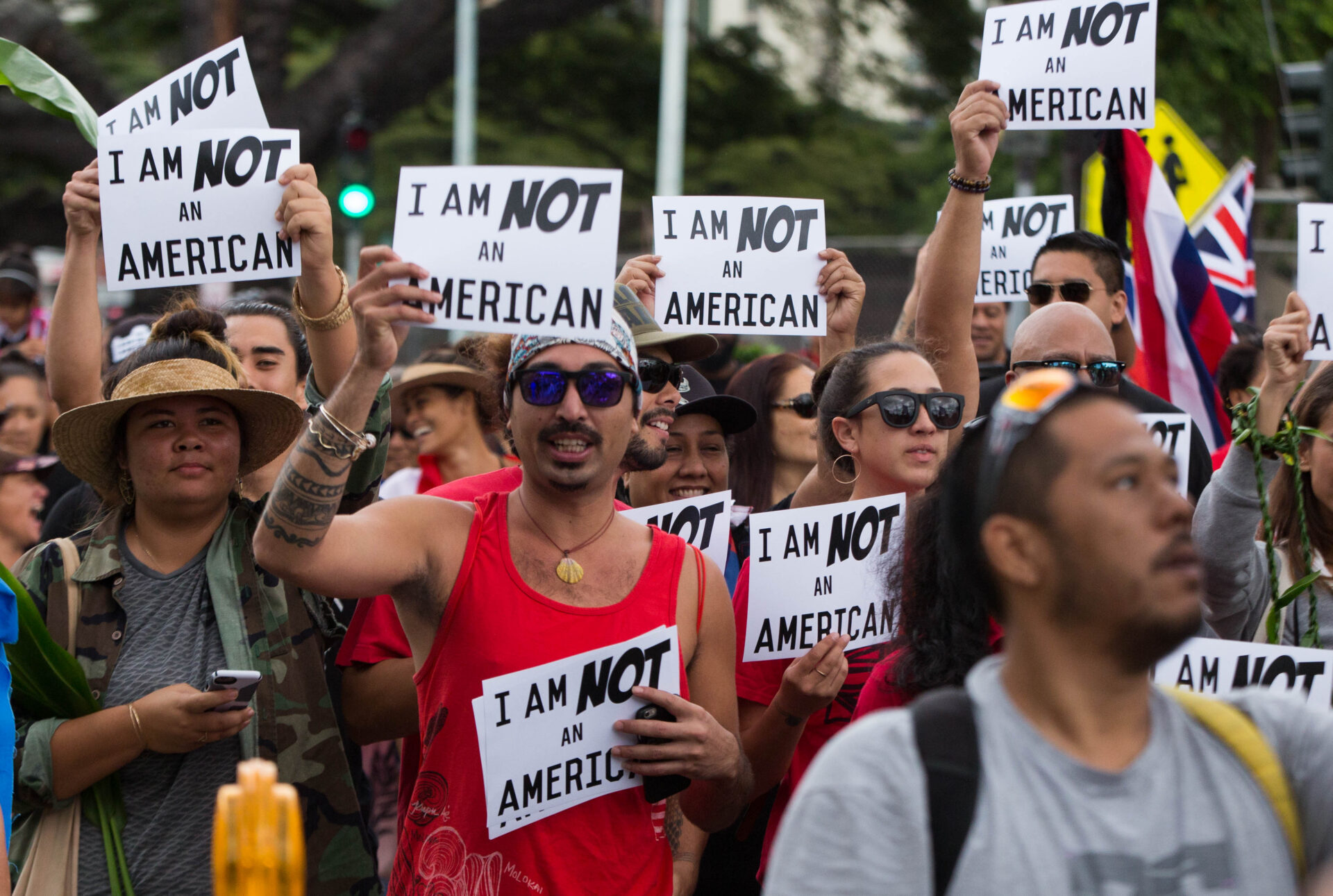
The report situates all of this within the longer history of how the military came to occupy Hawaiian land in the first place. University of Hawaiʻi at Mānoa professor Kyle Kajihiro argues that the military’s presence could not be understood apart from the illegal overthrow of the Hawaiian Kingdom in 1893, which President Grover Cleveland described at the time as “an act of war … committed with the participation of a diplomatic representative of the United States and without authority of Congress.” Native Hawaiian scholar Haunani-Kay Trask observes: “Whenever the US goes to war, the military takes more of our land.” Military holdings grew from 16,500 acres in 1900 to a peak of more than 648,666 acres in 1944.
Hundreds of former military bases across the US and around the world have been converted into housing, schools, hospitals, parks, farms, renewable energy installations, and cultural sites. The same is possible in Hawaiʻi, the authors argue, if residents and policymakers choose to treat it as such.