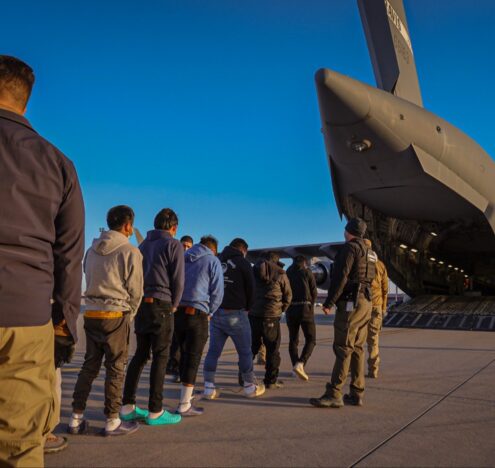










A new report from the Costs of War project at Brown University delves into the Trump administration’s aggressive immigration enforcement, its relation to the War on Terror, and how today’s anti-immigrant crackdown is a logical extension of US legal precedent.
In the report, Elizabeth Beavers, an assistant professor of law at Widener University Delaware Law School and an Inkstick contributor, points to five specific legal tools the executive branch, Congress, and the courts have normalized on a bipartisan basis since the Sept. 11 attacks in 2001. With these tools at hand, Beavers argues, the Trump administration has been able to redirect the War on Terror against migrants.
The paper’s central argument is that framing irregular migration as terrorism is not merely rhetorical. It reflects specific legal structures created and expanded since Sept. 11, 2001, structures that place sweeping discretionary authority in the hands of the executive branch and are, as Beavers writes, “particularly ripe for abuse against noncitizen persons of color by immigration authorities, law enforcement agents, and other executive branch officials.”
The Trump administration’s day-one executive orders declared that people unlawfully present in the US pose “significant threats to national security” and are engaged in “preparations for terror-related activities,” and directed the military to develop a campaign that included “repelling forms of invasion, including unlawful mass migration.”
Beavers traces the roots of this conflation to the immediate aftermath of Sept. 11, 2001, when the FBI’s PENTTBOM investigation conducted a dragnet roundup exclusively targeting Arab, Muslim, and South Asian immigrants.
More than 1,200 people were detained for weeks or months without charges and subjected to abuse by guards who explicitly said they were retaliating for the attacks despite having no evidence connecting those detained to them.
The program produced hundreds of arrests for minor immigration violations, such as taking too few academic credits on a student visa, and did not result in the conviction of anyone actually involved in terrorism. The creation of the Department of Homeland Security in 2002, with ICE nested inside it, then formally moved immigration enforcement under a counterterrorism umbrella.
As one scholar Beavers cites observed, the policy sent “[t]he message that immigrants of certain nationalities should be viewed as potential terror suspects first and as welcome newcomers second, if at all.”
DHS has since removed more than six million people from the US, and recent ICE data shows that the government has not alleged terrorism links or even conventional criminal records against most of those removed.
The Trump administration’s designation of transnational cartels as Foreign Terrorist Organizations has extended this pattern in ways the paper finds legally strained. The definition of terrorism the administration relies on is broad enough that one legal scholar has described it as allowing “almost any group to be designated.”
At least one of the designated groups, “Cartel de los Soles,” appears not to be an actual organization at all. Experts have described it as a figure of speech in Venezuela referring to corrupt government officials, and the Justice Department quietly dropped its claim that the group is real once it faced the prospect of litigating the assertion in court. The official designation nonetheless remains on the books.
The consequences for individual migrants are severe and, in the paper’s telling, follows directly from legal changes Congress made in the USA PATRIOT Act. Those changes allow deportations based not on violent conduct but on alleged connections to designated groups, or on contributions of “material support” to terrorism, even when that support is provided under duress and without knowledge that the group has been designated.
The paper documents cases in which the administration was using these provisions against people with no criminal history. One man from El Salvador facing indefinite detention had, as a child, given approximately $25 to MS-13 gang members who threatened and harassed him for the money. The administration argued this constituted material support for terrorism.
In the case of Kilmar Abrego Garcia, whose removal the administration had already acknowledged was an administrative error, White House Deputy Chief of Staff Stephen Miller publicly argued that the MS-13 designation meant Abrego Garcia “was no longer eligible, under federal law … for any form of immigration relief in the United States.”
The paper closes on the question of accountability, or its absence. Those who authorized and carried out CIA torture in the post-9/11 era faced no criminal consequences, a precedent the Obama administration ratified when it declined to investigate, saying it preferred “to look forward as opposed to looking backwards.”
More than 700 migrants have been sent to and from Guantánamo during Trump’s second term, and people deported to CECOT in El Salvador have described being told by prison officials, “You are all terrorists,” and “Terrorists must be treated like this.” A US District Court judge even wrote that Guantánamo has, since its post-9/11 opening, “been synonymous with pervasive mistreatment and indefinite detention.”
Beavers concludes: “The administration’s actions both represent a disturbing escalation of past precedent and are also enabled by that precedent. Since the earliest days after the attacks of Sept. 11, 2001, Congress has created and expanded presidential powers to designate, detain, and deport people the administration unilaterally determines to be ‘terrorists.’”