





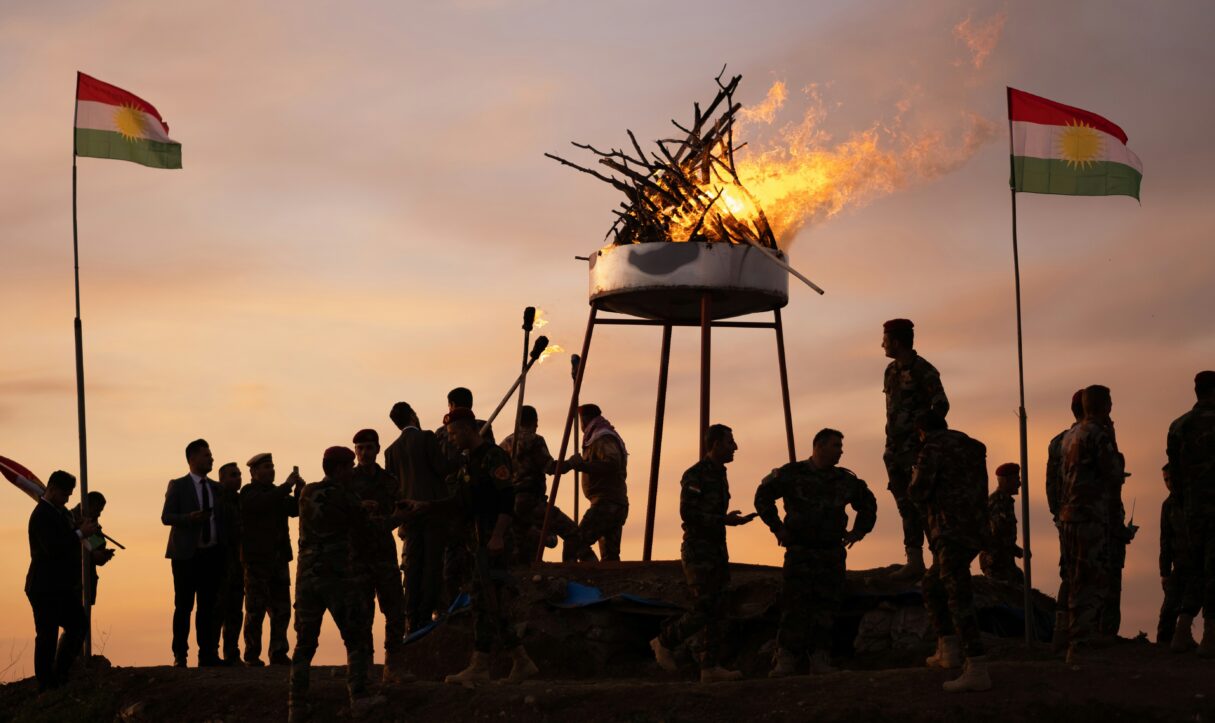
In Iraq’s Kurdistan Region, long-held hopes for reforming Peshmerga forces have been dying a slow death for years, denied and disputed with flagging sincerity by those responsible for carrying out the process. If it was once ambitious, urgent, and vital, it is now time to write its obituary.
“The reform program achieved important institutional progress, but it was not able to fully overcome the political realities and structural divisions within the Kurdistan Region,” Peshmerga Lieutenant General Bakhtiar Mohammed told Inkstick.
The Peshmerga is a light infantry force that serves as the Kurdistan Region’s military and is legally part of Iraq’s federal security forces. It was a crucial part of the US-led International Coalition that fought the Islamic State (ISIS) militant group, bearing much of the cost of the brutal ground campaigns to liberate hundreds of cities and villages.
According to the Kurdistan Regional Government (KRG), 1,814 Peshmerga were killed and more than 10,000 were wounded in the war.
But the force had significant internal challenges that undermined its effectiveness. Many units lacked sufficient training and equipment. They were politically divided between the Kurdistan Region’s two main political parties, the Kurdistan Democratic Party (KDP) and the Patriotic Union of Kurdistan (PUK).
The KRG’s chronic financial problems meant that Peshmerga units were not paid their salaries for months at a time, prompting protests by frontline fighters. Corruption and illicit payments to so-called “ghost soldiers,” employees who receive a salary for patronage reasons but rarely turn up to work, further weakened the mission.
The International Coalition and the KRG saw a mutual benefit to strengthening the Peshmerga and launched a reform program in 2017. It was a classic example of the low-hanging fruit that seemed ripe for security sector reform in the post-9/11 wars.
The US, Britain, Germany, and the Netherlands provided training, technical support, and political backing. Washington early on chipped in further with money for salaries, providing around $20 million per month in stipends during the first few years, to help keep the Peshmerga on the battlefield when the KRG could not make payroll.
The KRG was in turn responsible for implementing a 35-point plan to improve how the force operated. Some were purely military measures, others involved technocratic improvements, and some were deeply political. This program was formalized through a memorandum of understanding between the KRG and the US, with an initial version first signed in 2016 and renewed in 2022. The latter’s four-year timespan is set to expire in September.
For Kurds, though, the reform process had a deeper meaning. The Peshmerga traces its origins to the uprisings against the Iraqi dictatorship by armed revolutionary groups affiliated with the KDP, the PUK, and other political parties. However, after the Kurdistan Region achieved autonomy in the 1990s and Saddam Hussein was removed in 2003, these forces failed to unite and remained politically divided. Their loyalty was to party leaders, rather than the new and ostensibly unified KRG.
The Peshmerga reform program’s ambition was to harness the martial potential and revolutionary legitimacy of the Peshmerga and use it as a vehicle to rise above this political division — and in doing so, bring a stronger and united Kurdistan Region into being.
“Building a unified national force is the main desire of the Kurdish people,” Islam Zebari, a Kurdish military expert. “If this force is nationalized, it can no longer be used for political purposes.”
Peshmerga reform would also be a stepping stone to international recognition, a key preoccupation of Kurdish political hopes. The symbolism of American and European soldiers standing shoulder to shoulder with Peshmerga is powerful, particularly if they are viewed as better trained and more politically reliable than Iraq’s federal units.
But in the end, the Peshmerga reform process failed because the technocratic aims of the reform process were fundamentally incompatible with the political realities of the Kurdistan Region.
“It is difficult to resolve decades of political and military division within a limited reform period. The reform process was not simply a military restructuring effort; it also required building political trust and ensuring transparency in engagement between the parties,” Mohammed said.
The stronger gravity of partisanship reasserted itself over time, and the KDP and the PUK were unwilling to relinquish substantive control over the security forces.
Not only did control over the armed forces make sense under the zero-sum logic that increasingly plagues the dynamic between the two parties, but it was far too important as a tool of patronage that is doled out to ensure political loyalty from their bases.
“They don’t have any desire to give up their respective party’s control over resources…They don’t trust each other and, in fact, expect the worst from one another,” said Joost Hiltermann, a special adviser for the Middle East and North Africa at International Crisis Group.
Like most politicians around the world, Kurdish leaders are loath to acknowledge problems publicly, particularly as Peshmerga reform was elevated to such importance. But they are edging closer.
On May 14, Kurdistan Region President Nechirvan Barzani told a graduation ceremony for Peshmerga officer cadets in the city of Zakho the unification process has “not progressed as it should, and the necessary progress has yet to be achieved … [which] has negatively affected the reputation of the Kurdistan Region” in the eyes of both its people and foreign partners.
“The dedicated and capable graduates we celebrate today deserve to serve within a unified national force. The current situation is not acceptable and cannot continue,” he added.
It is undeniable that some progress has been made over the past decade towards this aim, but the cumulative progress towards the program’s most important political and technocratic aspect — the depoliticization and unification of the Peshmerga — is underwhelming.
Some partisan units were brought under control of the KRG’s Ministry of Peshmerga Affairs (MoPA), an ostensibly non-partisan institution. Between 2013 and 2019, the Peshmerga minister was not a member of either party in order to facilitate that policy, which resulted in the creation of several “regional brigades” under ministry control.
In late 2025, the two largest partisan units, the 80s Brigade of the KDP and the 70s Brigade of the PUK, were respectively renamed as Area Command 1 and Area Command 2 and assigned to MoPA. According to the US Department of Defense’s latest Lead Inspector General report to Congress on Operation Inherent Resolve (OIR) in February, which was issued after the announcement about the area commands, 84,923 personnel are now under MoPA control.
“Building a unified national force is the main desire of the Kurdish people.” – Islam Zebari
While this change was celebrated in the local media, which itself is largely controlled by the KDP and the PUK, the partisan character of these units remains largely intact.
“The creation of the area commands … does not mean freeing the Peshmerga from party domination. This step only legitimizes the party forces within the Peshmerga ministry,” Zebari said.
Moreover, tens of thousands of Peshmerga remained under partisan control and there is “little momentum toward integrating them under a non-partisan command structure,” the defense department report added.
In the face of this failure to convince the KRG’s foreign partners that additional progress will be made, some Peshmerga commanders insist that a process that has had 10 years to take root will somehow be fully completed in the four months that remain before the memorandum of understanding with the US expires.
Moreover, policy papers continue to be produced that make recommendations for tweaking the process so that it can finally succeed. At a recent conference in London, a scholar made a pitch to convince Western governments to develop a new “Marshall Plan” to invigorate the initiative and finally get it over the line.
This rings rather hollow. It is increasingly clear that time has run out on Peshmerga reform as constructed over the past decade. The most visible manifestation of this fact is that Washington is turning off the financial taps.
Congressional appropriations for the Peshmerga hit a peak of $415 million in 2016 as the war with ISIS reached a critical moment. It then declined year-on-year, with just $77 million appropriated this year. The money for stipends also ended this year, after being gradually reduced each year since 2023.
In April, the Pentagon released a draft proposal by the Department of Defense for the FY 2027 National Defense Authorization Act (NDAA) that completely cut contributions to the Peshmerga, including salary stipends and funding for equipment.
Iraq as a whole will receive $118.9 million under the Pentagon’s plans, which includes some small allocations that will be made for use in the units in the Kurdistan Region.
But for all practical purposes funding for Peshmerga reform has ended unless Congress inserts additional funds as the legislation makes its way through the appropriations process. Even then, the downward trend of funding over the last decade is unlikely to be reversed.
“It would not be accurate to describe it as a squandered opportunity, but the reform process was slow compared to the scale of support provided,” Mohammed said.
The Peshmerga is likely to enter a new era without significant direct and formal foreign assistance by the end of the year. The US and the other countries that participated in the program will remain supportive of the Peshmerga reform process’s ultimate goals, but the supportive structures that helped push the process along will end.
In September, the memorandum between the Pentagon and MoPA will expire, which includes all provisions for the payment of salary stipends. None of the sources who spoke to Inkstick believed that a new agreement was imminent. All spoke about it as one of several possibilities and some were dismissive that one would happen at all.
Then, by the end of 2026, US troops are scheduled to leave Erbil airbase and all remaining military installations in Iraq, according to an agreement between the US and Iraq’s federal government. This would be the second phase of US post-ISIS withdrawal from Iraq, with American soldiers leaving all other bases last year.
“The Peshmerga reform progress was happening because the US and Europeans wanted it to happen. If they end funding for it, the program will almost certainly end, because it was never internally driven,” Hiltermann said.
As a result, direct foreign assistance to the Kurdistan Region will largely exist at a rhetorical level, leaving Kurdish political leaders entirely responsible for achieving the goals of Peshmerga reform. Either they will be able to resolve the political differences that have undermined the process since it was first launched and find a way to fund the Peshmerga — or they will not.
The latter is much more likely given the political situation in the Kurdistan Region, with the KDP and the PUK growing increasingly estranged.
If the parties are unable to find a way forward together, the likelihood that Iraq’s federal government becomes more involved with the Peshmerga increases substantially. This may address the practical challenge of how to fund salaries and equipment, but control by Baghdad undercuts the Peshmerga’s primary purpose as guardians of the Kurdish people, a role that has involved great sacrifice. This would represent a political disaster from a Kurdish nationalist perspective.
“The continuation of this situation will allow Baghdad to interfere in the affairs of the Peshmerga,” Zebari said. “This allows for different and dangerous interpretations of the legitimacy of this institution.”
A decade of support from the Kurdistan Region’s foreign partners was never meant to be indefinite because it was supposed to succeed. If this period ends with the Peshmerga in a vulnerable position, ultimately it is because supportive foreign governments failed to reckon with the depth of the political divisions that plague the Kurdistan Region and the Kurdish leadership was unwilling to rise above their own bad faith. It is a hard lesson.