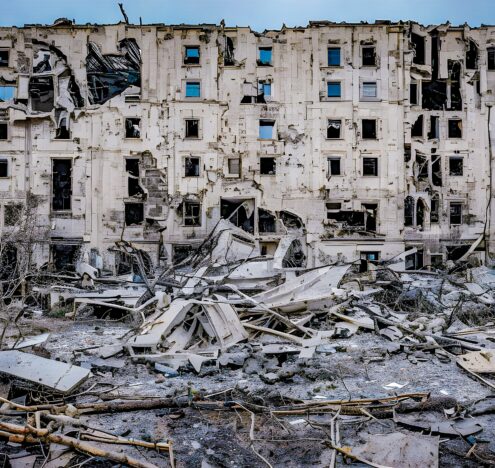













The last several years have seen military conflict fan out around the world — from Russia’s invasion of Ukraine to the US-Israeli war on Iran. Throughout these hostilities, there has been a trend of increasingly brazen violations of the foundational norms of armed conflict. One particularly concerning area is the rise in attacks on civilian infrastructure, many of which do not fulfil the criteria for legitimate military targets. If this trend of attacks on civilian infrastructure continues, as exemplified by the recent Ukrainian strikes on Russia’s Wildberries e-commerce warehouses, the power of the norm against them will only erode further, paving the way for more and more escalatory actions.
This year alone, US-Israeli strikes have hit a slate of civilian sites in Iran, while Israeli bombings in Lebanon have targeted roads, bridges, and hospitals that Israel’s government dubiously insists are military sites. Meanwhile, both sides in the Sudan war have targeted schools, medical facilities, dams, and displacement camps. The main consequence of these attacks is, of course, more death and misery for innocent civilians. As the death tolls of these conflicts continue to swell, the United Nations Stéphane Dujarric recently called for an end to “attacks against civilians and civilian infrastructure,” describing them as “a clear violation of international humanitarian law, wherever they occur.”
Throughout the war in Ukraine, Moscow has attacked civilian targets time and again. These assaults come amid a broader pattern of countless violations of international law dating back to the 2014 annexation of Crimea. The most brazen actions include attacks on medical facilities, such as children’s hospitals, as well as sabotage of civilian water supply. Certain Russian attacks on energy infrastructure, such as those on electric power plants and sub-stations, have also been formally declared war crimes by the International Criminal Court.
Despite these actions, the Kremlin has not fully abandoned the pretense of restraint, claiming that its attacks constitute legitimate strikes on military targets supporting the Ukrainian armed forces. And Moscow has so far held off from striking various sectors like domestic food distribution, civilian banking and payments systems, or nuclear power generation — despite recurring fears of damage to the Zaporizhzhia power plant since the conflict started.
This remaining restraint indicates that Russia, if only ever so slightly, continues to abide by an implicit limit on how far it is willing to go in violating internationally determined standards of appropriate behavior in warfare.
Still, there is no guarantee that this limit holds. If more and more countries demonstrate a willingness to break these norms, their power will continue to diminish, and Russia may abandon any semblance of restraint it still retains.
The United States, for its part, is exacerbating this trend through its war in Iran and the wanton targeting of civilian infrastructure. US military strikes have hit several desalination plants, including one in southern Iran that disrupted water access to nearly 10,000 people. US President Donald Trump has threatened further attacks on civilian targets in an attempt to apply pressure to the government of Iran via its people. Applying pressure on civilians to dissuade their government from further escalation might seem practical to some, but in doing so the Trump administration may push Iran into an even deeper humanitarian crisis, such as the one unfolding in Cuba.
While Ukraine has typically taken a more restrained approach towards distinguishing between civilian and military infrastructure, it too has recently shown signs of abandoning these norms. In the first few years following the full-scale invasion, Ukraine was unable to strike far into Russian territory. That has changed in the last year, with Ukraine launching attacks deep within Russia on military targets, such as the more than 40 Russian fighter jets that Ukraine destroyed with drones in mid-2025. But a shift towards targeting civilian infrastructure has taken place in the last month, during which Ukraine has repeatedly struck warehouses of the e-commerce company Wildberries, often described as the Amazon of Russia.
Ukraine has justified these attacks by arguing that the company markets thousands of items for Russians fighting on the frontlines, including body armor, helmets, and drone attachments. Yet Kyiv has also explicitly acknowledged its intention to damage the morale of Russian citizens, whom Putin has promised to protect from the impacts of the war. So far, the Wildberries attacks have killed at least eight civilians, injured dozens more, and destroyed half of the company’s facilities comprising a third of its total storage capacity. This has made a significant impact on Russia’s economy, particularly harming small and medium-sized Russian businesses that rely on the Wildberries platform. Russia has responded in turn by threatening “consequences” for the United Kingdom because it provides attack drones to Ukraine. For his part, Russian President Vladimir Putin has menacingly suggested that Ukraine’s strikes on economic targets have opened “Pandora’s box.”
Ultimately, Ukraine must distinguish itself from its aggressor by showing restraint. Although Kyiv has been fighting an existential conflict for its very survival, it should nonetheless refrain from abandoning international legal principles such as the separation of civilian and military targets. By striking key nodes of Russia’s civilian economy — from Wildberries warehouses to oil refineries — Ukraine is contributing to the broader breakdown of the international order, following in the footsteps of the United States under the Trump administration as well as Russia itself. The more the lines between military infrastructure, dual-use infrastructure, and civilian infrastructure are blurred, the greater the chances are of setting a dangerous precedent for future conflicts and ushering in a more chaotic world.