









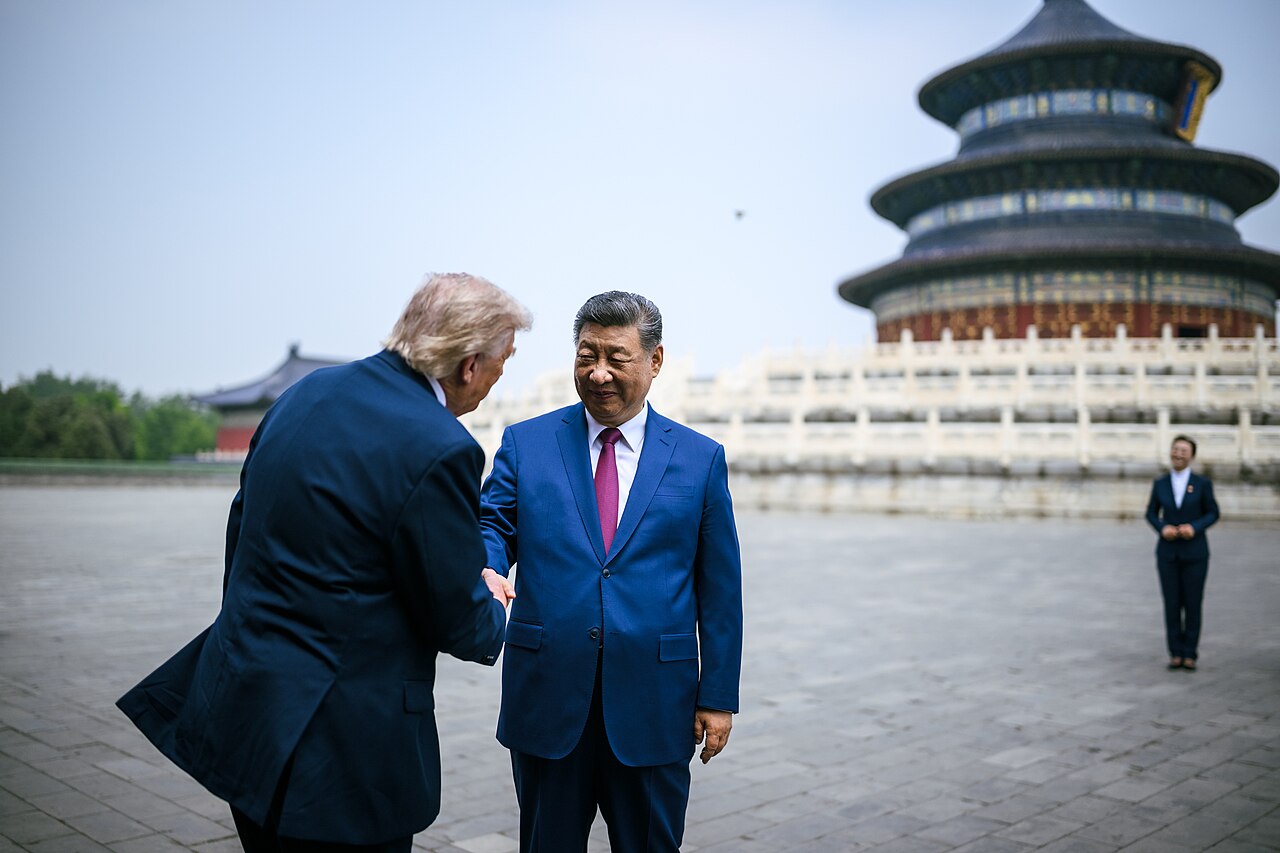
As expected, the recent Trump-Xi summit was met with great fanfare as industry executives, media personalities, and the broader foreign policy public observed both leaders meet on the red carpet in Beijing, China. Yet following the two-day event, questions immediately arose about the results of the historic visit. Were in-person meetings between these two great powers a signal of constructive progress in the relationship? Or was dialogue among American and Chinese counterparts largely symbolic and unproductive?
May’s Reimagining US Grand Strategy roundtable brought members of the foreign policy community together to discuss Trump’s visit and examine the future of US-China trade relations. Two guest speakers provided opening remarks on remaining points of tension between Washington and Beijing, and whether narratives of China’s strength may (or may not) be exaggerated. The group then discussed the implications of a supposed détente between the two powers and possible scenarios for the relationship going forward.
Rachel Ziemba, Founder, Ziemba Insights; Adjunct Senior Fellow, Center for a New American Security
The recent Xi-Trump summit helped extend the truce the countries agreed on and created some new institutions to manage the relationship. However the nature of the relationship, divides within the US government about the biggest challenges and the best approach to handle the Chinese challenge and alignment difficulties with G7+ countries will complicate this. A real breakthrough remains unlikely, meaning the best outcome might be a more predictable relationship. Still, since the meeting, more points of friction have materialized, including in the area of investment and export controls, proving a test of this new relationship. These frictions are unlikely to go away.
The meeting formally launched two new institutions — trade and investment boards that aim to derisk bilateral economic relationships and increase non-sensitive trade and investment. Examples include agriculture, and possibly energy. It remains difficult to see what sectors are deemed non-sensitive by both countries, as each wants to reduce reliance on the other in their key spheres of influence (those where they maintain chokepoints). In practice, the scope for agreement appears limited. Efforts to crowd in Chinese investment — like that of the Gulf, Europe, and developed Asia — remain politically unpalatable across many levels of government.
“A truce is better for both countries than a new escalation of tit-for-tat tensions.”
A truce is better for both countries than a new escalation of tit-for-tat tensions, which would be damaging to US business and consumers while still failing to address the US’s overall economic imbalances. Nonetheless, it’s important to use this truce time, and the window opened up by the Supreme Court’s tariff decisions to prioritize on key areas of the relationship with China — as well as to build coalitions to address some of the supply chains that China can weaponize. US tariff policy envisions differentiating among trading partners and sectors but continues to use a variety of relatively blunt tools to meet a wide variety of economic, fiscal, and strategic aims. Tariffs on G7 steel and aluminum, for example, can complicate efforts to build coalitions to reduce reliance on Chinese processing in other areas.
Prioritization across each area remains key, including within the critical mineral space. Business seeks longer-standing economic rules; the new infrastructure could create that space, but it requires more clarity within the administration and Congress. Tariff volatility and export control leverage add to price and macro volatility. Signaling whether deferred export controls and investment rules held in abeyance since October are really off the table, and how the US will use these statecraft tools would help US economic planning — and thus assist global business and consumers adjust to the ongoing supply shocks.
Ferial Saeed, Nonresident Fellow, Stimson Center; former career American diplomat
US-China economic decoupling is here to stay. Whether it still defines the relationship became an open question after the May summit, however. A more realistic framework emerged, best described as “managed interdependence,” in which de-risking in sensitive sectors like semiconductors coexists with continued integration where interests overlap. What’s new is that this overlap is negotiated through proposed new bilateral institutions.
Notably, the US delegation included prominent CEOs from a range of industries seeking improved market access, signaling that Washington sees a role for more commercial engagement within its national security-driven China policy. More significantly, the two sides agreed to establish US-China trade and investment boards and are broadly aligned on their purpose. For Washington, the boards will institutionalize economic engagement in non-sensitive sectors, while Beijing identifies them as one of two channels to expand bilateral cooperation.
This desire to manage interdependence reflects three hard realities.
First, Washington and Beijing still need each other. China seeks foreign capital and access to select advanced technologies despite US restrictions. The US still depends on Chinese manufacturing and supply chains in many sectors, and China remains vital to corporate revenues.
Second, neither can neatly bifurcate the global economy. In an international system marked by rising geopolitical risk and disruption, governments, businesses, and investors seek optionality, not exclusivity; the cost of choosing sides is too high. China makes it higher by expanding channels for foreign participation. Beijing recently allowed foreign investors to trade government bond futures to hedge interest rate risk, enhancing the appeal of Chinese sovereign bonds.
Third, China’s retaliation against US tariffs last year — restricting rare earths exports — was a wake-up call for Washington. Beijing demonstrated it could exploit a serious American vulnerability when threatened, raising the costs of overemphasizing coercion and national security in US policy.
Managed interdependence will face persistent political and security pressures, requiring the proposed trade and investment boards to be empowered with clear mandates. It will not revive the engagement era. Nonetheless, if it brings both sides into regular dialogue to decide the borders of economic separation, it can help stabilize relations and reduce escalation risk as US-China rivalry intensifies. The question is no longer how far decoupling will go, but where the US and China will decouple — and where they will maintain ties.
Evan Cooper, Research Analyst, Stimson Center
When Donald Trump visited Beijing last month, he relied heavily on cultural diplomacy to try to stabilize ties between the US and China. This engagement stems from a desire to improve ties between the powers, but his administration’s trade policies still pose an impediment. If the Trump administration actually wants to find a path forward with China, trade and cultural exchange have to be pursued simultaneously.
Starting in his first term (and sustained by the Biden administration), Trump utilized export controls, tariffs, and restriction of exchange (such as visas and flights), to try to undermine China. This fueled a tit-for-tat cycle that has harmed the economies of both countries and led to some extent of decoupling.
Yet the Trump administration at present does not seem entirely committed to continuing along this path. Trump has largely avoided escalating the trade war over the past year and his trip to Beijing was marked with a desire to increase US exports to China, particularly aircraft and agricultural sales. But his administration seems caught between two minds — it continues to use tariffs and export controls while expressing an interest in shifting to a more positive relationship with greater trade and exchange.
“Trump’s diplomacy at present appears decoupled from his administration’s economic statecraft.”
A clearcut ending of the trade war could open the possibility for greater exchange between the countries and ultimately reduce the prospects of war between the two powers. Trump’s professed desire to expand American exports to China, and his willingness to ease restrictions on Chinese students studying in American universities and applauding the historical ties the two countries share, indicates an interest in moving towards a more productive relationship. But movement towards a more constructive relationship positively cannot be sustained while trade is used as a cudgel against China.
If Xi Jinping’s trip to Washington later this year is to build on the relative success of the Beijing summit, the Trump administration needs to first make meaningful progress on reversing its destructive trade policies. Trump’s diplomacy at present appears decoupled from his administration’s economic statecraft, and those must be aligned if the US-China relationship is to be righted.
Robert A. Manning, Distinguished Fellow, Strategic Foresight Hub and China Program, Stimson Center
The significance of major power summits tends to get measured by “deliverables,” but sometimes less quantifiable things: Body language, symbolism, and quiet process reveal more about the state and trajectories of relationships. The Trump-Xi summit may be one of those times, reflecting a shift, albeit fragile — call it a new sobriety — in US-China relations.
While the meeting was certainly a spectacle of symbolism and pageantry, the results — Boeings, soybeans, and beef — were meager and vague, with China and the White House issuing different readouts.
But the summit was not just an extension of the trade truce reached last October. This is not the same trade war Trump 1.0 launched in 2017. That trade war hastened efforts by both the US and China to reduce their interdependence. US bilateral trade with China has shrunk by about a third, from $635 billion in 2017 to $415 billion in 2025.
What changed in Trump 2.0? China was the only nation to push back against Trump’s 145% “Liberation Day” tariffs. Prior to the first Trump-Xi summit in South Korea, China announced a mirror-image set of its own export controls of rare earth magnets and other minerals most of which China holds a near global monopoly. These minerals are essential for advanced weapons and all electronics, from semiconductors to autos.
Beijing demonstrating its leverage over the US economy, marked a turning point for Trump Follow on efforts The administration is conducting a review on a range of trade practices such as excess manufacturing capacity that may spur a new round of tariff wars.
The Board of Trade that was announced, along with the agreement to conduct follow-up dialogue, reflects an effort to manage US-China competition, define its terms, limits and the pace and scope of strategic decoupling, and “non-sensitive” trade and investment. Follow on efforts may face a rocky road. The administration is conducting a review on a range of trade practices such as excess manufacturing capacity that may spur a new round of tariff wars.
This is not to dismiss all the risks. All the manifold structural problems — fierce geopolitical and tech competition, Taiwan, and contending views of world order — persist and could undermine a manageable balance. All things considered, though, US-China relations seem to be entering a new chapter.
“Adults in a Room” is a series in collaboration with The Stimson Center’s Reimagining US Grand Strategy program. The series stems from the group’s monthly networking events that call on analysts to gather virtually and hash out a salient topic. It aims to give you a peek into their Zoom room and a deep understanding of the issue at hand in less than the time it takes to sip your morning coffee without the jargon, acronyms, and stuffiness that often come with expertise.